
Move your pointer over the image to zoom in
Complete Product Overview
Copper tape (bare copper earth tape) for earthing and lightning protection
Order Code: BCT 203–605
Last updated:
KALOT Group copper tape is a flat, bare copper conductor used in lightning protection as a down conductor and roof mesh, and in earthing as an earth ring and grid, earthing conductor and bonding conductor. We supply this tape in rolls, in ten sizes from 20 × 3 to 60 × 5 mm. Copper tape sits flat on walls and parapets, has more contact area with the soil than a round conductor of the same cross-section, and forms one integrated system with KALOT brass clamps and exothermic welding.
We make copper tape connections with KALOT brass clamps: the two-piece brass wall clamp, the square four-way clamp, the two-way tape-to-tape clamp, the A-type clamp on the top of the earth rod and the brass disconnector on the down conductor. Buried joints are made with exothermic welding. In soil and inside the earth pit up to the pit bar, bare copper conductor is used and concrete is poured around the pit. From the pit up to the main earth bar, green and yellow earth cable is used.
A flat copper conductor, from the roof to the earth ring
To choose copper tape, check three things: the tape's role in the design (down conductor, roof mesh, earth ring, earthing conductor or bonding), the fault current it must withstand, and where it will be installed (on walls and roofs, in soil, inside concrete or inside the earth pit). Copper tape is compatible with KALOT brass clamps and exothermic welding, and is not used alongside galvanised parts in soil.
- Flat bare copper conductor, ten sizes from 20 × 3 to 60 × 5
- Down conductors and roof meshes, earth rings and grids, bonding
- KALOT brass clamps and exothermic welding for the joints
- Supplied in rolls, to the length you order
All sizes equal or exceed the minimums in the standards
IEC 62561-2 and IEC 62305-3 set the minimum cross-section of copper tape for air termination conductors, down conductors and earth electrodes at 50 mm², and IEC 62561-2 recommends a thickness of 2 mm. IEC 60364-5-54, Topic 13 of the National Building Regulations and the Earthing System Installation Guideline require 50 mm² with a thickness of 2 mm for earth electrodes. Our smallest tape is 60 mm² and all sizes are 2 mm thick or more. For down conductors and roof meshes, we recommend 25 × 3 tape.
Brass clamps on buildings, exothermic welding in soil
On walls and roofs, we fix and join the tape with KALOT brass clamps. We use no clamps in soil: buried joints are made with exothermic welding, and clamps go only inside the earth pit, inside concrete or above ground.
Compatible with brass clamps and copper earth rods
Copper tape forms one integrated system with KALOT copper and copper-bonded earth rods, brass clamps and exothermic welding. In soil, do not connect copper tape to galvanised parts. Make connections to a galvanised structure only in air, with tinned tape or a brass clamp and an anti-corrosion coating, and do not install copper above galvanised or aluminium parts.
25 × 3 or 30 × 3?
For down conductors and roof meshes, we recommend 25 × 3 tape, because KALOT wall clamps, four-way clamps, disconnectors, conductor-to-tape clamps and structure clamps cover this size completely. 30 × 3 tape can also be installed with the DCC 303 wall clamp, the STCC 303 four-way clamp and the two-way conductor-to-tape clamp as the test point. For earth rings, use tape 3 mm thick or more (25 × 3, 30 × 3 and larger), and for substation earth grids, use the size set by the fault current calculation.
Drawings and datasheet
Copper tape datasheet (PDF)Beside the datasheet you will find the dimensions and code table, the earth ring and grid schematic, the roof mesh and down conductor schematic, the connection modes and the installation steps, with PDF files.
Technical Product Information
Click to view enlarged
Feature | Value |
|---|---|
Product type | Flat bare copper conductor (copper tape) for earthing, lightning protection and bonding |
Material | Copper, bare |
Dimensions (width × thickness) | From 20 × 3 to 60 × 5 mm, in ten sizes |
Cross-section | From 60 to 300 mm² |
Weight per metre | From 0.53 kg (20 × 3 and 30 × 2) to 2.67 kg (60 × 5); 25 × 3: 0.67 kg |
Reference standard | ASTM B187 |
Supply form | Roll, to the length you order |
Order code | BCT 203–605 |
Connections | KALOT brass clamps and exothermic welding; nuts and bolts on bars |
Compatibility | With copper, tinned copper and brass; no galvanised parts in soil |
Main application | Down conductors and roof meshes, earth rings and grids, earthing conductors up to the pit bar, bonding |
Copper tape table: code, dimensions and weight per metre
Order code | Width × thickness (mm) | Cross-section (mm²) | Weight per metre (kg) |
|---|---|---|---|
BCT 203 | 20 × 3 | 60 | 0.53 |
BCT 205 | 20 × 5 | 100 | 0.89 |
BCT 253 | 25 × 3 | 75 | 0.67 |
BCT 255 | 25 × 5 | 125 | 1.11 |
BCT 302 | 30 × 2 | 60 | 0.53 |
BCT 303 | 30 × 3 | 90 | 0.80 |
BCT 305 | 30 × 5 | 150 | 1.34 |
BCT 405 | 40 × 5 | 200 | 1.78 |
BCT 505 | 50 × 5 | 250 | 2.23 |
BCT 605 | 60 × 5 | 300 | 2.67 |
We write tape sizes as width × thickness. In the market the same size is also called thickness by width, so 25 × 3 tape is known as 3 by 25 tape. The weight per metre is the cross-section multiplied by the density of copper. We supply copper tape in rolls, to the length you order. Our products are continually improved and some dimensions may be updated, so please confirm the final dimensions with our specialists before you buy.
Copper tape dimensions, roll and code table
Download dimensions, roll and code table (PDF)
Structure and supply form of copper tape
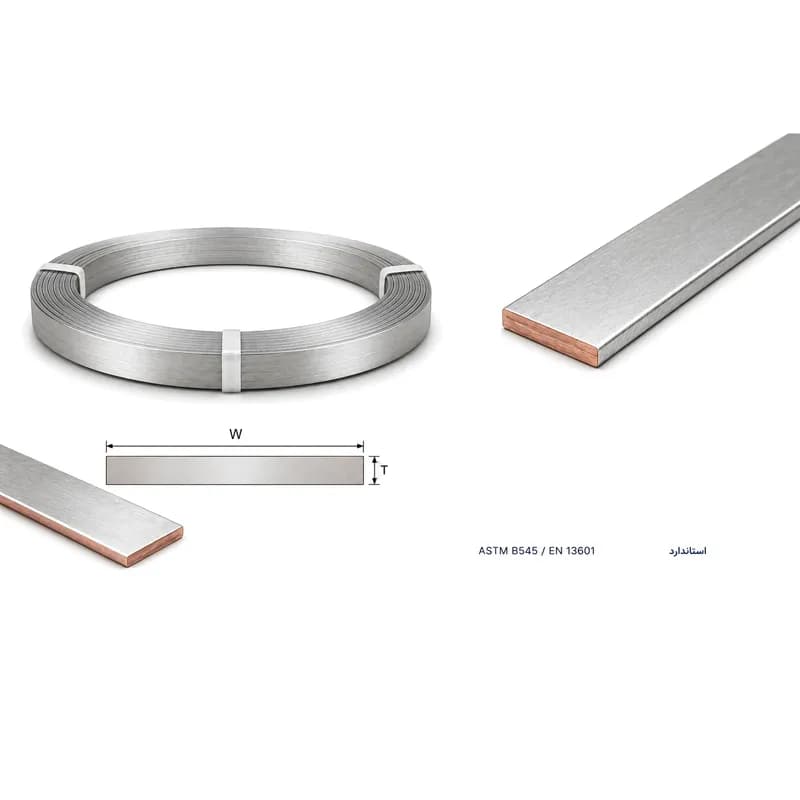
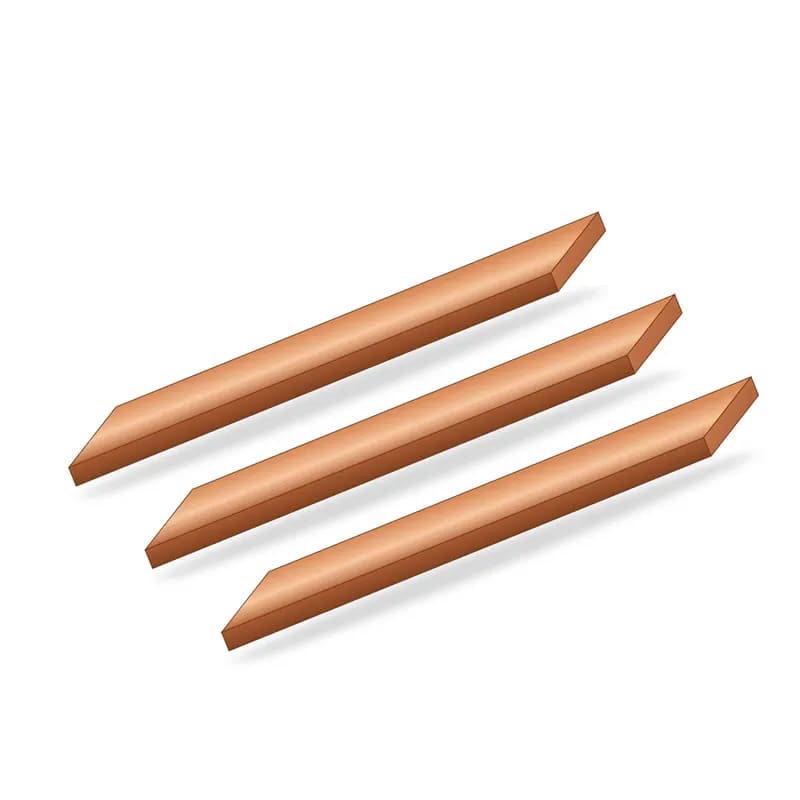
Copper tape is a solid, flat copper conductor: its cross-section is a rectangle of width W and thickness T, and it comes in ten sizes from 20 × 3 to 60 × 5 mm. We supply the tape in rolls, to the length you order, so long runs can be installed without joints. For rigid connections and bars, copper busbar is used. Where copper touches galvanised steel or aluminium in air, tinned copper tape is used. For bonding panel doors and moving parts, flexible bonding tape is used.
Click to view enlarged
Applications of copper tape in earthing and lightning protection
- Down conductor: on walls and columns, with a two-piece brass wall clamp or a BPH 76 stand-off base, plus one SKADL 100 brass disconnector (for 25 × 3 tape) or a two-way conductor-to-tape clamp (for 30 × 3 tape) above ground level for measurement. To learn about the components, see the lightning protection system and its components.
- Roof mesh: the air termination conductor mesh on roofs and parapets, with a square four-way clamp at crossings and a brass coupling for the connection to the air rod.
- Earth ring and horizontal electrode: tape set upright (on edge) in a trench 70 to 80 cm deep, 1 m from the outer walls, with buried crossings and branches made by exothermic welding.
- Connecting earth rods: inside the earth pit with an A-type clamp on the top of a copper-bonded earth rod or copper earth rod, or with a vertical tape U clamp (25 tape). Concrete is poured around the pit.
- Foundation earthing: copper tape can be run inside the foundation concrete, on edge and with at least 5 cm of concrete cover, and connected to the reinforcing bars. See earthing systems based on foundation earthing.
- Bonding: connect structures and steel plates with a tape-to-metal plate bonding clamp (25 × 3 tape), pipes with a one-piece clamp or a two-piece tape-to-pipe clamp (tape up to 26 mm wide), and bars with nuts and bolts. Make connections to steel and galvanised structures or pipes only in air and above ground, use tinned tape or a brass clamp, cover the joint with an anti-corrosion coating and do not run copper tape above galvanised parts. See bonding and equipotentialisation.
- Pit bar and earth bar: fix the tape with nuts and bolts on the earth pit bar or earth bar, each conductor on its own hole. The bolt diameter must not exceed one third of the tape width (BS 7430): M8 for 25 mm tape and M10 for 30 mm tape, with a wide flat washer on the bar. From the pit bar upward, green and yellow earth cable is used.
Earth ring and grid with copper tape and earth rods
Download earth ring and grid schematic (PDF)
Roof mesh and down conductor with copper tape
Download roof grid and down conductor schematic (PDF)
Copper tape connection modes with KALOT brass clamps and exothermic welding
Download connection modes (PDF)
Copper tape installation steps
- Take the earth ring route, the positions of the earth rods and pits, and the routes of the down conductors and roof mesh from the drawing, and choose the tape size according to its role and the fault current.
- Dig the trench 70 to 80 cm deep. In cold regions, place the tape below the frost depth. IEC 62305-3 requires the earth ring at least 0.5 m below ground and 1 m from the outer walls, Topic 13 of the National Building Regulations sets horizontal electrodes at a depth of 0.5 to 0.8 m, and the Earthing System Installation Guideline requires at least 0.7 m.
- Unroll the tape without twisting or folding it and lay it on edge in the trench. Make bends smooth, using a tape bender, and do not hammer the tape.
- Drive the earth rods at each inspection pit position: copper-bonded earth rods or copper earth rods.
- Inside the earth pit, fix the tape on the top of the earth rod with an A-type clamp and connect it with nuts and bolts to the pit bar (M8 for 25 mm tape and M10 for 30 mm tape, with a wide flat washer), then pour concrete around the earth pit. Tighten the nuts according to the installation instructions for that clamp.
- Make crossings and branches that will be buried in soil with exothermic welding. Do not bury clamps in soil.
- Backfill the trench with soft, moist soil free of stones and debris, and compact it. In high-resistivity soil, surround the tape with GIM ground improvement material.
- From the pit bar up to the main earth bar, use green and yellow earth cable.
- Down conductor and roof mesh: bring the down conductor straight down by the shortest route and do not place it inside a gutter or rainwater pipe. IEC 62305-3 recommends a fixing spacing for the tape of 1 m on vertical runs up to a height of 20 m and on horizontal roof surfaces and parapets, and 0.5 m on horizontal runs on the vertical face of a wall and on vertical runs above 20 m. Fix the tape with a brass wall clamp and do not drill it for wall mounting.
- Join roof mesh crossings with a square four-way clamp and in-line joints with a two-way tape-to-tape clamp. On each down conductor, above ground level, fit a brass disconnector (25 × 3 tape) or a two-way conductor-to-tape clamp (30 × 3 tape) that opens only with a tool.
- After installation, measure the continuity of the route and test the earth resistance with the disconnector open. Record the result with the date in the earthing system file.
Download the installation steps (PDF)
Installation tools
Drill and clamp fixing screws, spanner, tape bender, shears or a saw for cutting the tape, exothermic welding mould and powder, tape measure, continuity tester (milliohmmeter), earth resistance tester, and a camera to record the route before backfilling the trench or pouring concrete.
Continuity checks, measurement and inspection
Joints inside trenches and concrete cannot be seen once they are filled, so check the tape route and every joint before then and record them with drawings and photos. At each inspection, check the tightness of the clamps on the building and inside the pit, the condition of the tape where it enters the soil and concrete, and the earth resistance with the disconnector open. The green or dark surface of copper tape in air is the natural protective layer of copper, but if the resistance of a joint has risen, open it, clean it and tighten it again. IEC 62305-3:2010 recommends maximum inspection intervals for lightning protection systems: for protection levels I and II, a visual inspection every year and a full inspection every 2 years; for protection levels III and IV, a visual inspection every 2 years and a full inspection every 4 years. For office and commercial buildings and places where many people gather, the same standard recommends a full inspection every year. For the measurement method, see how earth termination resistance is measured.
Choosing copper tape and requesting a price
To request a copper tape price, send our specialists the size (width × thickness), length, application (down conductor, roof mesh, earth ring or bonding) and the clamps and accessories you need (wall clamp, four-way clamp, disconnector, earth rod clamp, structure and pipe clamp, exothermic welding mould, earth pit and green and yellow earth cable). If you also send the project's earthing drawing or lightning protection design, our specialists at KALOT Group will give you the list of tape and accessories with the current price.
Click to view enlarged
Copper is stable against corrosion in most soils, in air and inside concrete, and it conducts better than the other metals in an earthing system. The flat section of tape has several advantages: it sits flat on walls, parapets and roofs and is less visible, it has more contact area with the soil than a round conductor of the same cross-section, and it forms a large contact area in flat clamps. Earth resistance depends more on the length of the electrode than on its width, so choose the tape size according to its role and the fault current. Keep a few points in mind as well. In soil, do not connect copper to galvanised steel. Make connections to galvanised structures only in air, with tinned tape or a brass clamp and an anti-corrosion coating. Avoid copper-to-aluminium connections as far as possible, and if one is unavoidable, make it with tinned tape, above ground, with the joint fully covered. Do not install copper above galvanised or aluminium parts, because copper particles washed down by rain corrode those parts.
Advantages of KALOT copper tape
- Higher conductivity: copper conducts better than the other metals in an earthing system, so the same current is carried with a smaller cross-section.
- Flat on walls and roofs: the flat section sits flat on walls and parapets and is less visible.
- More contact area: for the same cross-section, more contact area with the soil and with flat clamps than a round conductor.
- Ten sizes: from 20 × 3 to 60 × 5, all with a cross-section of 60 mm² or more and a thickness of 2 mm or more.
- Supplied in rolls: to the length you order, so long runs are installed without joints.
- Connection with KALOT products: brass wall, four-way, test, earth rod, structure and pipe clamps, and tape exothermic welding moulds, all from one supplier.
Choosing the copper tape size according to its role in the design
Tape role | Installation location | Minimum size in the standards | Our recommendation |
|---|---|---|---|
Down conductors and roof grids | On the building | 50 mm²; recommended thickness 2 mm | BCT 253; or BCT 303 |
Earth ring and horizontal electrode | Soil, 70 to 80 cm deep | 50 mm², 2 mm thick; BS 7430: 3 mm thick | BCT 253, BCT 303 or larger (3 mm thick or more) |
Earthing conductor up to the pit bar | Soil and earth pit | Electrode size | Same size as the earth ring tape |
Substation and power plant earth grids | Soil | Based on the fault current | BCT 305 to BCT 605 |
Bonding bars and structures to the earthing system | Inside and on the building (not in soil) | 16 mm² copper (lightning bonding, IEC 62305-3) | BCT 203 and larger |
Foundation earthing | Inside foundation concrete | 50 mm², 2 mm thick | BCT 253 or BCT 303 |
Sizes are from IEC 62561-2:2018, IEC 62305-3:2010, IEC 60364-5-54:2011, Topic 13 of the National Building Regulations, the Earthing System Installation Guideline for Buildings and BS 7430:2011. The final size is set by the design and the fault current calculation. For conductor and electrode materials, see earth electrode materials.
See these products too
Product | When |
|---|---|
For places where copper touches galvanised steel or aluminium in air. | |
Flat conductor in straight lengths for bars and rigid connections. | |
Stranded round conductor for the same roles, compatible with the tape. | |
Fixes 25 × 3 and 30 × 3 tape on walls and parapets. | |
Crossings, T joints and straight joints of 25 × 3, 30 × 3 and 50 × 5 tapes. | |
In-line joint of two tapes. | |
Crossing of a 50 to 95 conductor with 25 × 3 tape. | |
Conductor-to-tape joint and test point. | |
Test point for a 25 × 3 tape down conductor, above ground level. | |
25, 30 and 50 tape on the top of the earth rod, inside the pit. | |
25 tape along an earth rod or reinforcing bar. | |
Connects 25 × 3 tape to column flanges, beams and steel plates, in air. | |
Bonding of rainwater pipes, gas pipes and railings. | |
Connects the roof mesh to the air rod. | |
Connection point for bare conductors inside the pit. | |
Permanent tape-to-tape, tape-to-copper-bonded earth rod and conductor-to-tape joints. |
Compare all earthing and bonding clamps in the "Which clamp should we choose?" table.
IEC 62561-2:2018 (lightning protection system components: conductors and earth electrodes) gives a minimum cross-section of 50 mm² with a recommended thickness of 2 mm for copper tape, whether used as an air termination conductor, a down conductor or an earth electrode. For copper, it requires a maximum resistivity of 0.018 microhm-metres and a tensile strength of 200 to 450 N/mm².
IEC 62305-3:2010 (protection of structures against lightning) sets the minimum cross-section of copper tape for air termination conductors, down conductors and earth electrodes at 50 mm². It requires the earth ring at least 0.5 m below ground and 1 m from the outer walls. It recommends a tape support spacing of 1000 mm on vertical runs up to 20 m and on horizontal surfaces, and 500 mm on horizontal runs along walls and on vertical runs above 20 m, and it asks for as few joints as possible. It generally does not accept clamped joints in soil, unless they have effective corrosion protection after installation, and it reminds us that a copper part must not be installed above an unprotected galvanised or aluminium part.
IEC 60364-5-54:2011 (earthing arrangements and protective conductors) requires 50 mm² with a thickness of 2 mm for a copper tape earth electrode and does not accept a joint that relies on solder alone. It calculates the cross-section needed for fault current with the formula S = I√t / k. For bare copper in normal conditions, with a starting temperature of 30 and a final temperature of 200 degrees Celsius, k is 159.
Topic 13 of the National Building Regulations (1395 edition) sets 50 mm² with a thickness of 2 mm for a copper tape earth electrode, requires horizontal electrodes at a depth of 0.5 to 0.8 m, and gives 50 mm² as the minimum cross-section for a main earth bar with copper conductor. The Earthing System Installation Guideline for Buildings also accepts copper tape of 50 mm² with a thickness of 2 mm, and requires horizontal electrodes at a depth of at least 0.7 m and below the frost depth.
BS 7430:2011 (code of practice for earthing) requires 50 mm² with a thickness of 3 mm for a copper tape electrode, does not allow fixing clamps to be more than 1 m apart, and does not accept drilling the conductor for mounting on a structure. For a bolted joint, it does not allow a bolt diameter above one third of the tape width. The same code requires copper tape that touches or is mounted on galvanised steel to be tinned, and for copper-to-copper joints it accepts zinc-free brazing, nuts and bolts, and exothermic welding.
Iranian National Standard 4123 (code of practice for earthing) regards horizontal electrodes as usually made of bare copper tape at least 2 mm thick, and requires copper tape in contact with galvanised steel to be tinned.
Bare copper tape: section and use
Documents & Downloads
Catalogues & datasheets
Drawings & schematics
- Copper tape dimensions, roll and code tableLanguage: Persian (opens in a new tab)
- Earthing ring and network schematic with copper tapeLanguage: Persian (opens in a new tab)
- Roof network and down conductor schematic with copper tapeLanguage: Persian (opens in a new tab)
- Copper tape connection modesLanguage: Persian (opens in a new tab)
- Copper tape installation stepsLanguage: Persian (opens in a new tab)
Frequently Asked Questions
What is copper tape and how is it used in earthing and lightning protection?
Copper tape is a solid, flat, bare copper conductor used for down conductors, roof meshes, earth rings and grids, earthing conductors and bonding conductors. We supply it in rolls, in ten sizes from 20 × 3 to 60 × 5 mm.
Copper tape table: what are the dimensions and weight per metre?
Copper tape weighs from 0.53 kg per metre (20 × 3 and 30 × 2) to 2.67 kg per metre (60 × 5). One metre of 25 × 3 tape weighs 0.67 kg and one metre of 30 × 3 tape weighs 0.80 kg. The weight per metre equals the cross-section (width × thickness) multiplied by the density of copper. The code, dimensions, cross-section and weight of all ten sizes are in the copper tape table on this page.
Copper tape 3 by 25 or 3 by 30: which size suits down conductors and roof meshes?
Lightning protection standards require copper tape of at least 50 mm² for down conductors and roof meshes, and IEC 62561-2 recommends a thickness of 2 mm. All our sizes are 60 mm² or more and 2 mm thick or more. For down conductors and roof meshes we recommend 25 × 3 tape (3 by 25), because KALOT wall clamps, four-way clamps, disconnectors and structure clamps cover this size completely. 30 × 3 tape (3 by 30) can also be installed with the wall clamp, the four-way clamp and the two-way conductor-to-tape clamp. For earth rings, use tape 3 mm thick or more, and for substation earth grids, use the size set by the fault current calculation.
Which is better, copper tape or bare copper conductor?
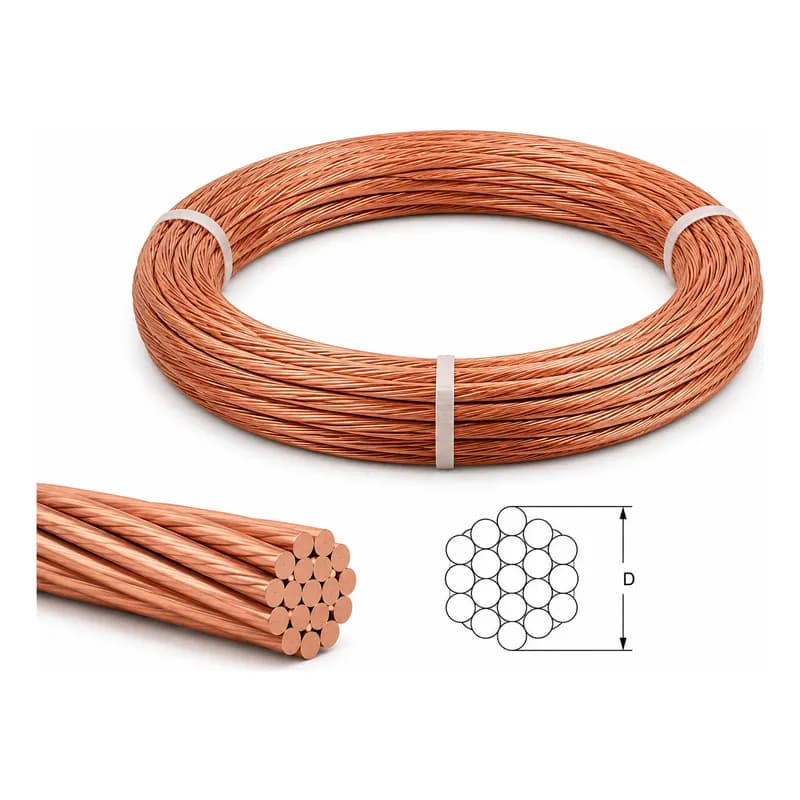
Both are accepted in the standards, and the choice depends on the design and where it is installed. Copper tape sits flat on walls and roofs, has more contact area with the soil for the same cross-section, and forms a large contact area in flat clamps. Bare copper conductor bends easily, seats in clamp saddles and is run as a spiral in earth pits.
Copper tape or galvanised tape: can the two be connected?
In soil, no: galvanised steel corrodes when connected to copper, so build the copper system and the galvanised system each with parts of its own metal. In air, copper tape can be connected to a galvanised structure with tinned tape or a brass clamp, provided the joint is covered with an anti-corrosion coating and the copper is not installed above galvanised parts.
Plain or tinned copper tape: which should we choose?
Plain copper tape suits soil, concrete and most outdoor air environments. Use tinned tape where copper touches or is mounted on galvanised steel or aluminium in air. BS 7430 and Iranian National Standard 4123 require copper tape in contact with galvanised steel to be tinned.
What is the difference between copper tape and copper busbar?
We supply copper tape in rolls, to the length you order, so long down conductor, roof mesh and earth ring runs can be installed without joints. Copper busbar is a flat conductor in straight lengths, used for bars, earth bars and rigid connections.
How do we connect copper tape to an earth rod?
Inside the earth pit, fix the tape to the earth rod with an A-type clamp (25, 30 and 50 tape on earth rods up to 16, 20 and 25 mm) or a vertical tape U clamp (25 tape), and pour concrete around the pit. For a permanent joint that can be buried, TE1 and TE2 exothermic welding moulds weld the tape to the top of a copper-bonded earth rod.
How do we install copper tape on a wall and how far apart should the clamps be?
Fix the tape with a two-piece brass wall clamp or on a BPH 76 stand-off base. IEC 62305-3:2010 recommends a support spacing of 1000 mm on vertical runs up to a height of 20 m and on horizontal surfaces, and 500 mm on horizontal runs along walls and on vertical runs above 20 m. BS 7430 does not accept drilling the conductor for mounting on a structure.
How do we join two copper tapes? Can the tape be drilled?
On buildings, join crossings and T joints with a square four-way clamp and in-line joints with a two-way tape-to-tape clamp. In soil, use exothermic welding only (TT moulds). For a bolted joint on a pit bar or earth bar you may drill the tape: BS 7430 does not allow a bolt diameter above one third of the tape width, which means M8 or smaller for 25 mm tape and M10 or smaller for 30 mm tape. For mounting on walls and structures, do not drill the tape: use clamps.
How and at what depth do we install copper tape in soil?
Lay the tape on edge in a trench 70 to 80 cm deep. IEC 62305-3 requires the earth ring at least 0.5 m below ground and 1 m from the outer walls, Topic 13 of the National Building Regulations sets horizontal electrodes at a depth of 0.5 to 0.8 m, and the Earthing System Installation Guideline requires at least 0.7 m. Make buried joints with exothermic welding and backfill the trench with soft soil free of stones and debris. In high-resistivity soil, surround the tape with GIM ground improvement material.
Why does copper tape turn green or dark? Is sulphation a defect?
The green or dark surface that copper tape takes on in normal air is the natural protective layer of copper and does not harm the conductor. During inspections, just test the joints: if the resistance of a joint has risen, open it, clean it and tighten it again.
What fault current can 25 × 3 copper tape withstand?
IEC 60364-5-54 calculates the required cross-section with the formula S = I√t / k. For bare copper in normal conditions, with a starting temperature of 30 and a final temperature of 200 degrees Celsius, k is 159, so 25 × 3 tape (75 mm²) withstands 11.9 kA for one second (75 × 159). This figure is a standard calculation, and the designer chooses the final size from the project's current and disconnection time.
How is the price of copper tape set and what should we send for a quote?
The price depends on the size, the length and the daily copper price. Some sellers quote per kilo and others per metre, and the weight per metre is in the table on this page. Send our specialists the size, length, application (down conductor, roof mesh, earth ring or bonding) and the clamps and accessories you need, and they will give you the current price together with the list of accessories.
Have a Technical Question?
KALOT Group's technical experts are ready to answer your questions about lightning rods and earthing systems.