
Move your pointer over the image to zoom in
Complete Product Overview
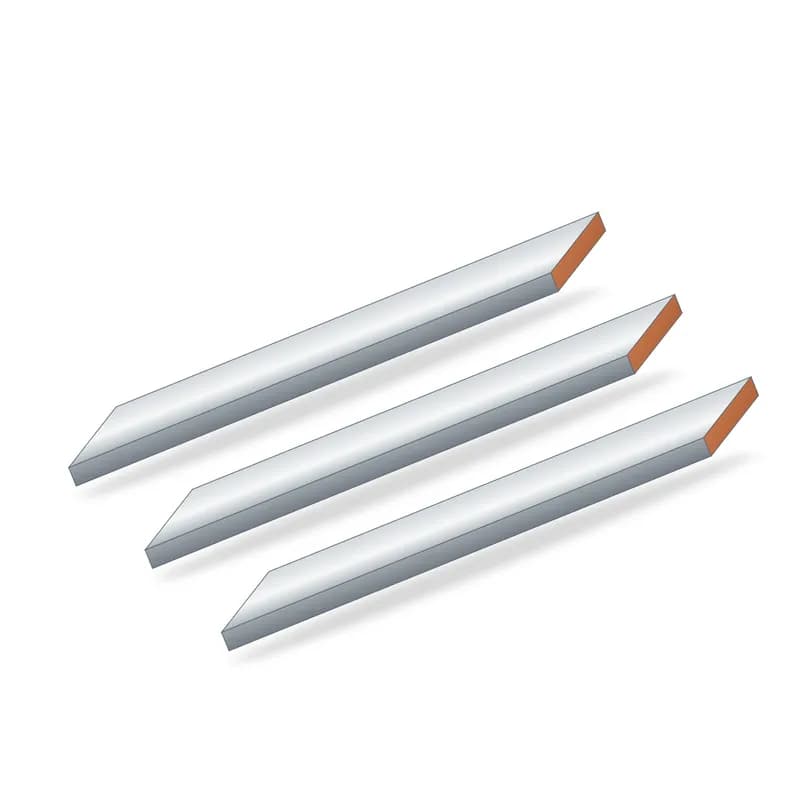
Bare copper busbar in 4 m lengths for earthing and bonding
Order Code: BCB 2003–1220
Last updated:
KALOT Group bare copper busbar is a flat copper conductor in 4 m lengths, used for the main earth bar, earth bars, bonding bars and short rigid connections in substations, transformer rooms, electrical rooms and panels. We supply it in twenty sizes, from 20 × 3 to 120 × 20 mm.
Flat copper conductor in straight lengths, for bars and rigid connections
Copper busbar is for places where the conductor must stay straight, be drilled and be fastened with nuts and bolts: the main earth bar, earth bars and bonding bars. For long runs, such as down conductors and earth rings, we recommend copper tape in coils.
- Straight 4 m length
- Twenty sizes from 20 × 3 to 120 × 20
- Main earth bar, earth bars and bonding bars
- Table of weight per metre and per length
Main earth bar: at least 50 mm²
Topic 13 of the National Building Regulations sets the minimum cross-section of the main earth bar, with a copper conductor, at 50 mm², and IEC 60364-5-54 requires each conductor on this bar to be disconnected separately and only with a tool. Our smallest busbar is 60 mm².
Bolt diameter up to one third of the width
BS 7430 and national standard 4123 do not allow a bolt diameter above one third of the busbar width. The largest bolt is therefore M8 for a 25 mm busbar, M10 for 30 mm, M12 for 40 mm and M16 for 50 mm.
Busbar or tape?
Copper tape in coils suits long runs without joints, such as down conductors and earth rings; copper busbar in 4 m lengths is for bars and short connections that must stay straight and be bolted.
Drawing and datasheet
Copper busbar datasheet (PDF)See the dimensions and code table of copper busbar as a PDF, next to the datasheet.
Technical Product Information
Click to view enlarged
Feature | Value |
|---|---|
Product type | Flat copper conductor in straight lengths (copper busbar) for earth bars, bonding and rigid connections |
Material | Copper, bare |
Dimensions (width × thickness) | From 20 × 3 to 120 × 20 mm, in twenty sizes |
Cross-section | From 60 to 2400 mm² |
Length | 4 m |
Order code | BCB 2003–1220 |
Tinned version | Tinned copper busbar in sizes 25 × 5, 30 × 5 and 50 × 5 |
Copper busbar table: code, dimensions and weight
Order code | Width × thickness (mm) | Cross-section (mm²) | Weight per metre (kg) | Weight per 4 m length (kg) |
|---|---|---|---|---|
BCB 2003 | 20 × 3 | 60 | 0.53 | 2.14 |
BCB 2005 | 20 × 5 | 100 | 0.89 | 3.56 |
BCB 2505 | 25 × 5 | 125 | 1.11 | 4.45 |
BCB 3005 | 30 × 5 | 150 | 1.34 | 5.34 |
BCB 4005 | 40 × 5 | 200 | 1.78 | 7.12 |
BCB 5005 | 50 × 5 | 250 | 2.23 | 8.90 |
BCB 6005 | 60 × 5 | 300 | 2.67 | 10.68 |
BCB 8005 | 80 × 5 | 400 | 3.56 | 14.24 |
BCB 1005 | 100 × 5 | 500 | 4.45 | 17.80 |
BCB 3010 | 30 × 10 | 300 | 2.67 | 10.68 |
BCB 4010 | 40 × 10 | 400 | 3.56 | 14.24 |
BCB 5010 | 50 × 10 | 500 | 4.45 | 17.80 |
BCB 6010 | 60 × 10 | 600 | 5.34 | 21.36 |
BCB 8010 | 80 × 10 | 800 | 7.12 | 28.48 |
BCB 1010 | 100 × 10 | 1000 | 8.90 | 35.60 |
BCB 6020 | 60 × 20 | 1200 | 10.68 | 42.72 |
BCB 1210 | 120 × 10 | 1200 | 10.68 | 42.72 |
BCB 1015 | 100 × 15 | 1500 | 13.35 | 53.40 |
BCB 1020 | 100 × 20 | 2000 | 17.80 | 71.20 |
BCB 1220 | 120 × 20 | 2400 | 21.36 | 85.44 |
We write dimensions as "width × thickness"; in the market the same size is also called "thickness by width", so a 25 × 5 busbar is known as a "5 by 25 busbar". We calculated the weight per metre from the dimensions: cross-section (mm²) × 8.9 ÷ 1000, with a copper density of 8.9 g/cm³; the weight per 4 m length is four times that. All sizes are supplied in 4 m lengths. Our products are continually improved and some dimensions may be updated, so please confirm the final dimensions with our specialists before buying.
Copper busbar dimensions and code table
Download the dimensions and code table (PDF)
How copper busbar is supplied
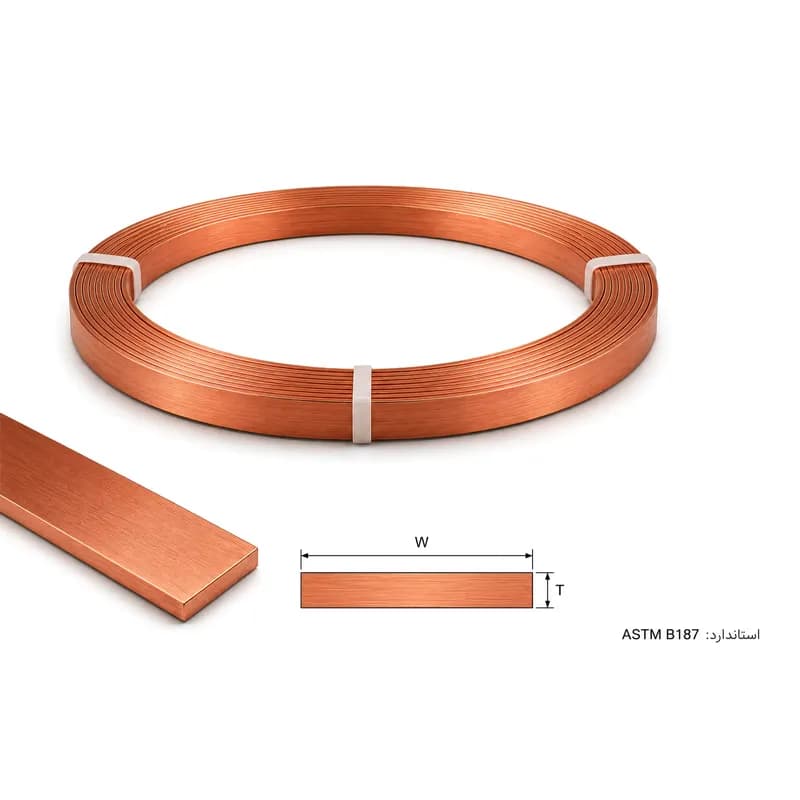
Copper busbar is a flat, straight copper conductor supplied in 4 m lengths; its section is rectangular, with width W and thickness T. We supply the same copper as copper tape in coils for long runs, and as tinned copper busbar for contact with galvanised steel or aluminium in air.
Click to view enlarged
Applications of copper busbar
- Main earth bar: the bar where a building's earthing conductor, protective conductors and bonding conductors come together; green and yellow earth cable is used from the earth pit to this bar.
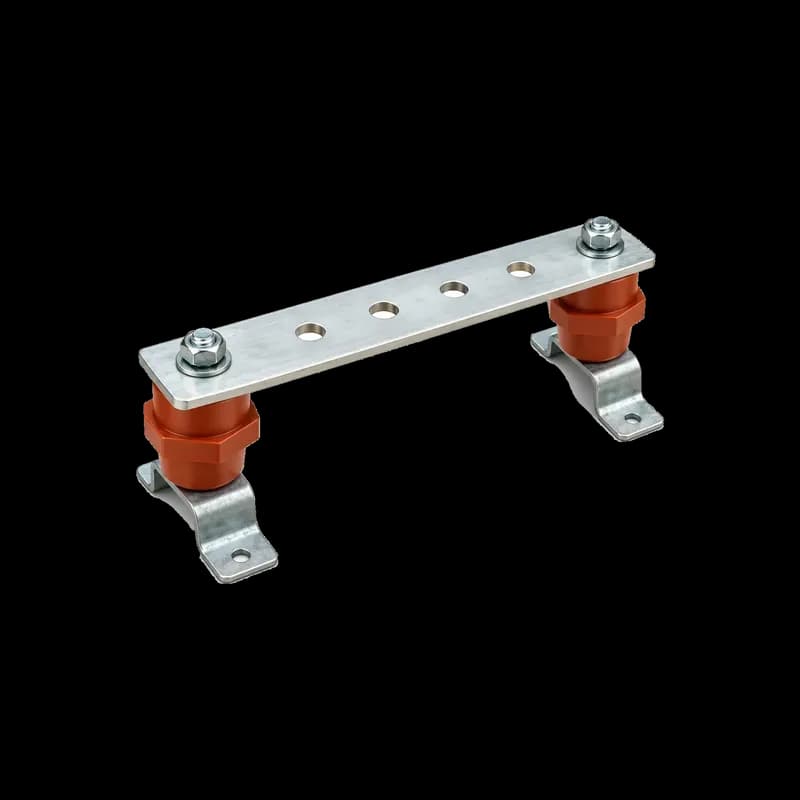
- Earth bars and bonding bars: earth bars in electrical rooms, substations, and transformer and generator rooms; the bar in KALOT earth bars and the copper version of the concrete pit's earth pit bar are also 50 × 5 copper busbar. For bonding, see bonding and equipotential bonding.
- Rigid, short connections: short links between bars, equipment and panels that must stay straight and be fastened with nuts and bolts or a cable lug.
- In soil: we assess busbar against the solid copper tape entry in the standards' tables (at least 50 mm²), and all our sizes are larger than that; for long runs in soil, however, copper tape in coils is installed without joints, and we make buried connections by exothermic welding.
Installation notes
- Cut the busbar to the required length and smooth the cut edges.
- Keep the bolt diameter to no more than one third of the busbar width (BS 7430), with each conductor on its own hole.
- Clean the contact surfaces and fasten the connection with a nut, bolt and wide flat washer.
- To allow for thermal expansion in long busbars, make the mounting holes slotted, or fix the busbar at one point and leave it free in the other supports.
Installation tools
Inspection
Copper busbar price enquiry
To ask for a copper busbar price, send our specialists the size (width × thickness), number of lengths or total metres and the application, and they will give you the current price. The price of busbar depends on the day's copper price and its weight, and the weight per metre and per length is in the dimensions table.
Click to view enlarged
Busbar or tape? We supply copper tape in coils, cut to the ordered length, so down conductors, roof networks and earth rings can be installed without joints; copper busbar is straight, in 4 m lengths, and is used for the main earth bar, earth bars, bonding bars and short rigid connections that must stay straight and be drilled and bolted. Plain or tinned? Plain copper busbar is enough for most applications; use tinned copper busbar where copper touches galvanised steel or aluminium in air. Choose the busbar size according to the design fault current and disconnection time.
Advantages of KALOT copper busbar
- Straight length: for bars and bolted connections that must stay straight.
- Twenty sizes: from 20 × 3 to 120 × 20, all with a cross-section of 60 mm² or more.
- Clear weight: the weight per metre and per 4 m length is in the table.
- Matches KALOT products: earth bars, earth pit bars, cable lugs and copper tapes.
See these products too
Product | When |
|---|---|
For contact with galvanised steel or aluminium in air. | |
Flat conductor in coils for long runs. | |
Ready-made earth bar, on insulators or without them, and with or without a link. | |
Connection point for bare conductors inside the pit. | |
Connects a cable to a bar with a nut and bolt. |
Topic 13 of the National Building Regulations (1395 edition) sets the minimum cross-section of the main earth bar, with a copper conductor, at 50 mm², and requires that the earthing conductor can be disconnected from the bar for measurement.
IEC 60364-5-54:2011 (earthing arrangements and protective conductors) connects the earthing, protective and bonding conductors to the main earth bar and requires each conductor to be disconnected separately and only with a tool; it calculates the required cross-section with the formula S = I√t / k and does not accept soldered connections.
BS 7430:2011 and Iranian national standard 4123 (code of practice for earthing) do not allow a bolt diameter above one third of the width of a flat conductor. IEC 62561-2 and IEC 62305-3 have no separate entry for busbar and require flat copper conductors to be at least 50 mm²; IEC 62561-2 recommends a thickness of 2 mm.
Uncoated copper bar: section and use
Documents & Downloads
Catalogues & datasheets
Drawings & schematics
Frequently Asked Questions
What is a copper busbar and what does it do in an earthing system?
A copper busbar is a flat copper conductor in a straight 4 m length. It is cut and drilled, then used for the main earth bar, earth bars, bonding bars and short rigid connections in substations, electrical rooms and panels.
What is the difference between copper busbar and copper tape?
Both are copper. We supply copper tape in coils, cut to the ordered length, so long runs can be installed without joints; copper busbar comes in straight 4 m lengths and is used for bars and bolted connections.
Copper busbar table: how much does copper busbar weigh per metre?
The weight per metre is width × thickness × 8.9 ÷ 1000 kg (copper density 8.9 g/cm³). For example, a 25 × 5 busbar weighs 1.11 kg per metre and 4.45 kg per 4 m length. The table on this page gives the weight per metre and per length for all twenty sizes.
What cross-section should a building's main earth bar have?
Topic 13 of the National Building Regulations sets the minimum cross-section of the main earth bar, with a copper conductor, at 50 mm²; the final size depends on the design fault current and disconnection time. The bar in KALOT earth bars is 50 × 5 copper busbar (250 mm²).
Can copper busbar be buried in soil?
Standards have no separate entry for busbar, so we assess it against the copper tape entry, and plain copper is accepted in soil. For long runs in soil, however, copper tape in coils is installed without joints, and we make buried connections by exothermic welding.
How is the price of copper busbar calculated?
The price of busbar depends on the day's copper price and its weight, and is usually quoted per length or per kilogram. Send our specialists the size, number of lengths or total metres and the application, and they will give you the current price.
Have a Technical Question?
KALOT Group's technical experts are ready to answer your questions about lightning rods and earthing systems.