
Move your pointer over the image to zoom in
Complete Product Overview
A-type clamp for connecting tape to earth rod (ERTC)
Order Code: ERTC 1625 · ERTC 2030 · ERTC 2550
Last updated:
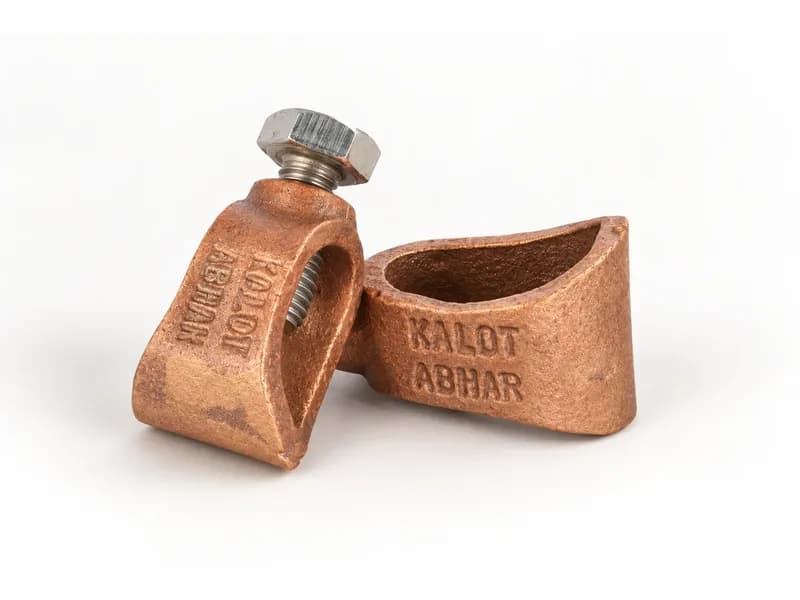
When the earth conductor is copper tape, it has to reach the top of the earth rod firmly and stay open to inspection. The KALOT A-type clamp, also known in the market as a "tape-to-earth rod clamp", does this with one piece and one bolt: the earth rod sits at the apex of the brass ring, the tape lies beside it, and the stainless steel bolt presses the tape against the earth rod, with no drilling of the tape.
This clamp connects earth grid tape and lightning protection down conductors to the earth rod inside the inspection pit, and undoing the same bolt separates them when you measure the earth rod resistance. Choose the size by earth rod diameter and tape width: ERTC 1625 for earth rods up to 16 and 25 tape, ERTC 2030 for earth rods up to 20 and 30 tape, and ERTC 2550 for earth rods up to 25 and 50 mm tape.
Connects tape to the top of an earth rod
The A-type clamp connects copper tape to the top of an earth rod with one bolt and without drilling the tape.
- Connects tape to the top of an earth rod
- No drilling of the tape
- One stainless steel bolt
- Earth rod 16 to 25, tape 25 to 50
The tape stays intact
The tape is neither drilled nor cut, so its full cross-section remains available to carry current.
One piece, one bolt
Installation in five steps (PDF)Installed with one spanner; it sits on top of the earth rod and takes up little room inside the inspection pit.
Material
Brass body and stainless steel bolt.
3 standard codes
Download the datasheet (PDF)Codes ERTC 1625, ERTC 2030 and ERTC 2550; choose the code by earth rod diameter and tape width.
Advice from KALOT specialists
When you enquire, tell us the earth rod diameter, the tape width and thickness and the quantity you need, and our specialists will recommend the right code.
Technical Product Information
Click to view enlarged
Feature | Value |
|---|---|
Type | A-type clamp (ring with one pressure bolt) |
Body material | Brass |
Bolt material | Stainless steel |
Application | Connecting copper tape to the top of an earth rod |
Maximum earth rod diameter | 16, 20 or 25 mm (according to code) |
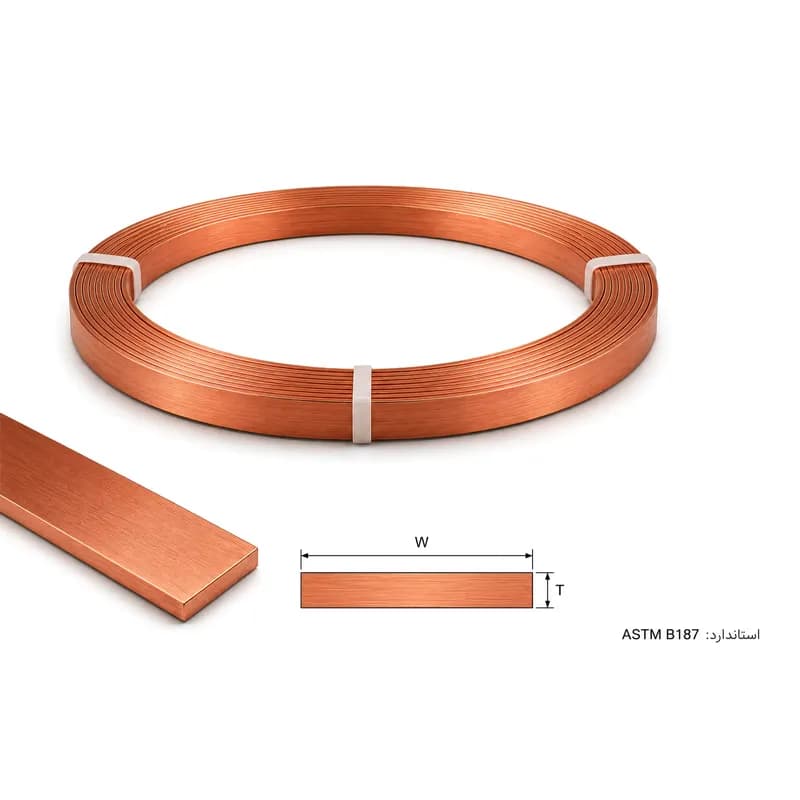
Tape width | 25, 30 or 50 mm (according to code) |
Installation method | One spanner; no drilling of the tape |
Codes | ERTC 1625, ERTC 2030 and ERTC 2550 |
A-type clamp (ERTC) codes and dimensions
Code | Maximum earth rod diameter (mm) | Tape width (mm) | L (mm) | W (mm) | H (mm) |
|---|---|---|---|---|---|
ERTC 1625 | 16 | 25 | 43 | 36 | 19 |
ERTC 2030 | 20 | 30 | 42 | 44 | 18 |
ERTC 2550 | 25 | 50 |
Dimensions are in millimetres; L is the ring height, W the width and H the body thickness. We keep improving our products and some dimensions may be updated, so please confirm the final dimensions with our specialists before you buy.
Dimensional drawing of the tape-to-earth rod clamp
Download the dimensional drawing (PDF)
Technical drawing of the A-type clamp
Download the technical drawing (PDF)
Click to view enlarged
Applications of the tape-to-earth rod clamp
- Connecting earth grid copper tape to the top of an earth rod inside an inspection pit
- Connecting the tape down conductor of a lightning protection system to an earth rod
- Connecting a tape earth ring around a building to earth rods
- Separating the tape from the earth rod to measure earth termination resistance, then reconnecting it
Installation schematic for connecting tape to an earth rod
Download the execution schematic (PDF)
Installation steps: how to connect tape to an earth rod
- Choose the clamp code from the code table, by the diameter of the earth rod and the width of the copper tape.
- Clean the top of the earth rod and the part of the tape that sits under the clamp with a wire brush.
- Loosen the bolt and drop the clamp on from above so the earth rod sits at the apex of the ring.
- Place the tape beside the earth rod, between it and the bolt tip, with the flat face of the tape towards the earth rod.
- Tighten the bolt with a spanner, following the manufacturer's instructions, until the tape is pressed fully against the earth rod.
- Pass the tape through the clamp opening until its full width lies under the bolt tip and against the earth rod; make any bend in the tape outside the clamp.
Download the installation steps (PDF)
Tools for installing the A-type clamp
To install the A-type clamp, an open-ended or ring spanner matching the bolt head is all you need, with no special tools. A torque wrench makes it easier to tighten all the clamps on a project evenly.
Inspecting and maintaining the tape-to-earth rod connection
During periodic pit inspections, check that the clamp and bolt are sound and free of corrosion or looseness. If you find either, open the connection, clean it and close it again. To measure earth rod resistance, undo the bolt so the tape separates from the earth rod, and after the measurement close it again following the manufacturer's instructions.
Enquire about the tape-to-earth rod clamp
When you enquire, tell us the earth rod diameter, the tape width and thickness and the quantity you need, and our specialists will recommend the right code.
Click to view enlarged
When the earth conductor is copper tape and has to reach the top of an earth rod, the A-type tape-to-earth rod clamp is the simplest route: one piece and one bolt, with no drilling of the tape. The earth rod sits at the apex of the ring, the tape lies beside it, and the bolt presses from behind the tape to hold it against the earth rod. The stainless steel bolt does not rust in the damp conditions of the pit, and the connection always stays accessible: visible for inspection and easy to open for measurement.
Advantages of the A-type clamp (tape-to-earth rod clamp)
- No drilling of the tape: the tape stays intact and installation is faster.
- One bolt, one spanner: the simplest way to connect tape to the top of an earth rod, with no special tools.
- Stainless steel bolt: it does not rust in the damp pit, so corrosion does not destroy the connection between tape and earth rod over time.
- Compact: it sits on top of the earth rod and takes up little room inside the inspection pit.
- Easy to open and close: to measure earth rod resistance, undo the bolt and the tape comes away.
- Brass body compatible with copper: next to copper tape and copper or copper-bonded earth rods, it forms a joint between metals of the same family.
Comparing the A-type clamp with the U clamp for tape to earth rod
Feature | A-type clamp | Vertical tape U clamp | Horizontal tape U clamp |
|---|---|---|---|
Fixing position on the earth rod | Top of the earth rod | Anywhere on the earth rod or on a reinforcing bar | Anywhere on the earth rod or on a reinforcing bar |
Tape direction | Vertical, beside the earth rod | Vertical, beside the earth rod | Horizontal |
Drilling the tape | Not needed | Not needed | Needed (two holes) |
Fixing method | One pressure bolt | U-bolt and two nuts | U-bolt and two nuts |
Earth rod diameter | 16 to 25 | Up to 50 | Up to 50 |
Tape width | 25, 30 and 50 | 25 | With drilling, at the spacing of the two U-bolt ends |
All these clamps make a connection that can be opened and closed, and they are used at accessible points such as inspection pits. BS 7430 and IEC 62305-3 provide for periodic inspection of earthing system connections, which is why these clamps are installed at accessible points such as inspection pits.
If these conditions apply to you, see these clamps as well
Clamp | When |
|---|---|
When the tape has to be fixed along the length of the earth rod or on a reinforcing bar, or when the earth rod is thicker than 25 mm. | |
When the conductor is a wire rather than a tape. |
Compare all our earthing clamps in the "Which clamp should we choose?" table.
The KALOT A-type clamp, like all our earthing clamps, is designed and made in line with IEC 62561-1, the standard that sets the requirements for connection components of lightning protection and earthing systems, clamps included. Under this standard, connection components are assessed for lightning current in two classes, H (heavy) and N (normal), after first being exposed to the corrosive conditions of salt mist and a sulphurous atmosphere, which shows how the connection behaves over time.
IEC 62305-3 and BS 7430 call for periodic inspection of the earthing system, so bolted connections should sit where they can be seen, tightened and, if needed, opened for measurement, for example inside an inspection pit or on the structure.
A-type clamp, tape to earth rod
Documents & Downloads
Catalogues & datasheets
Drawings & schematics
- Three-view technical drawing of the A-type clamp (ERTC) (PDF)Language: Persian (opens in a new tab)
- Installation schematic of the A-type clamp (ERTC) (PDF)Language: Persian (opens in a new tab)
- A-type clamp (ERTC) dimensional drawing | Dimension tableLanguage: Persian (opens in a new tab)
- A-type clamp (ERTC) technical drawingLanguage: Persian (opens in a new tab)
- A-type clamp installation schematic | Connecting tape to earth rodLanguage: Persian (opens in a new tab)
- A-type clamp installation in five stepsLanguage: Persian (opens in a new tab)
Frequently Asked Questions
How do you connect tape to an earth rod?
Clean the top of the earth rod and the tape with a wire brush, drop the A-type clamp on from above so the earth rod sits at the apex of the ring, place the tape beside the earth rod, between it and the bolt tip, then tighten the bolt following the manufacturer's instructions. The full width of the tape must lie under the bolt tip and against the earth rod; make any bend in the tape outside the clamp.
What is an A-type clamp, or tape-to-earth rod clamp?
A ring-shaped clamp with one bolt that connects copper tape to the top of an earth rod. The earth rod sits at the apex of the ring, the tape lies beside it, and the bolt presses the tape against the earth rod.
How do you choose the size of a tape-to-earth rod clamp?
By the earth rod diameter and the tape width. For a 16 mm earth rod and 25 mm tape, for example, choose code ERTC 1625.
Does the tape have to be drilled to connect it to an earth rod?
Not with an A-type clamp. The tape lies beside the earth rod inside the ring and the bolt presses it against the earth rod, so the cross-section of the tape stays untouched.
What is the difference between an A-type clamp and a U clamp for tape to earth rod?
The A-type clamp fastens onto the top of the earth rod with one bolt. The vertical tape U clamp closes around the earth rod with a U-bolt, fits anywhere along it or on a reinforcing bar, and also comes in models for thicker earth rods up to 50 mm.
Is the A-type clamp also suitable for copper-bonded earth rods?
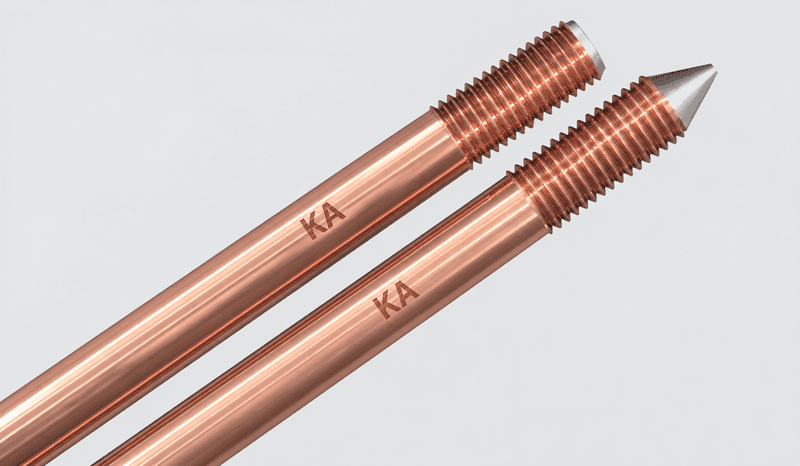
Yes. Compare the diameter of the largest part of the earth rod at the clamp position, usually the thread, with the maximum earth rod diameter in the code table. For 12.7 and 14.2 mm copper-bonded earth rods (9/16 and 5/8 inch thread, up to about 16 mm), choose ERTC 1625; for a 17.2 mm earth rod (3/4 inch thread, about 19 mm), choose ERTC 2030.
Can a tape-to-earth rod clamp be buried in soil?
This clamp is made for accessible points, such as inside an inspection pit. For connections buried in soil, exothermic welding is the choice.
Have a Technical Question?
KALOT Group's technical experts are ready to answer your questions about lightning rods and earthing systems.