
Move your pointer over the image to zoom in
Complete Product Overview
Tinned copper tape (tin-coated copper tape) for earthing and lightning protection
Order Code: TPBT 203–305
Last updated:
Tinned copper tape (tin-coated copper tape) from KALOT Group is the same solid copper tape, with a layer of tin over all its surfaces. We use this tape where copper in air touches or runs beside galvanised steel, zinc or aluminium, in the flue gas zone of a building chimney, for lightning protection down conductors and on facades that must stay free of green copper stains. We supply tinned tape in seven sizes, from 20 × 3 to 30 × 5 mm, in rolls; its cross-section and weight per metre match those of plain copper tape.
We make tinned tape connections with KALOT brass clamps: the two-piece brass wall clamp, the square four-way clamp, the two-way tape-to-tape clamp, the brass disconnector and the tape-to-metal plate bonding clamp. In soil and concrete, we recommend plain copper tape: the tin coating brings no advantage in soil, and tinned tape follows the same rules as copper there. A tinned down conductor comes down to the disconnector above ground, and from the disconnector downwards a bare copper conductor continues to the earth pit.
Copper with a tin surface, for where copper meets galvanised steel
To choose between plain and tinned copper tape, look at where it will run. If the tape in air touches or runs beside galvanised steel, zinc or aluminium, sits in the chimney flue gas zone, or the building facade must stay free of stains, use tinned tape. In soil and concrete, plain copper tape is enough. Select the size based on the tape's role and the fault current.
- Solid copper tape with tin coating; seven sizes from 20 × 3 to 30 × 5
- Connection to galvanised structures in air; beside aluminium, always below it
- Down conductors and roof networks; stain-free facades
- Supplied in rolls, to the length you order
Every size meets or exceeds the IEC minimum
IEC 62561-2 and IEC 62305-3 class tinned copper with copper and set the minimum tape cross-section for air termination and down conductors at 50 mm²; IEC 62561-2 recommends a thickness of 2 mm. Our smallest tinned tape is 60 mm², and every size is 2 mm thick or more.
Tin towards the galvanised part, copper below it
BS 7430 and National Standard 4123 require copper tape that touches or is mounted on galvanised steel to be tinned. The tin coating lowers the potential difference at the contact point. Even so, cover the joint and the cut end with anti-corrosion coating and run the tape below the galvanised or aluminium part.
Electroplated tin coating
The tin coating on our tapes is applied by electroplating over all surfaces and is at least 8 microns thick. Tin keeps the tape surface from darkening and staining in air, and where the tape meets galvanised steel, zinc or aluminium, it is the tin surface, not the copper, that makes contact.
Which size?
For down conductors, roof networks and connection to galvanised structures, we recommend 25 × 3 tape, because the KALOT wall clamp, four-way clamp, disconnector, conductor-to-tape clamp and structure clamp are all available for this size. 30 × 3 tape is also installed with the DCC 303 wall clamp, the STCC 303 four-way clamp and the two-way conductor-to-tape clamp. 30 × 2 tape is common for ESE air terminal down conductors.
Drawings and datasheet
Tinned copper tape datasheet (PDF)Dimensions and the code table, schematics for connection to galvanised structures and the rainwater rule, the roof network, the ESE air terminal down conductor, connection modes and installation steps are all available as PDF files beside the datasheet.
Technical Product Information
Click to view enlarged
Feature | Value |
|---|---|
Product type | Solid copper tape with tin coating (tinned copper tape) for lightning protection, bonding and earthing |
Material | Copper with tin coating |
Coating | Tin, electroplated; at least 8 microns thick |
Dimensions (width × thickness) | From 20 × 3 to 30 × 5 mm, in seven sizes |
Cross-section | From 60 to 150 mm² |
Weight per metre | From 0.53 kg (20 × 3 and 30 × 2) to 1.34 kg (30 × 5); 25 × 3: 0.67 kg |
Reference standard | ASTM B545 for the tin coating; EN 13601 for the copper |
Supply form | Roll, to the length you order |
Order code | TPBT 203–305 |
Connections | KALOT brass clamps; bolts and nuts on the earth bar |
Compatibility | With copper, tinned copper and brass; with galvanised structures only in air, below the galvanised part and with anti-corrosion coating over the joint; avoid connecting to aluminium wherever possible, and if it is unavoidable, make the joint above ground and fully covered |
Main application | Connection to galvanised structures in air, down conductors and roof networks, building chimney flue gas zones, bonding |
Tinned copper tape table: code, dimensions and weight per metre
Order code | Width × thickness (mm) | Cross-section (mm²) | Weight per metre (kg) |
|---|---|---|---|
TPBT 203 | 20 × 3 | 60 | 0.53 |
TPBT 205 | 20 × 5 | 100 | 0.89 |
TPBT 253 | 25 × 3 | 75 | 0.67 |
TPBT 255 | 25 × 5 | 125 | 1.11 |
TPBT 302 | 30 × 2 | 60 | 0.53 |
TPBT 303 | 30 × 3 | 90 | 0.80 |
TPBT 305 | 30 × 5 | 150 | 1.34 |
We write tape dimensions as width × thickness; in the market the same size is also quoted as thickness by width, so 30 × 2 tape is also called "2 by 30" tape. The tin coating adds less than one per cent to the weight of the tape, so the cross-section and weight per metre match those of plain copper tape. We supply tinned tape in rolls, cut to the length ordered. Our products are continually improved and some dimensions may be updated; please confirm final dimensions with our specialists before you buy.
Dimensions, tin coating and code table
Download dimensions, tin coating and code table (PDF)
Structure of tinned copper tape: solid copper with tin coating
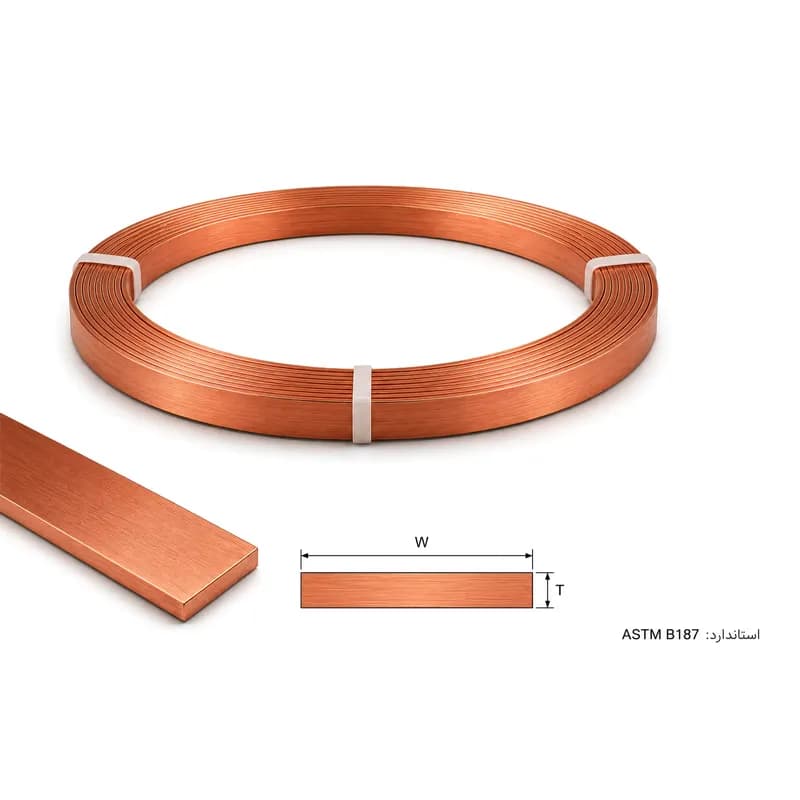
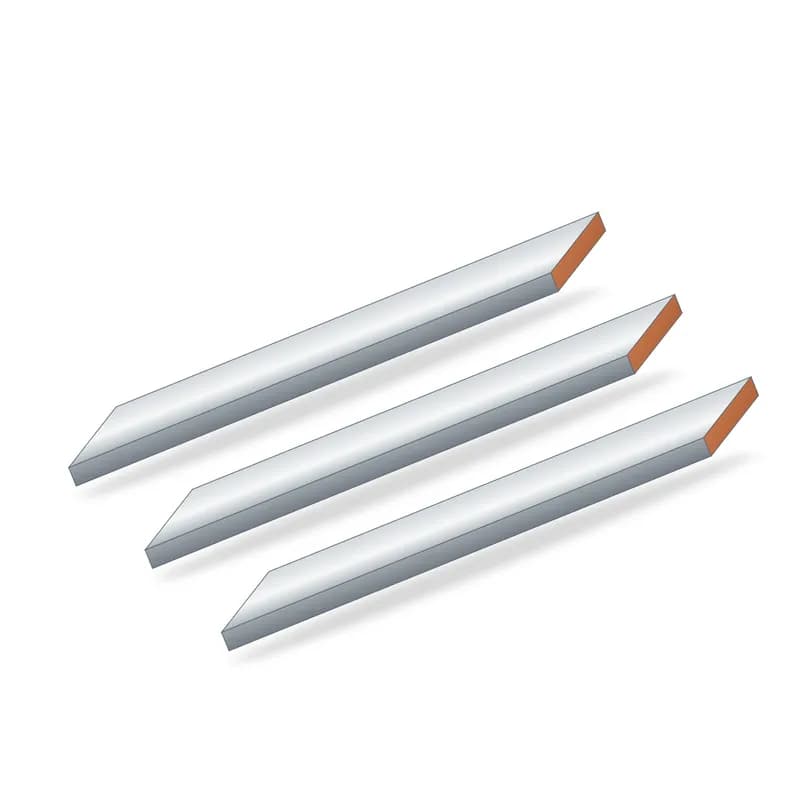
Tinned copper tape is the same flat, solid copper conductor, with an electroplated layer of tin over all its surfaces. Its section is a rectangle of width W and thickness T, and it comes in seven sizes, from 20 × 3 to 30 × 5 mm. This tape is not a copper-tin alloy: the core is copper and tin is only the surface, which is why its cut end and hole positions show copper. We supply the tape in rolls, cut to the length ordered. For rigid connections and earth bars, use tinned copper busbar, and for bonding panel doors and moving parts, use flexible bonding tape.
Click to view enlarged
Applications of tinned copper tape
- Connection to galvanised steel structures: bonding galvanised columns, beams, railings, cable trays and towers to the lightning protection system or earthing system, only in air and at least 250 mm above ground level, with the tape-to-metal plate bonding clamp (25 × 3 tape). Cover the joint and the cut end with anti-corrosion coating and run the tape below the galvanised part. For this work, see bonding and equipotential bonding.
- Down conductors and roof networks beside galvanised and aluminium parts: where the conductor passes sheets, gutters, railings or galvanised and aluminium parts, or connects to them from below. Never run the tape above these parts or on galvanised and aluminium sheets and roofs. On walls, use the two-piece brass wall clamp or the BPH 76 stand-off base, and at roof crossings the square four-way clamp. To learn about the components, see the lightning protection system and its components.
- ESE air terminal down conductors: tinned 30 × 2 tape is common for ESE air terminal down conductors, and 25 × 3 tape is installed with the full set of KALOT brass clamps; for example with the ACTIVE 1D+ ESE air terminal, a lightning counter on the most direct down conductor and a brass disconnector on each down conductor.
- Building chimneys: a conductor exposed to flue gas needs a continuous coating. AS/NZS 1768 requires this coating to reach at least 500 mm below the top of the chimney and says it must not be scraped at joints. For industrial chimneys, highly corrosive gases and coastal areas, the design sets the conductor material and the sealing of joints.
- Stain-free facades: water running off copper leaves green stains on facades and paving. As long as the tin coating stays intact, tinned tape leaves no such stains on light-coloured and stone facades.
- Bonding in electrical rooms and at earth bars: connecting structures and equipment to a tinned earth bar with bolts and nuts; each conductor on its own hole, and the bolt diameter no more than one-third of the tape width (BS 7430).
- Connection to pipes: bonding metal pipes with the one-piece clamp and the two-piece tape-to-pipe clamp (tape up to 26 mm wide), in air. On galvanised pipe, cover the joint with anti-corrosion coating.
Where to use tinned tape: connection to galvanised structures, the rainwater rule and chimneys
Download schematic for connection to galvanised structures, rainwater and chimneys (PDF)
Roof network and down conductor with tinned tape
Download roof grid and down conductor schematic (PDF)
ESE air terminal down conductor with tinned tape
Download ESE air terminal down conductor schematic (PDF)
Connection modes for tinned tape with KALOT brass clamps
Download connection modes (PDF)
Installation steps for tinned copper tape
- Mark on the drawing every point where copper meets galvanised steel, zinc, aluminium or flue gas, and select the tape size based on its role and the fault current.
- Unroll the tape without letting it twist or fold. Make bends gently, by hand or with a tape bender, and do not hammer the tape, so that the tin coating does not crack.
- Fixing to walls: fix the tape with the brass wall clamp (25 × 3 and 30 × 3) or the two-piece stainless steel clamp for fixing tape to walls (30 × 2 and 20 × 3), and do not drill it for installation. IEC 62305-3 recommends a fixing spacing of 1 m on vertical routes up to 20 m high and on horizontal surfaces, and 0.5 m on horizontal routes along walls and vertical routes above 20 m. For ESE air terminals, NF C 17-102 requires three fixings per metre.
- Make crossings and T joints with the square four-way clamp and in-line joints with the two-way tape-to-tape clamp. Do not scrape the tin coating at clamp positions.
- To connect to a galvanised structure, fit the tape-to-metal plate bonding clamp on the column flange or steel plate, in air and at least 250 mm above ground level, and cover the joint with anti-corrosion coating. Run the tape below the galvanised part.
- The cut end and the bolt hole position are bare copper; cover them with anti-corrosion coating as well.
- On each down conductor, above ground level, fit a brass disconnector (for 25 × 3 tape) or a two-way conductor-to-tape clamp (for 30 × 3 tape) that opens only with a tool. From the disconnector down to the earth pit, use a plain copper conductor.
- After installation, measure the continuity of the route and test the earth resistance with the disconnector open. Record the result with the date in the earthing system file.
Download the installation steps (PDF)
Installation tools
Drill and clamp fixing screws, spanner, tape bender, shears or saw for cutting the tape, anti-corrosion coating and brush for the joint and cut end, tape measure, continuity tester (milliohmmeter), earth resistance tester and camera to record the joints.
Checking continuity and coating, and inspection
At each inspection, check the tightness of the clamps, the condition of the tin coating at clamp positions, cut ends and connections to galvanised structures, and the condition of the anti-corrosion coating. Clean and recoat any place where the coating is damaged. If the resistance of a joint has risen, open it, clean it and retighten it, and measure earth resistance with the disconnector open. IEC 62305-3:2010 recommends maximum inspection intervals for the lightning protection system: at protection levels I and II, a visual inspection every year and a complete inspection every 2 years; at protection levels III and IV, a visual inspection every 2 years and a complete inspection every 4 years. For office and commercial buildings and places where many people gather, the same standard recommends a complete inspection every year. For the measuring method, see how earth termination resistance is measured.
Selecting tinned copper tape and requesting a price
To request a price for tinned copper tape, send our specialists the size (width × thickness), length, application (connection to a galvanised structure, down conductor, ESE air terminal or bonding), location (near a chimney, industrial or coastal air) and the clamps and accessories you need (wall clamp, four-way clamp, disconnector, structure and pipe clamps, anti-corrosion coating and plain copper conductor to the earth pit). If you also send the project's lightning protection or bonding drawing, our specialists at KALOT Group will give you the list of tape and accessories with the current price.
Click to view enlarged
In the electrochemical series, tin sits closer to zinc and aluminium than copper does. So where the tape touches galvanised steel, zinc or aluminium, tin rather than copper makes contact and the potential difference at that point falls. That is why BS 7430 and National Standard 4123 require copper tape in contact with galvanised steel to be tinned. Tin keeps the tape surface from darkening in air and, as long as the coating is intact, water running over it leaves no green copper stains on the facade. Conductivity and cross-section remain those of copper, because the core is copper and the tin coating takes up less than one per cent of the cross-section. Keep a few points in mind: the tin coating does not remove the need for anti-corrosion coating at galvanised connections, because the cut end and hole position are bare copper; do not install the tape above galvanised or aluminium parts; and in soil, tinned tape behaves just like copper and is not connected to galvanised parts. For conductor and electrode materials, see earth electrode materials.
Advantages of KALOT tinned copper tape
- Tin surface towards galvanised and aluminium parts: in air, tin rather than copper touches galvanised steel, zinc and aluminium.
- Copper conductivity: the core of the tape is copper, and its cross-section and weight per metre match those of plain copper tape.
- Stain-free facades: as long as the tin coating stays intact, rainwater running over tinned tape leaves no green copper stains on facades and paving.
- Coating of at least 8 microns: tin is electroplated over all surfaces of the tape.
- Seven sizes: from 20 × 3 to 30 × 5, with 30 × 2 for ESE air terminal down conductors; all with a cross-section of 60 mm² or more.
- Supplied in rolls: to the length you order, so long runs are installed without joints.
- Connections with KALOT products: brass wall and four-way clamps, disconnector, structure and pipe clamps, all from one supplier.
Tinned, plain copper or stainless steel tape? Choosing by location
Installation location | Our recommendation | Note |
|---|---|---|
Soil, earth ring, foundation concrete | Plain copper tape (BCT) | The tin coating brings no advantage in soil; buried joints by exothermic welding |
Down conductors and roof networks on masonry walls and roofs | Plain or tinned 25 × 3 copper tape | Tinned for a facade that must stay free of stains |
Connection to galvanised structures, in air | Tinned tape TPBT 253 | Brass clamp; anti-corrosion coating over the joint and cut end; tape below the galvanised part |
Beside sheets, gutters or aluminium parts | Tinned tape | Tape below the aluminium; avoid connecting to aluminium wherever possible, and if it is unavoidable, above ground and covered |
Building chimneys | Tinned tape | Continuous coating to at least 500 mm below the top of the chimney, not scraped at joints (AS/NZS 1768); for industrial chimneys, the design sets the conductor material |
ESE air terminal down conductors | TPBT 302 or TPBT 253 | Three fixings per metre; a disconnector on each down conductor (NF C 17-102) |
Where you do not want copper | Stainless steel tape | Needs a larger cross-section for the same current |
The installation rules in this table come from IEC 62305-3:2010, BS 7430:2011, National Standard 4123, NF C 17-102:2011 and AS/NZS 1768; the design and the fault current calculation set the final size. For conductor materials, see earth electrode materials.
See these products too
Product | When |
|---|---|
For soil, earth rings, concrete and most routes in air. | |
Flat conductor in lengths for earth bars and rigid connections. | |
Braided tape for bonding panel doors and moving parts. | |
Where you do not want copper. | |
Fixes 25 × 3 and 30 × 3 tape on walls and parapets. | |
Fixing 30 × 2 and 20 × 3 tapes to walls. | |
Crossings, T joints and straight joints of 25 × 3 and 30 × 3 tapes. | |
In-line joint of two tapes. | |
Crossing of a 50 to 95 conductor with 25 × 3 tape. | |
Test point for a 25 × 3 tape down conductor, above ground level. | |
Conductor-to-tape joint and test point. | |
Connects 25 × 3 tape to column flanges, beams and steel plates, in air. | |
Bonding of rainwater pipes, gas pipes and railings. | |
An ESE air terminal down conductor can be installed with tinned tape. | |
On the most direct down conductor of an ESE air terminal. | |
Bonding bar in the electrical room; copper or tinned. |
Compare all earthing and bonding clamps in the "Which clamp should we choose?" table.
IEC 62561-2:2018 (lightning protection system components: conductors and earth electrodes) classes tinned copper with copper: the minimum tape cross-section for air termination conductors, down conductors and earth electrodes is 50 mm², with a recommended thickness of 2 mm. It requires a tin coating of at least 1 micron, applied by hot dipping or plating, and tests coated conductors with a bend test (90 degrees, at a radius of five times the thickness) to confirm that the coating does not crack or peel.
IEC 62305-3:2010 (protection of structures against lightning) requires the same minimum cross-section for tinned copper tape as for copper. For steel-to-copper joints in air that are not welded, it requires full tinning or a complete, lasting moisture-proof coating, and it notes that a copper part must not be installed above an unprotected galvanised or aluminium part. It recommends a tape fixing spacing of 1000 mm on vertical routes up to 20 m and on horizontal surfaces, and 500 mm on horizontal routes along walls and vertical routes above 20 m.
BS 7430:2011 (code of practice for earthing) requires copper tape that touches or is mounted on galvanised steel, and any earth conductor connected to a galvanised steel structure, to be tinned. For copper-to-aluminium connections, it requires a bolted joint with a hot-tinned copper surface, at least 250 mm above ground, with grease and a sealing coating. It does not accept drilling the conductor to fix it to a structure, and it does not allow a joint bolt diameter above one-third of the tape width.
Iranian National Standard 4123 (code of practice for earthing) requires copper earth tape that touches or rests on galvanised steel to be tinned to prevent electrolytic reaction, and requires earth conductors to be tinned when connected to galvanised metal parts. Topic 13 of the National Building Regulations, in its table of metal corrosion in bonding, treats tinned copper like copper and considers bonding a smaller galvanised steel surface to a larger tinned copper surface unsuitable.
NF C 17-102:2011 (ESE air terminals) requires each air terminal in a non-isolated system to be connected to at least two down conductors, preferably on two separate facades. It requires a straight, short conductor route, a bend radius of at least 20 cm and fixing with three clamps per metre; it does not accept drilling the conductor for fixing, requires a protective tube up to at least 2 m above ground and requires a disconnector on each down conductor. A lightning counter, if installed, goes on the most direct down conductor.
AS/NZS 1768:2007 (lightning protection) requires a copper conductor exposed to flue gas or other corrosive gases to have a continuous coating of tin, lead or another suitable material, reaching at least 500 mm below the top of the chimney, and says the coating must not be scraped at joints.
IEC 60364-5-54:2011 (earthing arrangements and protective conductors) does not accept soldered joints in protective conductors, so connect tinned tape with clamps or bolts and nuts. EN 50522:2010 takes 150 degrees Celsius as the final temperature of tinned copper under fault current.
Tinned copper tape: section and use
Documents & Downloads
Catalogues & datasheets
Drawings & schematics
- Tinned copper tape dimensions, tin coating and code tableLanguage: Persian (opens in a new tab)
- Schematic of tinned copper tape connected to galvanised structures, rainwater fittings and chimneysLanguage: Persian (opens in a new tab)
- Roof network and down conductor schematic with tinned copper tapeLanguage: Persian (opens in a new tab)
- ESE air terminal down conductor schematic with tinned copper tapeLanguage: Persian (opens in a new tab)
- Tinned copper tape connection modesLanguage: Persian (opens in a new tab)
- Tinned copper tape installation stepsLanguage: Persian (opens in a new tab)
Frequently Asked Questions
What is tinned copper tape and how does it differ from plain copper tape?
Tinned copper tape is the same solid copper tape, with a layer of tin over all its surfaces. Its sizes, cross-section and weight per metre match those of plain copper tape. The difference lies in the surface: in air, tin rather than copper touches galvanised steel, zinc and aluminium, and the potential difference with these metals is lower. As long as the coating stays intact, it leaves no green copper stains on the facade. This tape is not a copper-tin alloy; its core is copper.
Tinned copper tape table: what are the dimensions and weight per metre?
We supply tinned tape in seven sizes: 20 × 3 and 30 × 2 at 0.53 kg per metre, 20 × 5 at 0.89, 25 × 3 at 0.67, 25 × 5 at 1.11, 30 × 3 at 0.80 and 30 × 5 at 1.34 kg. The weight per metre equals the cross-section multiplied by the density of copper, and the tin coating adds less than one per cent. The code, dimensions, cross-section and weight of each size are in the table on this page.
Where is tinned copper tape used?
Wherever copper in air touches or runs beside galvanised steel, zinc or aluminium, such as when bonding galvanised columns and towers; in the flue gas zone of a building chimney; for lightning protection down conductors, especially with ESE air terminals; on facades that must stay free of stains; and for bonding to a tinned earth bar.
Tinned copper tape or plain copper tape: which should we choose?
Neither is better everywhere; the choice depends on where the tape runs. In soil, concrete and most routes in air, plain copper tape is enough. Use tinned tape where the tape in air touches or runs beside galvanised steel, zinc or aluminium, in the chimney zone and on facades that must stay free of stains. BS 7430 and National Standard 4123 require copper tape in contact with galvanised steel to be tinned.
Can copper tape be connected to a galvanised tower or structure?
In air, yes: with tinned tape and a brass bonding clamp, provided you cover the joint and the cut end with anti-corrosion coating and run the tape below the galvanised part. In soil, no: galvanised steel joined to copper, plain or tinned, corrodes.
Can tinned copper tape be used in soil and in an earth ring?
In soil, tinned tape behaves just like copper and the tin coating brings no advantage. That is why, for soil, earth rings and foundation concrete, we recommend plain copper tape. A tinned down conductor comes down to the disconnector above ground, and from there a plain copper conductor continues to the earth pit. Copper tape, plain or tinned, is not connected to galvanised parts in soil.
How thick is the tin coating on the tape, and how is tin applied to the copper?
The tin coating on our tapes is applied by electroplating over all surfaces and is at least 8 microns thick. IEC 62561-2 requires a coating of at least 1 micron for tinned copper.
Does cutting or drilling the tape destroy the tin coating?
The tin coating stays on the tape surfaces, but the cut end and the wall of a bolt hole are bare copper. So cover the joint, the cut end and the hole with anti-corrosion coating, especially next to galvanised and aluminium parts, and do not scrape the coating at clamp positions. Check these points at each inspection and renew any damaged coating.
Which tape suits an ESE air terminal down conductor? Tinned 30 by 2 tape?
Tinned 30 × 2 tape (also called 2 by 30) is common for ESE air terminal down conductors, and tinned 25 × 3 tape is installed with the full set of KALOT brass clamps. Both have a cross-section of 60 mm² or more and a thickness of 2 mm or more. For non-isolated systems, NF C 17-102 requires at least two down conductors, three fixings per metre, a bend radius of at least 20 cm, a protective tube up to at least 2 m high and a disconnector on each down conductor. See also our ESE air terminals, such as ACTIVE 1D+.
Tinned copper tape or stainless steel tape?
Tinned tape has the conductivity of copper and, at the same cross-section, carries more current than stainless steel tape. Use stainless steel tape where you do not want copper; for the same current it needs a larger cross-section.
How does tinned copper tape differ from tinned braided tape and tinned copper busbar?
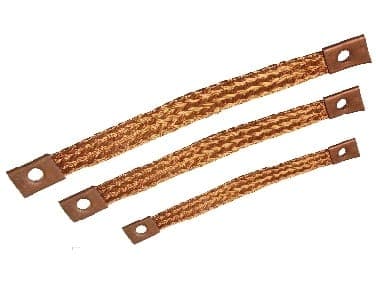
Tinned copper tape is a flat, solid conductor supplied in rolls for long runs. Braided tape is a flexible conductor for bonding panel doors and moving parts, and tinned copper busbar is a flat, rigid conductor in lengths for earth bars and rigid connections.
How do we install tinned copper tape on a wall, and how far apart should the clamps be?
Fix 25 × 3 and 30 × 3 tapes with the two-piece brass wall clamp, and 30 × 2 and 20 × 3 tapes with the two-piece stainless steel clamp for fixing tape to walls. Contact between tinned tape and a stainless steel clamp is common in normal atmospheric conditions; in highly corrosive environments, check compatibility with our specialists before installation. IEC 62305-3:2010 recommends a fixing spacing of 1000 mm on vertical routes up to 20 m high and on horizontal surfaces, and 500 mm on horizontal routes along walls and vertical routes above 20 m. For ESE air terminals, NF C 17-102 requires three fixings per metre. Do not drill the tape to install it.
What fault current can 25 × 3 tinned tape withstand?
EN 50522 takes 150 degrees Celsius as the final temperature of tinned copper under fault current. With this value and a starting temperature of 30 degrees, the factor k in the formula S = I√t / k from IEC 60364-5-54 is 138. So 25 × 3 tape (75 mm²) withstands a current of 10.35 kA (75 × 138) for one second. This figure is a standard calculation; the designer selects the final size based on the project's current and disconnection time.
How is the price of tinned copper tape determined?
The price depends on size, length and the current copper price, and tinned tape costs a little more than plain copper tape because of the tin coating. Send our specialists the size, length, application (connection to a galvanised structure, down conductor or bonding) and the clamps and accessories you need, and they will quote the current price with a list of accessories.
Have a Technical Question?
KALOT Group's technical experts are ready to answer your questions about lightning rods and earthing systems.