
Move your pointer over the image to zoom in
Complete Product Overview
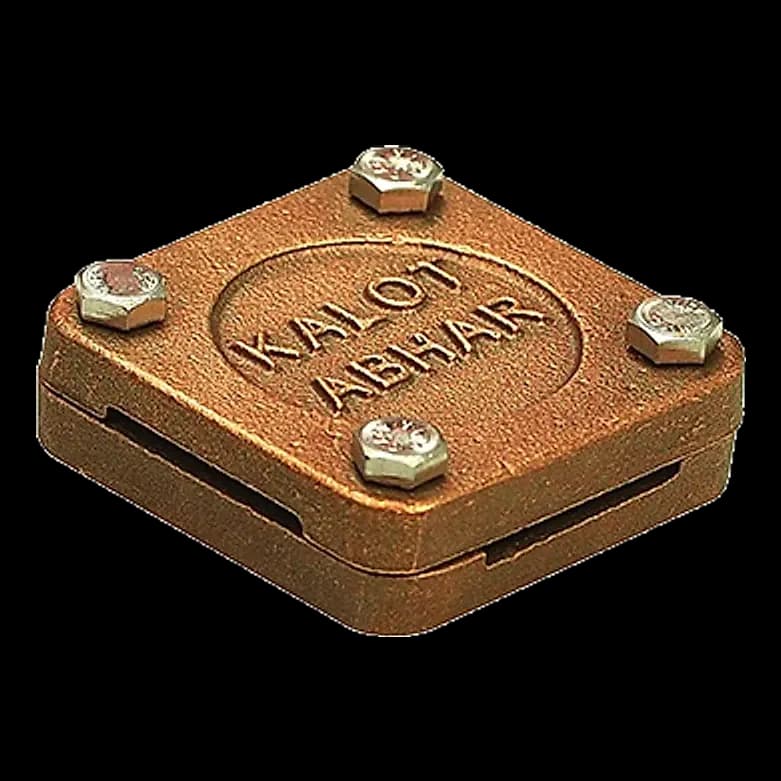
Two-way tape-to-tape clamp
Order Code: JCTC 255 · JCTC 510
Last updated:
KALOT's two-way tape-to-tape clamp (Junction Clamp) joins two copper tapes in line, wherever a down conductor, roof network or earthing tape route must continue or two of its sections must meet.
The clamp body is a brass sleeve with a through channel: the two tapes enter the channel from opposite ends, overlap inside it, and two stainless steel bolts press them firmly together. The result is a bolted, inspectable joint with no need for welding.
We manufacture this clamp in two models: JCTC 255 for tape up to 25×5 and JCTC 510 for tape up to 50×10 mm.
Continuing the tape route without welding
When installing lightning protection and earthing systems, tapes are delivered in limited lengths, and a long roof or down conductor route has to be continued several times. KALOT's two-way tape-to-tape clamp makes this joint on site, quickly and with reliable electrical continuity, and it is easy to check during periodic inspections.
End-to-end and overlapping joint
The two tapes overlap in the clamp's channel. A larger contact area means a more reliable electrical connection.
Two bolts, even pressure
Two stainless steel bolts spread the pressure along the joint and lock the tapes in place.
Two models for tapes up to 50×10
JCTC 255 for tape up to 25×5 and JCTC 510 for tape up to 50×10 mm, from common down conductor tapes to wide earth bars.
Brass sleeve and stainless steel bolts
The brass body is compatible with copper tape, and the stainless steel bolts keep the joint stable against corrosion outdoors.
An inspectable joint
It is a bolted joint, so bolt tightness, the condition of the tapes and route continuity can be checked during periodic inspection.
Technical Product Information
Feature | Value |
|---|---|
Product type | Two-way tape-to-tape clamp (Junction Clamp) |
Application | End-to-end or overlapping joint of two tapes in line |
Conductor | Copper tape (models by maximum tape size) |
Maximum tape size | JCTC 255: 25×5; JCTC 510: 50×10 mm |
Body material | Brass |
Bolts | 2 pieces, stainless steel, hex head |
Structure | Sleeve with a through channel; two bolts on one face press the tapes together inside the channel |
Dimensions | JCTC 255: 65 × 35 × 23 mm; JCTC 510: 90 × 63 × 26 mm |
Order code | JCTC 255 , JCTC 510 |
Our products are continually improved and some dimensions may be updated; please confirm the final dimensions with our specialists before you buy.
Order code | Maximum tape size (mm) | L (mm) | W (mm) | H (mm) |
|---|---|---|---|---|
JCTC 255 | 25×5 | 65 | 35 | 23 |
JCTC 510 | 50×10 | 90 | 63 | 26 |
Choose the model according to the largest tape on your route: JCTC 255 for 20×3, 25×3 and 25×5 tapes, and JCTC 510 for wider tapes up to 50×10. If you have a question about choosing a model, our specialists at KALOT Group will be glad to guide you.
Click to view enlarged
KALOT's dimensional drawing shows three views of the clamp: a top view with the two hex bolts, a side view and an end view with the through channel for the tape, together with a table of the two models. JCTC 255: L 65 · W 35 · H 23 mm; JCTC 510: L 90 · W 63 · H 26 mm. PDF and SVG files are in the "Documents and downloads" section of this page.
Click to view enlarged
Application
- Continuing the down conductor tape route on the building facade;
- Joining tape sections of roof networks and parapets;
- Joining earthing and bonding network tapes in accessible locations.
Installation sequence
- Choose the clamp model according to the largest tape on your route.
- Straighten the ends of the two tapes and clean their contact surfaces of paint, oxide, grease and dirt.
- Loosen the bolts so that the clamp's channel is fully open.
- Insert the two tapes into the channel from opposite ends so that they overlap inside the clamp.
- Tighten the two bolts gradually and evenly until both tapes are pressed firmly together.
- Hold the tape on the surface with a wall clamp on each side of the joint, and check the continuity of the route.
Choosing the right clamp for tape
- Continuing the tape route in line: this clamp, JCTC 255 / JCTC 510.
- Four-way or cross joint of tapes: Square four-way tape-to-tape clamp.
- Joining tape to round conductor: Four-way conductor-to-tape clamp.
- Bonding tape to a metal plate or structure: Tape-to-metal plate bonding clamp.
- Holding the tape on the wall: Two-piece brass clamp for fixing tape to walls or Two-piece stainless steel clamp for fixing tape to walls.
Technical notes
- Keep the number of joints on the route as low as possible, because each joint is an inspection point.
- The brass sleeve is compatible with copper tape. For aluminium or galvanised steel tapes, the system designer should decide on material compatibility.
- For connections buried in soil or concrete, the designer should decide the connection method; many designs make these connections by exothermic welding.
The following standards set out the requirements for joints on conductor routes in lightning protection systems:
IEC 62561-1 (connection components)
This standard sets the requirements and tests for the connection components of lightning protection systems, including conductor-to-conductor clamps.
IEC 62305-3 (system design and installation)
Joints on conductor routes must be electrically and mechanically reliable and kept as few as possible. Bolted joints are checked during periodic inspections.
NF C 17-102 (ESE air terminals)
In ESE systems too, down conductor joints must be firm, inspectable and stable against corrosion. Read the key points of the NFC 17-102 standard in this article.
T clamp for wire and two-way clamp for tape
Documents & Downloads
Catalogues & datasheets
Drawings & schematics
Frequently Asked Questions
What is the two-way tape-to-tape clamp used for?
This clamp joins two copper tapes in line, to continue a down conductor, roof network or earthing tape route with no need for welding.
Which model should I choose?
For tapes up to 25×5 mm (such as 20×3, 25×3 and 25×5), model JCTC 255, and for wider tapes up to 50×10 mm, model JCTC 510.
How do the tapes sit inside the clamp?
The two tapes enter the clamp's channel from opposite ends and overlap inside it, and two stainless steel bolts press them firmly together.
What are the clamp and bolts made of?
The clamp body is brass and its two bolts are stainless steel.
Is this clamp suitable for two tapes of different sizes?
Yes, as long as the larger tape does not exceed the model's maximum dimensions. For example, JCTC 510 also suits connecting a 25×3 tape to a 50×5 tape. Tighten the bolts evenly so that both tapes are held firmly.
How does this clamp differ from the square four-way tape-to-tape clamp?
This clamp joins tapes in line, while the square four-way clamp is for cross or T joints of tapes in roof and earthing networks.
Can this connection be inspected?
Yes. It is a bolted joint, so bolt tightness, corrosion and route continuity can be checked during periodic inspection.
Is this clamp suitable for buried connections?
This clamp is made for accessible connections on the structure. For connections buried in soil or concrete, the system designer decides the connection method, and many designs use exothermic welding.
Have a Technical Question?
KALOT Group's technical experts are ready to answer your questions about lightning rods and earthing systems.