Short answer: the main design standard for lightning protection, worldwide and in Iran, is IEC 62305. Its third edition was published in 2024 and has four parts: principles, risk assessment, protection of structures and protection of equipment. Alongside it, IEC 62561 sets the quality of components, IEC 61643 and IEC 60364 cover surge protective devices (SPDs) and electrical installations, and national standards such as NF C 17-102 (ESE air terminals), NFPA 780 (USA) and Iranian regulations apply on specific projects.
Many clients, and even designers, picture the "lightning protection standard" as one document. In practice each standard answers one question: does this building need protection? What system, with what dimensions? Which tests must each component pass? How do we keep the electrical equipment inside the building safe from the lightning surge? In this article we sort the references into five groups on that basis and give the valid edition of each in 2026. If you are interested in how these standards evolved, read the history of lightning protection standards.
How should lightning standards be classified?
The simplest way is to ask which project question each document answers. The table below shows the five main groups, and the rest of the article explains each group separately.
Group | The question it answers | Key standards |
|---|---|---|
1. System design | Is protection needed? At what level? Where do the air terminals, down conductors and earthing system go, and with what dimensions? | IEC 62305-1 to IEC 62305-4 |
2. Components | Which tests must clamps, conductors, air rods, earth electrodes, inspection pits and lightning counters pass? | IEC 62561-1 to IEC 62561-8 |
3. Overvoltage and SPDs | Where is an SPD needed, which type, and how should it be installed? | IEC 61643, IEC 60364-4-44, IEC 60364-5-53 |
4. National and regional | Which document governs in our country or contract? | EN and BS EN 62305, NF C 17-102, NFPA 780 and UL 96A, Iranian regulations |
5. Special applications | Solar power plants, wind turbines, oil tanks, electrical substations, telecommunications and storm warning | IEC 60364-7-712, IEC 61400-24, IEEE 998, TIA-607 and others |
1. IEC 62305: the main design standard for lightning protection
The IEC 62305 series comes from Technical Committee 81 of the International Electrotechnical Commission (IEC) and is the main reference for most building and industrial projects. The third edition of all four parts was published in 2024, and in 2026 it also became available as a single combined package (changes in the IEC 62305 package). The four parts work like four consecutive steps:
- IEC 62305-1:2024 General principles: defines lightning current parameters, types of damage and the four lightning protection levels (LPL I to IV). For example, at level I the highest current the system must withstand is 200 kA, and at levels III and IV it is 100 kA (lightning effects and types of damage).
- IEC 62305-2:2024 Risk assessment: uses the building's dimensions, the regional lightning density, the type of occupancy and the value of the equipment to work out whether protection is needed and which level is enough. This step is the right starting point for any design (our lightning risk assessment and calculation service).
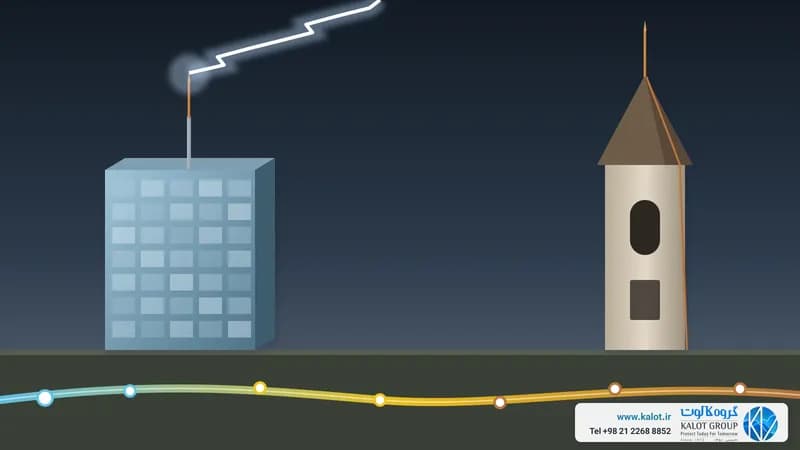
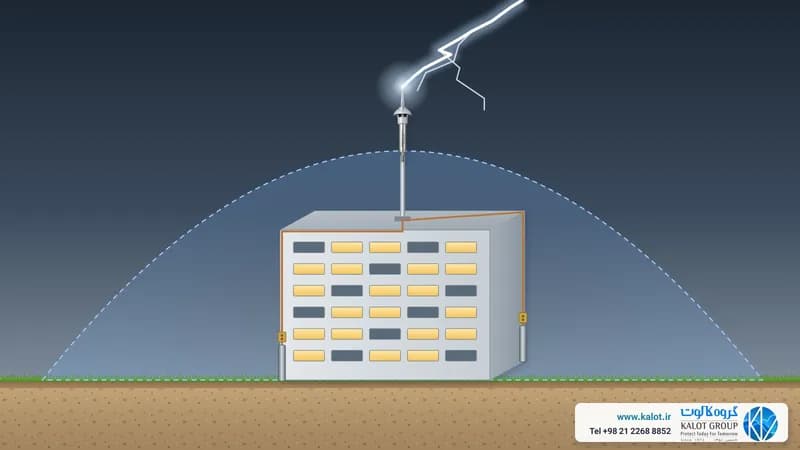
- IEC 62305-3:2024 Protection of structures and people: sets out the design of the external system (air terminals, down conductors and earthing system) using three methods, rolling sphere, protection angle and mesh, and the internal system (bonding and safe separation distance) (the lightning protection system and its components).
- IEC 62305-4:2024 Protection of electrical and electronic systems: describes lightning protection zones (LPZ), shielding, cable routing and coordinated SPDs (LPZ lightning protection zones).
The table below shows how the protection level relates to the design dimensions. The figures come from the tables of IEC 62305-1 and IEC 62305-3 and are the ones designers use on their drawings.
System class (LPS) | Maximum lightning current | Rolling sphere radius | Mesh cell size |
|---|---|---|---|
I | 200 kA | 20 m | 5 × 5 m |
II | 150 kA | 30 m | 10 × 10 m |
III | 100 kA | 45 m | 15 × 15 m |
IV | 100 kA | 60 m | 20 × 20 m |
In Europe these same four parts have been adopted as EN IEC 62305, and in the UK and Germany they are published as BS EN IEC 62305 and DIN EN IEC 62305 (VDE 0185-305). The previous European versions (EN 62305 from 2011 and 2012) remain valid until 31 October 2027 and are withdrawn after that, so for new projects it is best to work to the 2024 edition from now on.
2. IEC 62561: the standard for lightning protection and earthing components
IEC 62305 says what the system should look like. The IEC 62561 series says which tests each component must pass to withstand lightning current, corrosion and the passage of time. In Europe this series has replaced EN 50164. When buying, ask the seller for the component's test report to the relevant part. The table below shows its eight parts alongside components of the same type that we offer.
Part and edition | Topic | Components in this group at KALOT |
|---|---|---|
Connection components: clamps, couplings and welded joints | Lightning protection clamps and fittings, earthing clamps, KALweld® exothermic welding | |
Conductors, air rods and earth electrodes | Earth conductors and tapes, conventional air rods, copper-bonded earth rods | |
Isolating spark gap (ISG) for indirect bonding | In bonding design (bonding and equipotentialisation) | |
Conductor supports and wall clamps | BPH 76 down conductor stand-off base, wall clamp for conductors | |
Inspection pits and earth electrode seals | ||
Lightning counters | ||
Ground improvement materials | Ground improvement materials (standard for ground improvement materials) | |
Isolated lightning protection system components (insulated down conductors) | In isolated system design (design and consulting) |
In 2026 Part 8 moved from a technical specification (TS) to a full standard. Test joints on the down conductor also belong to the connection components group; one example is the brass down conductor disconnector.
3. Overvoltage and surge protective device (SPD) standards
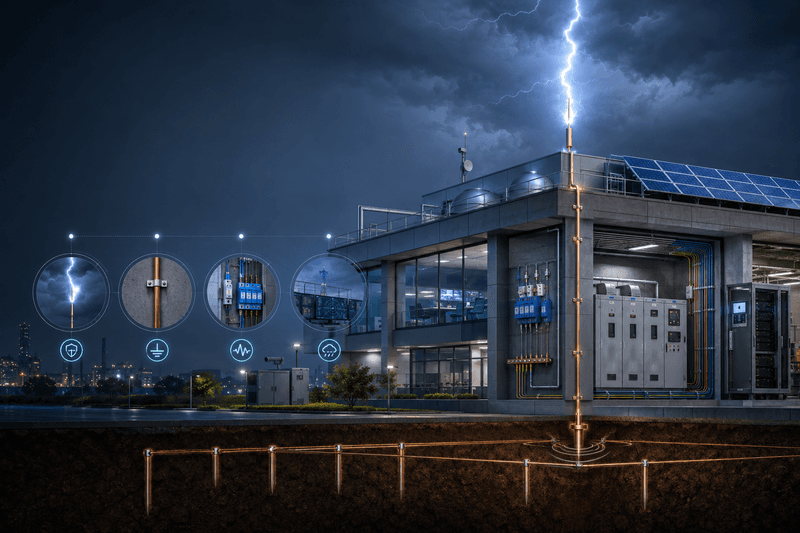
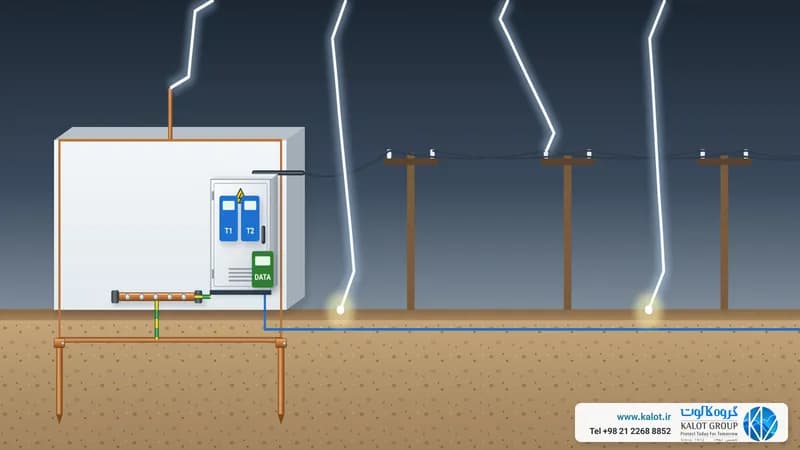
In today's buildings most lightning damage falls on electrical and electronic equipment, not on the structure itself. That is why two more families matter alongside IEC 62305-4: the IEC 61643 series for the construction and selection of SPDs, and the IEC 60364 series for where they go in the electrical installation (secondary lightning protection and SPDs).
Standard | The subject in plain words |
|---|---|
Testing and specifications of low-voltage AC power SPDs (Types 1, 2 and 3). Its 2011 edition was withdrawn in June 2025. | |
Guide to selecting and coordinating power SPDs | |
SPDs for telecommunication, data and signal lines: testing and selection | |
SPDs for the DC side of solar systems: testing and selection | |
Clause 443: when overvoltage protection is required | |
Clause 534: SPD selection and installation, connecting lead lengths and backup fuse | |
Earthing system and cross-section of protective conductors |
The SPDs we offer are listed in the SPD category: power SPDs, data line SPDs, photovoltaic SPDs and fire alarm SPDs. For the difference between Types 1, 2 and 3, see our article on types of SPD.
4. National and regional standards
Most countries have adopted IEC 62305 under their own national name, but a few national documents follow a separate path and appear often in contracts:
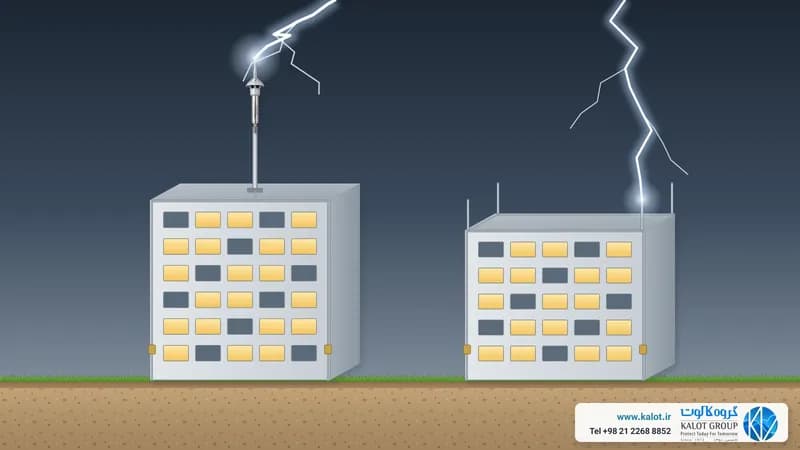
- France, NF C 17-102:2011: the standard for early streamer emission (ESE) air terminals, which calculates the protection radius from the lead time (ΔT). The 2011 edition is still the valid one, and the old NF C 17-100 has been withdrawn. The full details are in our NF C 17-102 guide and 25 points for applying this standard. Spain has a similar document, UNE 21186:2011.
- USA, NFPA 780: the standard for the installation of lightning protection systems, currently in its 2026 edition. Alongside it, UL 96 (2025 edition) sets component testing and UL 96A (2023 edition) sets installation requirements.
- Europe: EN IEC 62305 is the same as the 2024 edition of IEC 62305, and it has replaced the old national standards in CENELEC member countries.
- Iran: the Safety Code for Earthing Systems (approved in 1401 by the Supreme Council for Technical Protection) is mandatory for workplaces covered by the Labour Law. It recognises four lightning protection system classes in line with IEC 62305 (Article 2, clause 43), requires a lightning protection system for silos (Article 341) and requires a risk assessment to the national standard INSO-IEC 62305-2 for tall temporary structures (Article 372). On building projects, Part Thirteen of the National Building Regulations and the contract documents also apply. So the answer to "which is the national lightning protection standard?" is effectively the IEC 62305 family; the 1401 code makes its second part the benchmark under the name of the national standard INSO-IEC 62305-2.
For the choice between ESE and conventional (Franklin) air terminals, and which standard each is designed to, read our article on the difference between ESE and passive air terminals. The ESE air terminals we offer, such as the Franklin France ACTIVE 1D+, are in the ESE air terminals category, and the conventional ones are in the air terminals category.
5. Standards for specific industries and applications
Some projects have a dedicated document in addition to IEC 62305. The most important are:
- Solar power plants and systems: IEC 60364-7-712:2025 for photovoltaic electrical installations, the technical report IEC TR 63227:2020 for their lightning and surge protection, and IEC 61643-31 and -32 for DC SPDs (lightning protection for solar power plants).
- Wind turbines: IEC 61400-24:2019+AMD1:2024 for the blades, nacelle and tower.
- Oil and flammable material tanks: NFPA 780 has a chapter dedicated to tanks, and API RP 545 (2009) has long been the reference for floating roof tanks. The floating roof is bonded to the shell with an ARG® device.
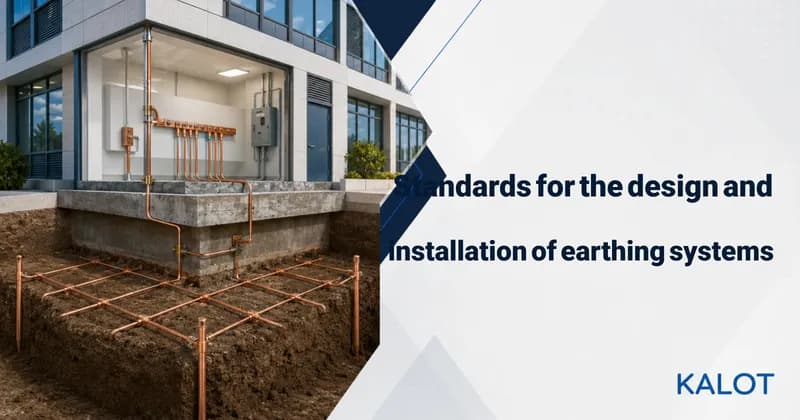
- Electrical substations: IEEE 998-2012 for lightning shielding in substations and IEEE 80-2013 for the substation earthing grid. Both now have "inactive, reserved" status at IEEE but remain common engineering references; for earthing systems, see our article on standards for earthing system design and installation.
- Telecommunications and data centres: ANSI/TIA-607-E for telecommunications bonding and earthing, and TIA-942-C for data centre infrastructure. Lightning protection of the building and equipment is still designed to IEC 62305-3 and -4 (earthing, bonding and EMC).
- Military installations: MIL-STD-188-124B for earthing, bonding and shielding, and MIL-STD-464D for electromagnetic effects, including lightning.
- Storm warning and lightning density: IEC 62793:2020 for storm warning systems in open-air locations and IEC 62858:2019 for calculating lightning density from detection network data (lightning incidence in Iran).
Which standard for which project?
Project type | Main reference | Supplementary references |
|---|---|---|
Residential, office and commercial buildings | IEC 62305-2 and -3, NF C 17-102:2011 | IEC 62305-4, IEC 61643-11, IEC 62561 |
Factories and warehouses | IEC 62305-2 to -4, NF C 17-102:2011 | Safety Code for Earthing Systems 1401, IEC 60364-4-44 |
Hospitals and healthcare centres | IEC 62305-2 to -4, NF C 17-102:2011 | IEC 60364-7-710 for the electrical installations of medical rooms, coordinated SPDs |
Solar power plants | IEC 62305-3 and IEC TR 63227, NF C 17-102:2011 | IEC 60364-7-712, IEC 61643-31 and -32 |
Wind turbines | IEC 61400-24 | IEC 62305-4, IEC 62561 |
Refineries and oil tanks | IEC 62305 or NFPA 780 as per the contract, NF C 17-102:2011 | API RP 545, client requirements |
Electrical substations | IEEE 998 or IEC 62305-3 | IEEE 80, IEC 61936-1 |
Telecommunications and data centres | IEC 62305-3 and -4, NF C 17-102:2011 | ANSI/TIA-607-E, TIA-942-C, IEC 61643-21 |
The table above is a starting guide; the final reference for each project is set by the contract, the client and local regulations.
How do we check the valid edition?
One of the most common faults in drawings and technical specifications is citing an old edition or a document that is no longer active. A few important examples in 2026:
Document | Status in October 2026 |
|---|---|
IEC 62305, 2010 edition | Replaced by the 2024 edition |
EN 62305, 2011 and 2012 editions | Valid until 31 October 2027, then withdrawn |
IEC 61643-11, 2011 edition | Replaced by the 2025 edition in June 2025 |
IEC TS 62561-8:2018 | Replaced by the full standard IEC 62561-8:2026 |
NF C 17-100 | Withdrawn; in France, NF EN IEC 62305 is used for conventional systems and NF C 17-102:2011 for ESE air terminals |
IEEE 80, IEEE 142 and IEEE 998 | "Inactive, reserved" at IEEE; a revision of IEEE 80 is under way |
API RP 545 (2009) | Listed among API's historical publications |
Three simple recommendations: always write the full number and edition year (for example IEC 62305-3:2024), check the publisher's official page before starting a design, and do not use a component standard (such as IEC 62561-2) in place of a design standard (IEC 62305-3).
Where can you get the text of IEC 62305?
The official version of each standard is sold by its publisher: for IEC 62305, the IEC online store (links above), and for the national version, the Iranian National Standards Organisation. Free copies circulated as "IEC 62305 standard download" are usually old editions or incomplete; for design and supervision, rely on the official, up-to-date version. In our technical information articles we explain the practical points of these standards in plain language.
How can we help?
At KALOT Group we stand beside you from risk assessment to project handover: lightning risk assessment to IEC 62305-2, lightning protection system design, overvoltage protection design and SPD selection, installation and execution and periodic inspection. If you are not sure which standard your project falls under, contact our specialists.