
The IEC 62305:2026 package is out: what has changed in lightning protection?
The International Electrotechnical Commission has published the IEC 62305:2026 package to give unified access to its set of lightning protection standards. The set covers the four main parts of IEC 62305 and deals with topics such as risk assessment, external protection system design, protection of electrical and electronic equipment, thunderstorm warning and the continuity of service in installations.
An important point: the title "IEC 62305:2026" does not mean a completely new technical edition was released in 2026. This product is in fact a commercial, unified package that offers the four technical parts revised in 2024 side by side. The official IEC page gives the publication date of the package as 10 July 2026. The main technical changes therefore belong to the 2024 editions, but since 2026 all the parts can be obtained as one set. Official details of the IEC 62305:2026 package
What does the IEC 62305:2026 package include?
The package consists of four complementary parts. None of them covers all the needs of a project on its own, and a sound design has to take the links between them into account.
IEC 62305-1: general principles of lightning protection
The first part sets out the general principles for protecting buildings, installations, people and internal systems. In the third edition of this part, the link with the IEC 62561 family of standards for lightning protection system components has been strengthened.
One of the key changes is greater attention to disruption of service availability and system operation. The lightning surge current parameters used to select overvoltage protection equipment in low voltage and telecommunication networks are also stated more precisely.
This change matters especially for data centres, telecommunication networks, hospitals, continuous process industries, transport infrastructure and any installation where even a short stoppage causes considerable loss. Details of IEC 62305-1:2024
IEC 62305-2: risk assessment and management
The second part is devoted to calculating and managing lightning risk. In the new edition, the risk assessment method is simpler and, in some sections, more practical.
Key changes include the use of the ground strike-point density, or NSG, attention to the frequency of damage, assessment of the direct strike hazard for people outdoors and the option of using temporary preventive measures.
A thunderstorm warning system, or TWS, can form part of the preventive measures if it complies with IEC 62793. A timely warning can, for example, lead to work at height being stopped, an open area being cleared or high-risk activities being temporarily halted. Even so, a warning system does not replace air terminals, bonding, earthing or overvoltage protection equipment. Details of IEC 62305-2:2024
IEC 62305-3: physical protection of buildings and people
The third part deals with the design of the external protection system, including air terminals, down conductors, the earthing system, separation distance and bonding.
In the new edition, the methods for calculating separation distance are clearer, and the requirements on reinforcement continuity, air terminal placement, facades with protruding elements, green roofs and tall buildings have been expanded.
The thickness of sheets and pipes that may be exposed to thermal effects or hot spots is also examined more closely. These points directly affect design in projects with metal facades, roof equipment, solar panels or mechanical installations on the roof. Details of IEC 62305-3:2024
IEC 62305-4: protection of electrical and electronic systems
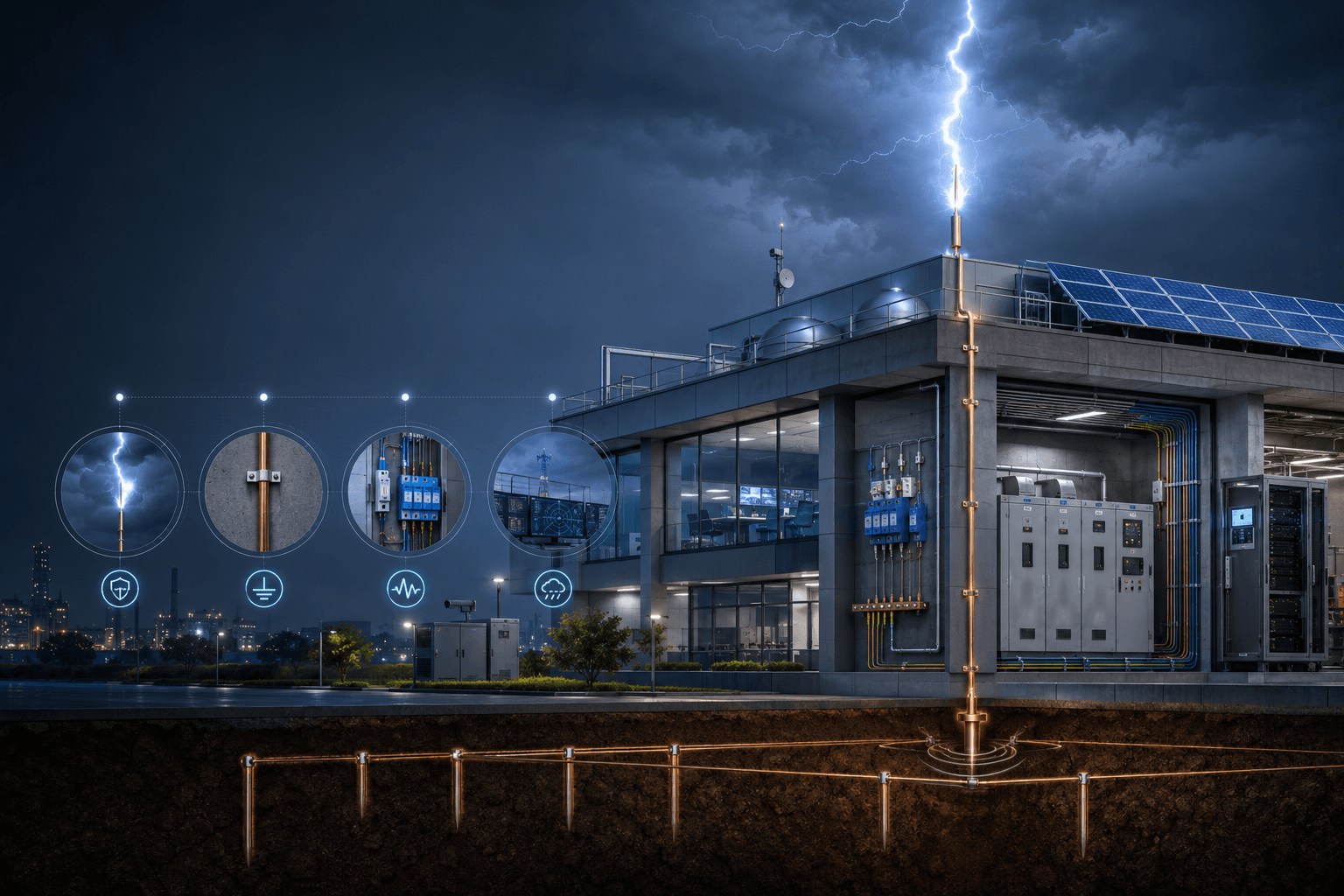
The fourth part covers the protection of equipment inside the building against the electromagnetic effects of lightning. It addresses topics such as lightning protection zones, current paths, bonding, shielding, cabling, and the selection and coordination of SPDs.
The new edition adds annexes on examining current sharing through modelling, photovoltaic systems, system-level performance testing and induced voltages in installations protected by SPDs.
These changes show that installing one SPD at the building entrance does not guarantee complete protection on its own. The SPD type, installation location, protection level, connection lengths, coordination between stages and cable routing must all be reviewed as one integrated system. Details of IEC 62305-4:2024
What industry experts say about the IEC 62305 changes
Matt Waldram, chair of the ATLAS lightning protection committee, sees the new edition as the result of more than a decade of review and international cooperation. His main takeaway is that people in the industry must align their working methods with the new knowledge and requirements, and must not treat the change to the standard as a mere administrative update.
ATLAS also stresses that how and when the new edition becomes mandatory depends on national regulations, the project contract and the transition period in each country. The transition period announced in the UK, for instance, cannot be applied directly to Iran or other countries without checking the regulations. ATLAS analysis of the IEC 62305 revision
Krzysztof Wincencik, a specialist in lightning and overvoltage protection, considers the greater attention to "frequency of damage" one of the meaningful changes in this set. According to his analysis, design is no longer limited to the probability of loss of life or property: service continuity and equipment availability have also gained importance.
This view matters for solar power plants, electric vehicle charging stations, telecommunication networks and industrial control systems, because a lightning event may interrupt service or cause data loss without any widespread physical damage. Wincencik also explains that the main lightning current parameters have not been transformed, and that the bigger change lies in how they are assessed and used. Wincencik's technical analysis
Stefan Schmidt, a specialist in lightning detection systems and a contributor to the IEC 62793, IEC 62858 and IEC 62305 standards, has examined the role of early warning in reducing people's exposure. A study he presented on 100 wind farms in 11 Western European countries showed that combining a thunderstorm warning system with physical protection can reduce the risk to people.
This result should not be read as a guaranteed percentage for every project. The effectiveness of TWS depends on data quality, geographical location, reaction time, operating procedures and the type of activity. WindEurope study on TWS and lightning risk
Why do these changes matter?
Today's buildings and installations rely more heavily on electronic equipment, communication networks, industrial controllers, photovoltaic systems and data storage. In such projects, lightning damage is not limited to a burnt cable or physical harm to the building.
A transient overvoltage can stop a production line, cause data loss, disturb protective equipment, damage a solar inverter or take a critical system out of service. Lightning protection design must therefore connect external protection, the earthing system, bonding, overvoltage protection and continuity of service.
The new IEC 62305 set reinforces this integrated view and asks designers not to settle for installing an air terminal or lowering earth resistance.
Which projects should be reviewed sooner?
A review against the 2024 editions is especially important for the following projects:
- data centres, telecommunications and control rooms;
- power plants and photovoltaic systems;
- hospitals and critical infrastructure;
- industries with continuous production processes;
- tall buildings or those with complex metal facades;
- green roofs and roofs carrying a lot of equipment;
- flammable material stores or environments with an explosion hazard;
- sites where staff work outdoors or at height;
- installations where a service outage has serious financial or safety consequences.
Recommended actions for clients and designers
In new projects, the version of the standard written into the technical specifications and the contract must be made clear. A general phrase such as "in accordance with IEC 62305" is not enough: the edition year of each part should also be recorded.
For projects designed to the 2010 edition, we recommend a gap analysis between the existing design and the 2024 edition. This review does not necessarily mean a full redesign, but it may lead to changes in risk calculation, air terminal placement, separation distance, solar system protection, SPD coordination or warning procedures.
Lightning density data should come from reliable sources that suit the project location. The components of the external protection system should also match the relevant requirements of the IEC 62561 family and the project's execution specifications.
Calculation results, the conductor route drawing, bonding points, SPD specifications, test reports, inspection records and any changes made on site should also be kept in the project's technical file.
Are existing installations no longer valid?
No. The release of the IEC 62305:2026 package does not in itself mean that every installation designed to the previous version has suddenly become invalid or unsafe.
Whether a given edition of a standard must be used depends on national law, contract terms, client specifications, insurance requirements and the opinion of the competent authority. In Iran, the latest corresponding national standards, project regulations and the requirements of the supervising body must also be checked.
Even so, if a building is extended, its use changes, a solar system, sensitive equipment or a server room is added, or a lightning-related failure occurs, reviewing the design against the new edition is a sensible, preventive step.
Conclusion
The IEC 62305:2026 package is not a stand-alone technical edition but a unified set of the four parts revised in 2024. Its main value lies in coordinated access to the requirements for risk management, physical protection, electronic equipment protection and the continuity of service in installations.
The message of this revision is clear: effective lightning protection comes from combining air terminals, down conductors, the earthing system, bonding, SPDs, cabling design, risk assessment and an inspection programme. No single component can replace a coordinated, documented design.