Short answer: contrary to common belief, lightning does not cause damage only when it hits a building directly. The international standard IEC 62305 separates four sources of damage: a direct strike to the structure, a strike near the structure, a strike to an incoming power or telecom line and a strike near those lines. A direct strike can cause fire, structural damage and electric shock, while the indirect effects, namely lightning's magnetic field and earth potential rise, create overvoltage even from a distance, and that overvoltage damages electrical and electronic equipment.
In this guide, we at KALOT Group explain the ways lightning harms buildings, people and equipment, and the protection available for each. If you want to know what lightning itself is and what types there are, read our article What is lightning and what types are there.
How does lightning cause damage? Four sources of damage under IEC 62305
The IEC 62305-1 standard groups the sources of damage into four categories according to where the lightning strikes:
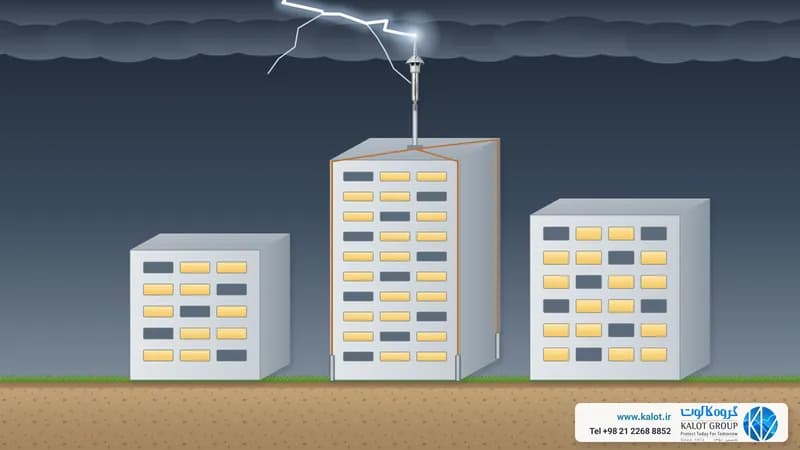
- S1 (direct strike to the structure): lightning hits the building itself, its roof or the equipment on it.
- S2 (strike near the structure): lightning hits the ground or an object close to the building.
- S3 (direct strike to an incoming line): lightning hits a power line, telecom line or pipe entering the building.
- S4 (strike near an incoming line): lightning hits the ground close to these lines.
The same standard also names three types of damage: injury to people from touch and step voltage, physical damage such as fire, explosion and mechanical destruction, and failure of electrical and electronic systems from overvoltage. The key point is that the third type, equipment failure, can come from any of the four sources, whether lightning hits the building directly, lands near it or strikes the incoming lines.
Direct effects of lightning
Direct strike to a building or structure (S1)
Lightning current is very large. According to IEC 62305-1, a protection system at the highest level (LPL I) is designed for lightning currents up to 200 kA, and the lowest levels (III and IV) for 100 kA. If a building has no protection system, this current finds its way to earth by whatever path it can, such as reinforcing bars, pipes or wiring, with these consequences:
- fire and mechanical damage to the roof, chimney and façade;
- sparks between metal parts that are not connected to each other, which pose an explosion risk in flammable environments;
- dangerous touch and step voltage for people close to the point of strike or the conductors;
- severe overvoltage in the electrical installation and the equipment inside the building.
Strikes to equipment on the roof and outside the building
Antennas, cameras, solar panels, ventilation units and any other equipment installed on the roof or outside the building may take a direct strike if they sit outside the air terminal's protection area, and may carry lightning current into the building through their cables. This equipment should be placed within the protection area of the air termination system, with its metal body bonded.
Strikes to power transmission lines and a building's incoming lines (S3)
Lightning that hits a high-voltage line creates a voltage far above what the insulators can withstand. A flashover jumps across the insulator, the network protection trips the line, and power may be lost over a wide area. When lightning hits a low-voltage or telecom line connected to a building, part of the lightning current enters the building through that line, with a fire risk at the point of entry and a risk of failure in connected equipment. That is why a Type 1 SPD, tested to carry lightning current, is installed at the power intake of buildings with an overhead line or an air terminal.
Indirect effects of lightning
Lightning does not have to hit the building itself to harm equipment: under IEC 62305-1, failure of electrical and electronic systems can come from any of the four sources of damage. The main mechanisms of indirect effects are:
Magnetic induction from a nearby strike (S2)
Lightning current peaks within a few microseconds and builds a very strong, fast magnetic field around itself. Wherever power and data cables together form a "loop", for example a power cable and a network cable that both reach the same rack or computer, this field induces voltage in the loop. The larger the loop, the higher the induced voltage. This is why IEC 62305-4 lists cable routing with the smallest loop area, shielding and bonding among its protective measures.
Strikes near incoming lines (S4)
Long power and telecom lines act like huge antennas. Lightning that hits the ground near these lines induces overvoltage on them, and that overvoltage travels along the line to the panel and the equipment inside the building.
Earth potential rise
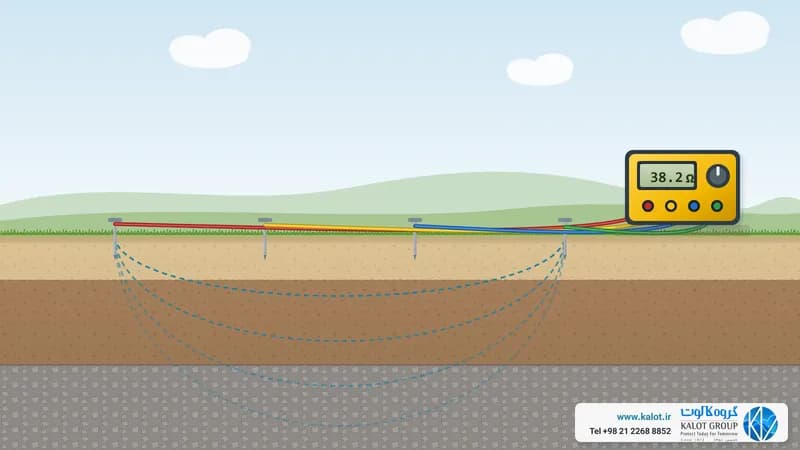
When lightning current reaches the earth, the voltage of the soil around the point of strike climbs very high for a moment, and falls with distance. If two parts of an installation connect to two separate earth points, for example the building to its own earthing and a telecom cable to a distant earth, a voltage difference appears between them and reaches the equipment through the cables. The solution is to unify the earthing system and apply bonding and equipotential bonding to all metal parts.
Switching overvoltage
Switching large loads, motors and capacitors on and off in the power network also creates transient overvoltages that affect equipment much as lightning does, though with less energy. SPDs in panels and close to equipment protect against these overvoltages too.
Ways to protect against the effects of lightning
No single component protects against all the effects of lightning on its own. Complete protection is built from several layers, each one blocking one of the paths of damage:
1. Risk assessment
The first step is to know what level of protection a building needs. IEC 62305-2 gives the method for calculating lightning risk based on the building's location, dimensions, use, incoming lines and equipment. Lightning risk assessment and calculation is one of the services we provide.
2. External protection: air terminal, down conductor and earthing system
An external protection system to IEC 62305-3 captures the current of a direct strike and carries it to earth along a controlled path outside the building. It has three main parts:
- Air termination system: air rods and roof conductors. We offer conventional air rods, air rod bases and ESE air terminals in models ACTIVE 1D+, ACTIVE 2D and ACTIVE 4D, together with a telescopic mast. We explain the difference between these two methods in choosing the best air terminal.
- Down conductors: these bring the current from the roof to the ground along the façade. They are fixed to the façade with lightning protection clamps and fittings and have a disconnector (test joint) at the bottom so the earthing system can be measured. For the conductors we supply copper tape, bare copper conductor, stainless steel tape and galvanised round wire.
- Earthing system: the ring and earth rods that spread the current through the soil. In new buildings, foundation earthing is its best basis. Our earthing equipment covers everything from earth rods and clamps to ground improvement materials.
We cover the components of this system in more detail in The lightning protection system and its components.
3. Equipotential bonding
All the metal parts of the building, its pipes, metal structure, cable shields and the earthing system connect at the building entrance to one bonding bar, such as an earth bar with disconnect link, so that no dangerous voltage difference or sparking arises between them during a strike.
4. Internal protection: LPZ zones and SPDs
IEC 62305-4 divides a building into lightning protection zones (LPZ) and brings the overvoltage down one step at each boundary:
- LPZ 0A: outside the air terminal's protection area, exposed to direct strikes and the full lightning field.
- LPZ 0B: within the air terminal's protection area and safe from direct strikes, but still exposed to the full lightning field.
- LPZ 1: inside the building. Incoming currents are limited by SPDs at the boundary, and the walls and reinforcing bars reduce the field somewhat.
- LPZ 2 and above: rooms or panels with extra protection for sensitive equipment.
In practice this means three stages of SPD: Type 1 at the main power intake (the LPZ 0 to 1 boundary), which withstands lightning current, Type 2 in the distribution boards and Type 3 close to sensitive equipment. We offer Type 1, 2 and 3 power SPDs, including the Class 1 three-phase TNS SPD, the combined Class 1+2+3 three-phase TNS SPD and the socket-type SPD, along with the data SPD with RJ45 connector, data and telecom line SPDs and solar system SPDs. We explain how to select and coordinate these devices in types of SPD and their role, and the concept of zones in stepped overvoltage reduction with the LPZ method.
5. Periodic inspection and maintenance
Over time, connections may loosen, conductors may be damaged, or SPDs may fail after discharging severe overvoltages. The protection system should be inspected and tested on a schedule. A lightning strike counter records the number of discharges, and a remote tester checks the condition of the ESE air terminal. Periodic inspection and maintenance of earthing and air terminals is one of the services we provide on site.
Reference standards
- IEC 62305-1:2024, general principles of lightning protection (sources of damage, types of damage and protection levels);
- IEC 62305-2:2024, risk management;
- IEC 62305-3:2024, physical damage to structures and danger to people;
- IEC 62305-4:2024, electrical and electronic systems within structures.
We set out the changes in the 2024 edition of this series in The IEC 62305:2026 package and its changes. For projects inside Iran, Topic 13 of the National Building Regulations and local rules also apply.
Conclusion
Lightning causes damage in four ways: strikes to the building, near it, to the incoming lines and near those lines. Direct strikes bring more physical damage and danger to life, while indirect effects mostly damage electrical and electronic equipment. Complete protection combines the air terminal and down conductor, a suitable earthing system, bonding and coordinated SPDs at the LPZ boundaries. To see how large these losses are in practice, read Losses caused by lightning.
If you want to know which lightning effect your building or facility is vulnerable to, our specialists at KALOT Group assess the risk, design the lightning protection system and SPD overvoltage protection, and supply and install the equipment you need. For advice or a quotation, please contact us.