Short answer: lightning protection standards took shape in three stages. From 1750 to the end of the nineteenth century, scientists such as Franklin and the academies of sciences wrote the first instructions. In the twentieth century each country had its own code, such as NFPA in the USA, BS in the UK and VDE in Germany. From 1980 the International Electrotechnical Commission (IEC) began work on a global standard, which led to IEC 62305 in 2006; the edition in force today is the third, from 2024. IEC 62561 covers the system components, and the French standard NF C 17-102:2011 applies to ESE air terminals.
Methods of protecting against lightning, and the theories behind them, have long been debated by scientists and specialists. This research led to specialist societies and organisations, whose work produced national and international guidelines and standards. In this article, we at KALOT Group follow that path year by year, with a source for each event. If you only want the list of today's standards, see our article Lightning protection standards.
Before standards: from Franklin's air rod to the rules of the nineteenth century
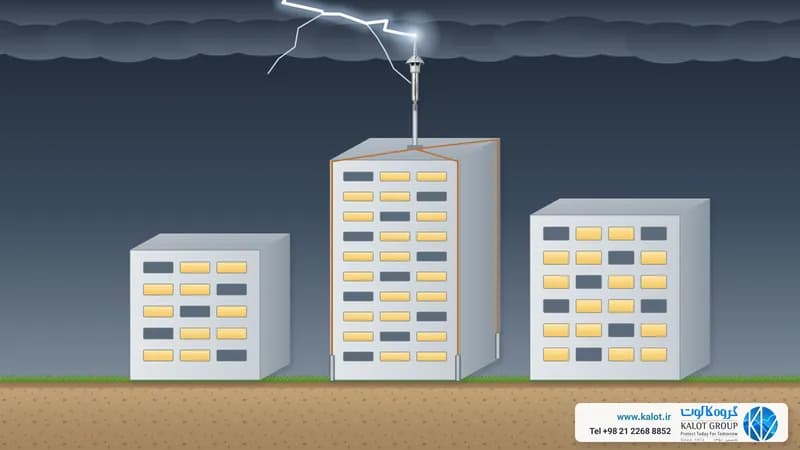
In letters of 1749 and 1750, and in a text titled "Opinions and Conjectures", Benjamin Franklin proposed fitting a pointed metal air rod on the highest point of a building and running a wire from it down to the earth. In May 1752 his experiment succeeded at Marly-la-Ville in France, and in the autumn of that year the first earthed air rods were installed on buildings in Philadelphia (Physics Today). In 1754 Prokop Diviš, a priest in Bohemia, built his own earthed device.
The scientific debate started early. In 1772 the Royal Society recommended a pointed air rod to protect the Purfleet powder magazine, but one member argued for a blunt one. After lightning struck the same building in 1777, a second committee again chose the pointed type. This was the first "standards dispute" in the history of lightning protection.
In the nineteenth century, guidance became official. In 1823 the French Academy of Sciences adopted the "Instructions on Lightning Conductors" with a report by Gay-Lussac, and added supplements in 1854 and 1867. In Britain the Lightning Rod Conference worked from 1878, and its 1882 report included a "code of rules" for installation. In 1892 Oliver Lodge, in his book "Lightning Conductors and Lightning Guards", showed that lightning does not always take the path of least resistance and that alternative paths must be considered too.
The twentieth century: national codes
As buildings were wired for electricity, lightning protection rules became national safety codes:
- USA: in 1904 the National Fire Protection Association (NFPA) published the first specifications for protecting buildings against lightning, the origin of NFPA 78, which was renumbered NFPA 780 in 1992 (GAO). In 1929 the US National Bureau of Standards (NBS) also published the "Code for Protection Against Lightning", approved by the American Standards Association.
- Germany: from 1924 to 1968 the ABB lightning protection committee published eight editions of the book Blitzschutz, and in 1982 standard VDE 0185 Parts 1 and 2 took its place (VDE chronology). VDE celebrated the ABB's hundredth anniversary in 1985.
- UK: BS CP 326 was published in 1965 and gave way to BS 6651 in 1985.
- Australia: the 1969 standard AS MC1 was renumbered AS 1768 in 1975.
These codes were similar in principle but differed in details such as the spacing of down conductors, conductor dimensions and earth resistance. Those differences made the need for a global standard all the clearer.
From 1980 to today: the birth of the global IEC standard
In 1980 the International Electrotechnical Commission set up technical committee TC 81 for lightning protection. Its first result was IEC 61024-1 in 1990, which gave the principles for protecting structures up to 60 m high. In 1995 IEC 61312-1 for lightning electromagnetic impulse (LEMP) and IEC 61662 for risk assessment were added.
In January 2006 all these documents came together in a single four-part family: IEC 62305. Europe adopted it at the same time as EN 62305, and in 2008 the UK set BS 6651 aside. The second edition came in December 2010 and the third edition was published on 12 September 2024:
- IEC 62305-1: general principles;
- IEC 62305-2: risk assessment;
- IEC 62305-3: physical damage to structures and life hazard;
- IEC 62305-4: electrical and electronic systems within structures.
We explain the changes in the 2024 edition in our article IEC 62305 update.
The design standard did not give precise component specifications. So in 2012 the IEC 62561 family for lightning protection system components was launched, replacing EN 50164 in Europe. Its parts received second editions in 2017 and 2018 and third editions from 2023 to 2025; IEC 62561-8 for isolated system components also moved from a technical report to a full standard in June 2026.
ESE air terminals and the NF C 17-102 standard
France also took a path of its own. Under an order effective from 1987, installing radioactive air terminals was banned in France (INRS). That same year NF C 17-100 was published for conventional air terminals, followed in 1995 by NF C 17-102 for ESE air terminals with an advance time. Its 2011 edition remains in force, and Spain has UNE 21186:2011 for the same technology.
In the USA, the draft NFPA 781 for ESE was sent back to committee in 1993 and rejected in 1995, after a NIST review. Today ESE air terminals are designed to NF C 17-102, and conventional (Franklin) air rods to IEC 62305-3 using the rolling sphere, protection angle and mesh methods. We cover the difference between the two in The difference between ESE and passive air terminals and the main points of NF C 17-102 in Key points of the NF C 17-102 standard.
Lightning protection standards in Iran
In our country, the national standard "Protection of structures against lightning", number 1-6213, has been published and in use since 1380 (Persian calendar). It was prepared on the basis of NF C and IEC standards. The National Building Regulations also refer to this standard where they require lightning protection for certain building groups.
The Safety Code for Earthing Systems, approved by the Supreme Council for Technical Protection on 23 Aban 1401 (Persian calendar), defines the "lightning protection system" and accepts the four protection classes I to IV in line with IEC 62305. Its Article 341 requires a lightning protection system on all silos, and Article 372 leaves the decision on protecting tall temporary structures to a risk assessment under the national standard INSO-IEC 62305-2.
Year-by-year table of lightning standards
This table lists the main events in date order, with their sources:
years | Event and source | Country or body |
|---|---|---|
1750 | In "Opinions and Conjectures", Franklin proposes a pointed air rod connected to the earth (source) | USA |
1752 | The Marly-la-Ville experiment in France and the first earthed air rods installed in Philadelphia (source) | France and USA |
1754 | Prokop Diviš builds his earthed "weather machine" in Bohemia | Bohemia (Czechia) |
1772 and 1777 | Royal Society committees on the Purfleet powder magazine: the dispute over pointed and blunt air rods (source) | UK |
1823 | "Instructions on Lightning Conductors" from the French Academy of Sciences, with a report by Gay-Lussac | France |
1882 | Report of the London Lightning Rod Conference, with a "code of rules" (source) | UK |
1904 | First NFPA specifications for protecting buildings against lightning (the origin of NFPA 78 and NFPA 780) (source) | USA |
1924 | First edition of the book Blitzschutz from the ABB committee; eight editions up to 1968 (source) | Germany |
1929 | "Code for Protection Against Lightning" from the US National Bureau of Standards (NBS), approved by ASA (source) | USA |
1965 | Code of practice BS CP 326 (valid until 1985) (source) | UK |
1975 | AS 1768 replaces the 1969 standard AS MC1 (source) | Australia |
1980 | IEC technical committee TC 81 established for lightning protection (source) | IEC |
1982 | Publication of VDE 0185 Parts 1 and 2 (source) | Germany |
1985 | BS 6651 replaces CP 326 (later editions in 1990, 1992 and 1999) (source) | UK |
1987 | NF C 17-100 for conventional air terminals; the ban on radioactive air terminals takes effect in France (source) | France |
1990 | IEC 61024-1, the first international standard for protecting structures (up to 60 m high) | IEC |
1992 | NFPA 78 is published under the new number NFPA 780 (source) | USA |
1995 | IEC 61312-1 for lightning electromagnetic impulse and IEC 61662 for risk assessment (source) | IEC |
1995 | First edition of NF C 17-102 for ESE air terminals (source) | France |
1995 | Draft NFPA 781 (ESE air terminals) rejected after a NIST review (source) | USA |
1380 (2001) | Publication of national standard 6213, "Protection of structures against lightning", based on NF C and IEC standards | Iran |
2006 | IEC 62305, in four parts, replaces IEC 61024, IEC 61312 and IEC 61662; EN 62305 in Europe (source) | IEC |
2008 | BS 6651 is withdrawn and BS EN 62305 becomes the only UK reference (source) | UK |
2010 | Second edition of IEC 62305 (Parts 1 to 4) (source) | IEC |
2011 | NF C 17-102:2011 in France and UNE 21186:2011 in Spain (source) | France and Spain |
2012 | First parts of IEC 62561 for lightning protection system components; replaces EN 50164 in Europe (source) | IEC |
2017 and 2018 | Second edition of the IEC 62561 parts | IEC |
1401 (2022) | Safety Code for Earthing Systems: the four protection classes of IEC 62305 and risk assessment to INSO-IEC 62305-2 (source) | Iran |
2023 to 2025 | Third edition of Parts 1 to 7 of IEC 62561 (source) | IEC |
2024 | Third edition of IEC 62305 Parts 1 to 4 (12 September 2024) (source) | IEC |
2025 | Publication of the 2026 edition of NFPA 780 (source) | USA |
2026 | IEC 62561-8 for isolated LPS components, first edition as a full standard (source) | IEC |
Which edition is in force today?
Editions in force as of Mehr 1405 (October 2026):
Standard | Current edition | Topic |
|---|---|---|
IEC 62305-1 to 4 | Edition 3, 2024 | Principles, risk, protection of structures, protection of electrical and electronic equipment |
IEC 62561-1, 3, 4, 5, 6 | Edition 3, 2023 | Connections, isolating spark gaps, holders, inspection pits, lightning strike counters |
IEC 62561-7 | Edition 3, 2024 | Ground improvement materials |
IEC 62561-2 | Edition 3, 2025 | Conductors and earth electrodes |
IEC 62561-8 | Edition 1, 2026 | Isolated LPS components |
NF C 17-102 | 2011 | ESE air terminals, France |
UNE 21186 | 2011 | ESE air terminals, Spain |
NFPA 780 | 2026 edition | Installation of lightning protection systems, USA |
AS 1768 | 2021 | Lightning protection, Australia |
In Europe, national standards equivalent to the previous edition of EN 62305 are to be withdrawn by 31 October 2027. If a project's documents still cite BS 6651, IEC 61024 or the 2010 edition, agree with the client which edition applies before starting the design.
What does this history mean for your project?
Each generation of standards has made the design method and component specifications more precise. In today's projects:
- The design of conventional air rod systems and risk assessment are carried out to IEC 62305; we provide lightning risk assessment and lightning protection system design;
- Components must match the relevant part of IEC 62561: conventional air rods and conductors with IEC 62561-2, clamps and fittings with Parts 1 and 4, and the lightning strike counter with Part 6;
- If an ESE air terminal has been chosen, its design and testing follow NF C 17-102:2011; we supply ESE air terminals such as ACTIVE 1D+ for this application.
See all the parts of a complete system in The lightning protection system and its components. To choose the right standard and equipment for your project, get in touch with our specialists through our Contact us page.
This article is a historical overview and general guide. The design criterion is the latest edition of the standard stated in the project documents.