
Connected ESE air terminalFranklin France ESE Air Terminals
Franklin France ACTIVE 4D ESE air terminal
ESE air terminal, storm detection, strike counter and remote testing in one system
Franklin France's next-generation capacitive electronic lightning rod, certified to NFC 17-102.
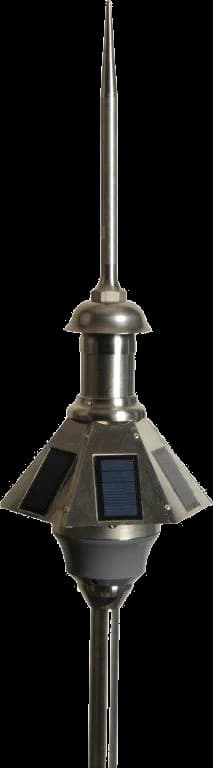 Early Streamer Emission

Protection, warning and strike logging in one device
ACTIVE 4D by Franklin France is an ESE air terminal its maker presents as “a complete lightning protection system, always connected to the user”: the air terminal, storm detection and strike counter are all in the device itself, and the LMS software brings their data together in one place.
ESE air terminal with two units
Impulse Device to start the upward leader, Power Device to support its propagation
Storm detection and strike counting
Field sensors warn before lightning; every strike’s data is logged automatically
Remote testing and monitoring
Run the function test and view the data from a computer with Activ’Control and the LMS software
Operating, monitoring and alarm scenario
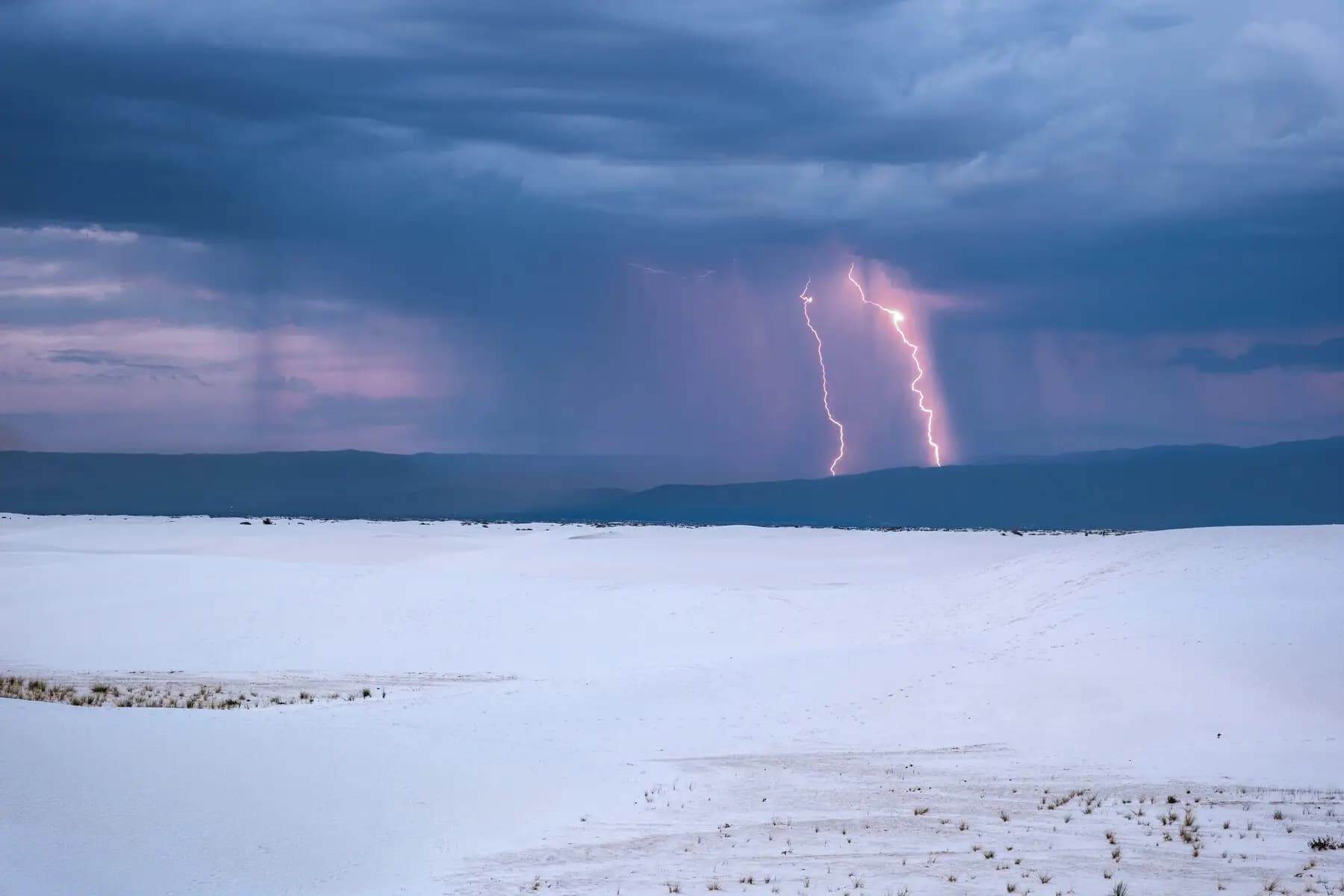
Connected operation and monitoring: ACTIVE 4D
ACTIVE 4D, made by Franklin France, combines an ESE air terminal, a storm detection system, a strike counter and remote testing in one device. The LMS software shows all this information in one place.
Impulse Device: starting the upward leader
As a storm cloud approaches, this unit stores electrostatic energy from the atmosphere. An integrated sensor measures the electric field and activates the Impulse Device at the right moment.
Power Device: sustaining leader propagation
Solar energy is stored in power capacitors, so the device is always pre-charged. A second sensor measures the discharge current. When the downward leader enters the protection zone and this current exceeds the characteristic threshold (1 A), the capacitors discharge and release the energy needed for the upward leader to keep propagating until it connects with the downward leader.
Storm detection and warning
Two sensors measure the electrostatic and electromagnetic fields, with a detection radius of about 30 kilometres. You set the warning threshold in the LMS software, and when the risk reaches it, the Dry Contact output on the Activ’Control box triggers an audible alarm (siren) or a visual one (rotating beacon).
Integrated strike counter
Strikes are counted and time-stamped automatically: number, date and time, plus the value, waveform and energy of the lightning current. The data travels by radio to Activ’Control and is available in the LMS software, together with the current curve.
Remote testing and the LMS software
The performance test runs from a computer at a distance, and the result appears immediately: solar cell voltage, battery voltage, the air terminal's temperature trend and a very high voltage (VHV) test. Testing with a radio remote tester is also possible.
- What ΔT means: the triggering time advance compared with a simple air rod (passive air terminal), measured in the laboratory under the NF C 17-102 protocol. For ACTIVE 4D it is 30 or 60 µs depending on the model. Besides ΔT, the protection radius also depends on the height h and the protection level.
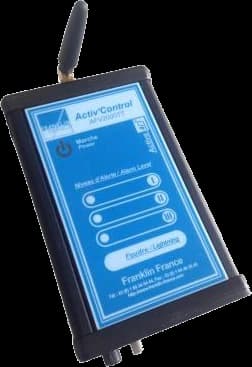
How the system works and communicates
Recorded tests and reports
The recorded tests of ACTIVE 4D and the reference for each; the reports are available in the documents section of this page.
Impulse current test
Passed successfullyNF C 17-102:2011 Annex C, clause C.3.4; 100 kA (10/350 µs); three samples of AFB10604D; report CITEL LER-14-095-RE (2014)
ESE performance test
Passed successfullyBazet high-voltage laboratory, France (2014)
Environmental conditions test
Passed successfullySICAME LABEP, France (2014)
Specifications, tests and protection radius
| Manufacturer | Franklin France, France |
|---|---|
| Air terminal type | ESE (Early Streamer Emission) air terminal with storm detection and integrated strike counter |
| Application | External lightning protection of buildings and structures |
| Models | ACTIVE 4D 30 and ACTIVE 4D 60 |
| Advance time ΔT | 30 µs (ACTIVE 4D 30) or 60 µs (ACTIVE 4D 60) |
| Energy sources | Electrostatic energy from the atmosphere as a storm cloud approaches (Impulse Device); solar energy stored in power capacitors (Power Device) |
| Storm detection | Two integrated sensors measuring electrostatic and electromagnetic fields; detection radius about 30 km |
| Storm warning | Warning threshold set in the LMS software; Dry Contact output on the Activ’Control box to trigger an audible (siren) and/or visual (rotating beacon) alarm |
| Lightning strike counter | Integrated in the device; strikes counted and time-stamped automatically |
| Recorded strike data | Number of strikes, date and time of each strike, plus value, waveform and energy of the lightning current |
| Remote testing | From a computer with Activ’Control and the LMS software, with an immediate result: solar cell voltage, battery voltage, air terminal temperature trend and very high voltage (VHV) test; or with a radio remote tester |
| Monitoring software | LMS (Lightning Monitoring System) |
| LMS features | Shows the storm risk trend, sets detection thresholds, displays strike data and current curves, runs the performance test |
| Communication and data transfer | 433 MHz radio link between the air terminal and Activ’Control, up to 100 m; Activ’Control connects to the computer with an RJ45 cable |
| Protection radius | Per NF C 17-102:2011; depends on the model, height h and protection level; see the protection radius table |
| Material | Stainless steel |
| Height | 1000 mm |
| Maximum diameter | 270 mm |
| Weight | 5.2 kg |
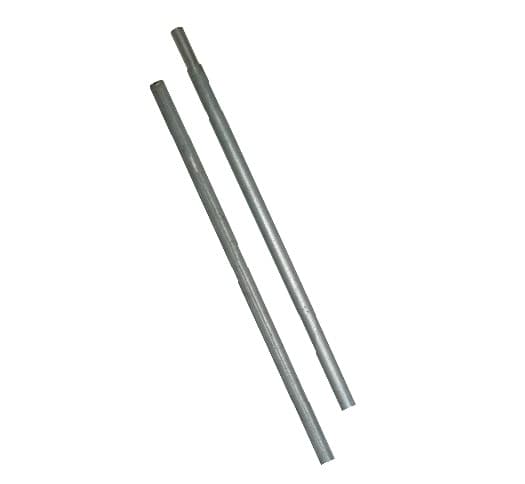
| Installation | On mast no. 1 with a 25 cm overlap, using Franklin France mounting equipment, suited to the height and to the resistance needed against snow and wind |
| Manufacturer's order code | Without Activ’Control: AFB10304D (ACTIVE 4D 30) and AFB10604D (ACTIVE 4D 60); with Activ’Control (AFV2000TT): AFB18304D and AFB18604D |
| Items supplied with the device | Tip, body, mast mounting base, spring washer, Allen key, screw, conductor connection clamp and warranty card |
Standards
- Product standard (ESE air terminal)
- NF C 17-102:2011
- Strike counter standard
- NF EN 62561-6, according to the Franklin France general catalogue 2026
Product test status
- Impulse current testPassed successfullyNF C 17-102:2011 Annex C, clause C.3.4; 100 kA (10/350 µs); three samples of AFB10604D; report CITEL LER-14-095-RE (2014)
- ESE performance testPassed successfullyBazet high-voltage laboratory, France (2014)
- Environmental conditions testPassed successfullySICAME LABEP, France (2014)
Model | Advance time ΔT | Activ’Control box | Order code |
|---|---|---|---|
ACTIVE 4D 30 | 30 µs | No | AFB10304D |
ACTIVE 4D 60 | 60 µs | No | AFB10604D |
ACTIVE 4D 30 | 30 µs | Included (AFV2000TT) | AFB18304D |
ACTIVE 4D 60 | 60 µs | Included (AFV2000TT) | AFB18604D |
Depending on the order code, Activ’Control is supplied separately or as part of the set.
Reference: Franklin France general catalogue of lightning and overvoltage protection products, 2026 edition.
ACTIVE 4D dimensional drawing: the body of this model is identical to ACTIVE 2D, so the drawing applies to both.
Choosing a model does not replace system design
A larger ΔT is not automatically the better engineering choice for every project. The model must suit the risk level, the size and height of the structure, the points exposed to strikes, the down conductor routes and the layout of the earthing system; the location of Activ’Control and its cable route are part of the same design.
ACTIVE 4D models
ACTIVE 4D 30
ΔT = 30 µs
Protection radius at a height of 5 m, protection levels I to IV
48–71 m
ACTIVE 4D 60
ΔT = 60 µs
Protection radius at a height of 5 m, protection levels I to IV
79–107 m
- Assess the risk and set the protection level
- Model the protected volume on the real geometry of the structure
- Design the down conductors, bonding and earthing system
- Locate Activ’Control, the local alarms and the computer connection

Catalogues and documents
Catalogues & datasheets
Certificates & test reports
- ACTIVE 4D impulse current test report: CITEL LER-14-095-RE (2014)Multilingual · 2014
- ESE performance test report in a high voltage laboratory for the Franklin France Active 4D ESE air terminal | Bazet high voltage laboratory, France 2014English · 2014
- Environmental conditions test report for the Franklin France Active 4D ESE air terminal | SICAME LABEP laboratory, France 2014Multilingual · 2014

Frequently Asked Questions
How does ACTIVE 4D differ from a standard ESE air terminal?
Besides working as an ESE air terminal with its two units, the Impulse Device and the Power Device, this one device brings together storm detection with two field sensors, an integrated strike counter and remote performance testing through Activ’Control and the LMS software.
Does ACTIVE 4D come with Activ’Control?
It depends on the order code. According to the Franklin France general catalogue (2026), codes AFB18304D and AFB18604D come with Activ’Control (AFV2000TT), while codes AFB10304D and AFB10604D come without it.
How do the air terminal and Activ’Control communicate?
According to the manufacturer's datasheet, the radio link runs at 433 MHz over a distance of up to 100 metres. Activ’Control connects to a computer with an RJ45 cable and has one Dry Contact output for alarm equipment.
What is the protection radius of ACTIVE 4D?
It depends on the model (ΔT of 30 or 60 µs), the height h and protection levels I to IV, and you can read it from the protection radius table on this page, based on NF C 17-102:2011. The final choice should rest on a risk assessment and a complete protection system design.
Does ACTIVE 4D have a lightning strike counter?
Yes. The strike counter is built into the device and, according to the manufacturer's catalogue, complies with NF EN 62561-6.
Have a Technical Question?
KALOT Group's technical experts are ready to answer your questions about lightning rods and earthing systems.