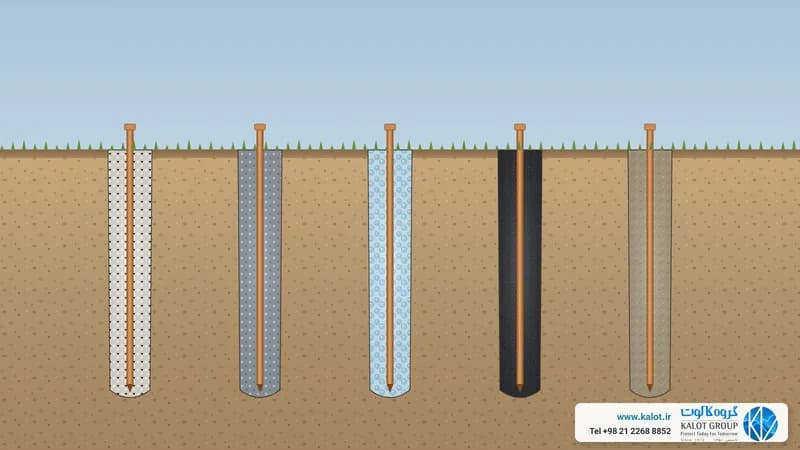
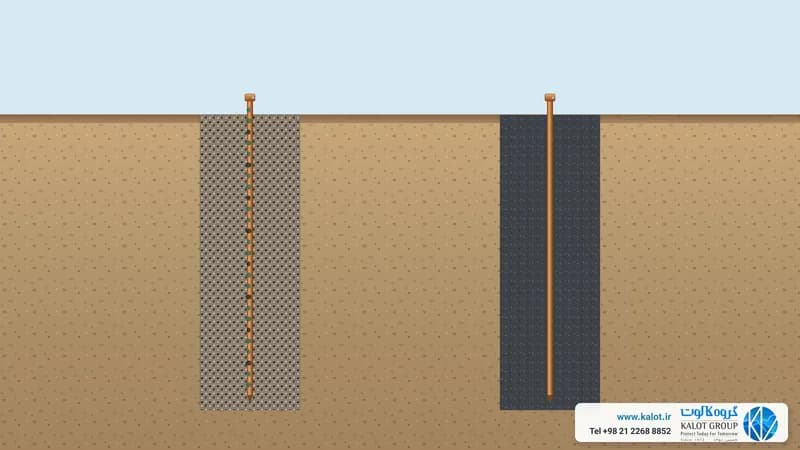
Short answer: no. Ground improvement material, also called earth resistance reducing material or GIM, is not essential in every soil. In rocky, high-resistivity soil, where a longer earth rod, more earth rods or a larger earthing network still will not reach the required resistance, there is almost no alternative to ground improvement material. As we know, soil moisture at the site is one of the factors in lowering earth connection resistance. In sandy soil and soil that dries out in summer, these materials are also recommended to keep the resistance stable, so that the earthing system resistance does not rise in dry periods. In moist clay soil, where the native soil alone reaches the target resistance, using ground improvement material is entirely optional. Even so, an earthing system works permanently, and a low resistance on installation day is not enough: the resistance must stay stable for years and the electrode must stay sound.
In this article we at KALOT Group explain where ground improvement material is needed, how much effect it has, what the alternatives are and how to decide in a few simple steps. We introduce the types of these materials in Types of ground improvement material.
In which soils is it needed, and in which is it optional?
- Rocky, high-resistivity soil (essential): BS 7430:2026 (clause 8.2.2) states that in high-resistivity locations or rocky ground where long-term equipment performance is required, the use of a conductive backfill, that is ground improvement material such as GIM, around earth conductors such as earth wire, earth rods and earth plates and earth pipes should be considered more carefully. In these soils, driving longer or more earth rods is also often difficult or impossible. The same standard (clause 8.7.1, note 3) explains that a large part of the earth electrode voltage drops within the few centimetres of soil directly in contact with it, which is why paying attention to and improving this zone has such an effect.
- Sandy, gravelly or seasonally dry soil (recommended): According to BS 7430 (clause 8.14.3.3), sand and gravel are poor conductors, especially when dry, and do not hold water. The resistance of these soils rises and falls with the seasons (effect of soil moisture on earth resistance). A uniform column of ground improvement material designed for corrosive environments, which has passed the relevant standard tests, such as KALOT GIM, gives full contact with the earth electrode and makes the earthing system resistance more stable.
- Moist clay soil (optional): BS 7430 (clause 8.14.2.1) states that if the native soil at the site has suitable conductivity and contains no corrosive substances, that same soil should be used to backfill around the earth electrode and be well compacted. So in clay soil, with the right length and number of earth rods or horizontal conductors, we will reach the target resistance and ground improvement material is not mandatory.
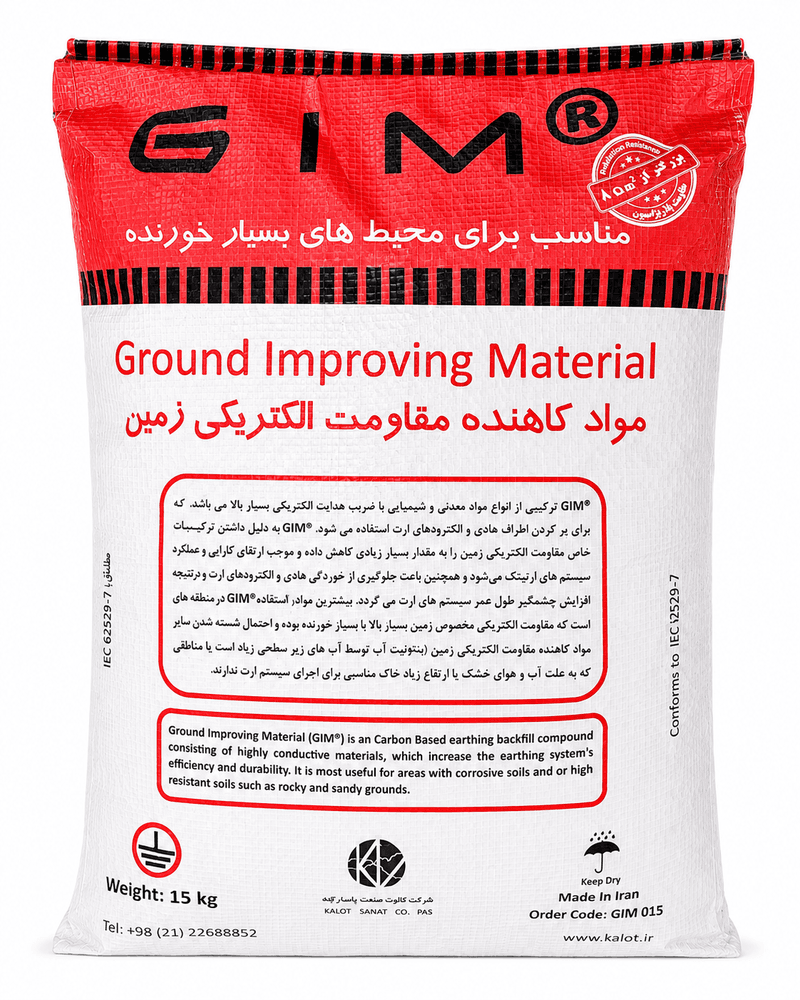
A note on good soils: soil with low resistivity is usually more corrosive. BS 7430 (notes 1 and 2 to clause 8.11.1) ranks soils by corrosivity from sandy to silty, clay and organic soils, and states that the least corrosive soils are usually those with high resistivity. That is why, even in clay and saline soil where the earth resistance is easily achieved, a tested ground improvement material that coats the electrode evenly, has a high polarisation resistance (such as KALOT red bag GIM) and is designed for highly corrosive environments can prevent corrosion and help extend the life of the earthing system (ground improvement materials and earthing system corrosion).
How much effect does ground improvement material have?
BS 7430 (clause 8.5.7) has a separate formula for an electrode inside a column of low-resistivity material. Using this formula, we calculated a 3 m earth rod of 14.2 mm diameter with and without a 10 cm diameter column of material in three soils:
- In clay soil with a resistivity of 20 ohm-metres: from 6.8 to 4.9 ohms (about 2 ohms lower)
- In ordinary soil with a resistivity of 100 ohm-metres: from 34.1 to 23.9 ohms (about 10 ohms lower)
- In sandy or rocky soil with a resistivity of 500 ohm-metres: from 171 to 119 ohms (about 52 ohms lower)
The percentage reduction is about the same in all three soils (around 30 percent), but the number of ohms removed differs greatly. In clay soil, two ohms less may not be needed to reach the target; in high-resistivity soil, the same 30 percent can be the difference between an earthing system design that passes and one that fails. We cover the fuller calculation and the effect of column diameter in the article Why is ground improvement material useful?
The alternatives: a longer earth rod and more earth rods
Ground improvement material is not the only way to reduce resistance. The length of earth rods, such as copper-bonded earth rods and galvanised, copper and stainless steel earth rods, has the greatest effect, and when they reach moister layers the resistance is also more stable. More earth rods also lower the resistance; according to IEEE Std 142 (clause 4.1.5), a second earth rod only brings the resistance close to half when it is installed at a distance several times the length of the first earth rod. Copper-bonded earth rods can be joined with couplings and driven deeper. The formula for each arrangement is given in the article Earth electrode resistance calculation formulas.
In practice all these methods are used together: in soil where driving is possible, we first get the length and number right, and ground improvement material comes in only for stability and protection, and only if needed; in rocky ground where driving is not possible, boreholes, trenches and pits are dug for the earth rods, the space around the earth conductors is filled with ground improvement material, and the column of material surrounding the conductors does the main work.
How should you decide?
- Measure the soil resistivity (Soil resistivity and the Wenner method). Table values are only a guide.
- Calculate the electrode resistance and compare it with the project's target resistance. The target resistance is set by regulations and the designer. Site members can use the KALOT website earth resistance calculator and its report.
- If it does not reach the target: if a longer or additional earth rod is feasible, look at that first; if not, ground improvement material is needed.
- If it reaches the target: if the soil is corrosive, rocky or seasonally moist, ground improvement material is recommended for stability and electrode protection; otherwise, well-compacted native soil is enough.
- Measure after installation, and record and repeat the measurement periodically (how to measure earth termination resistance).
Not every substance is a ground improvement material
If you finally decide to use ground improvement material, the material must be standard-compliant. BS 7430 (clause 8.14.1) states that the backfill around the electrode must be conductive, stable and compatible with the soil and the electrode material, and must not contribute to its corrosion. The same standard lists materials such as fly ash among prohibited backfills because they are corrosive. Salt and charcoal also lower the resistance only temporarily and corrode the electrode (Are salt and charcoal standard materials?).
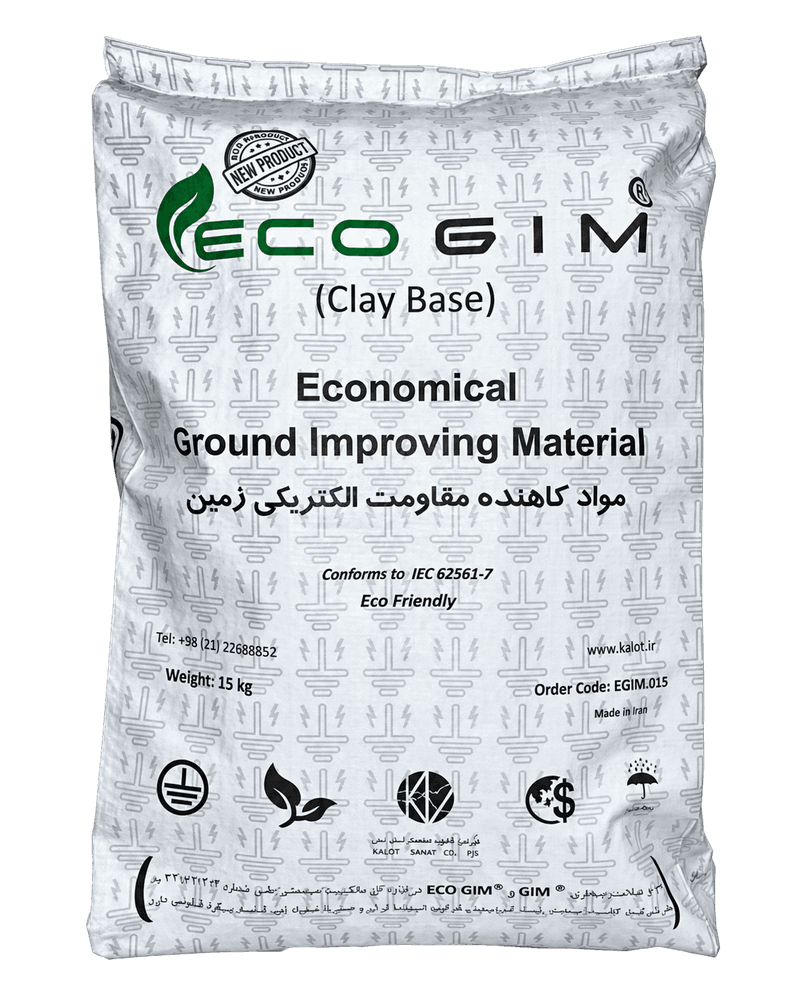
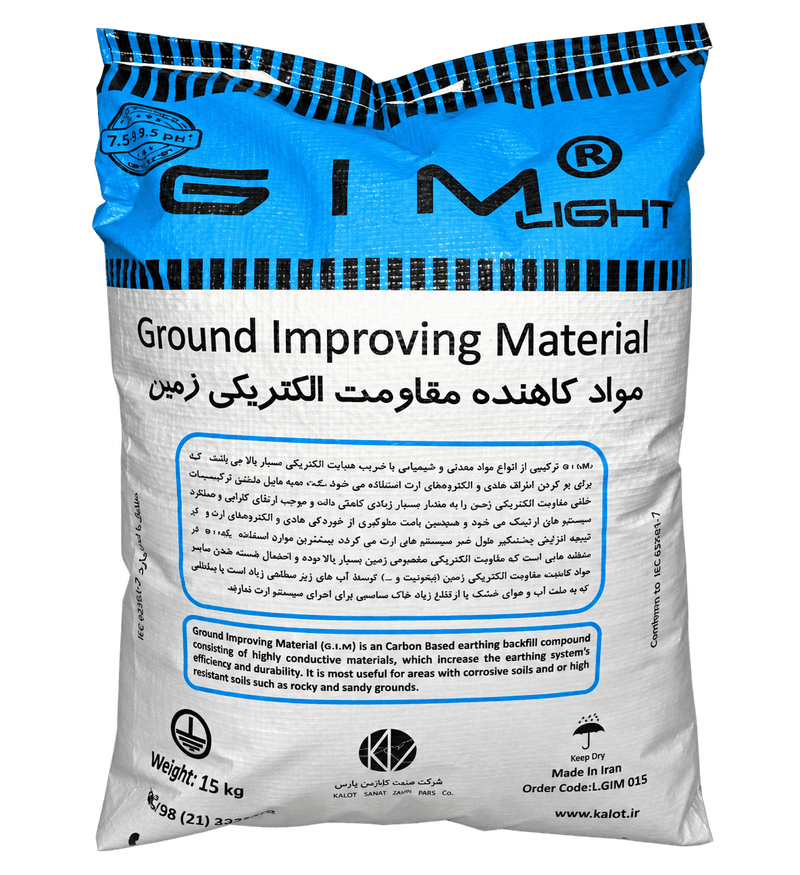
We manufacture the GIM ground improvement material family to IEC 62561-7 and to the National Iranian Gas Company standard IGS-I-EL-001, which is slightly stricter than IEC in some tests: GIM for high-resistivity soils and highly corrosive environments, GIM LIGHT for high-resistivity soils with lower corrosivity, and ECO GIM for normal ground that needs a quality material and stable resistance all year round. If you are not sure whether your project needs it, send us the soil resistivity value and the target resistance, and our experts will answer your questions as soon as possible.