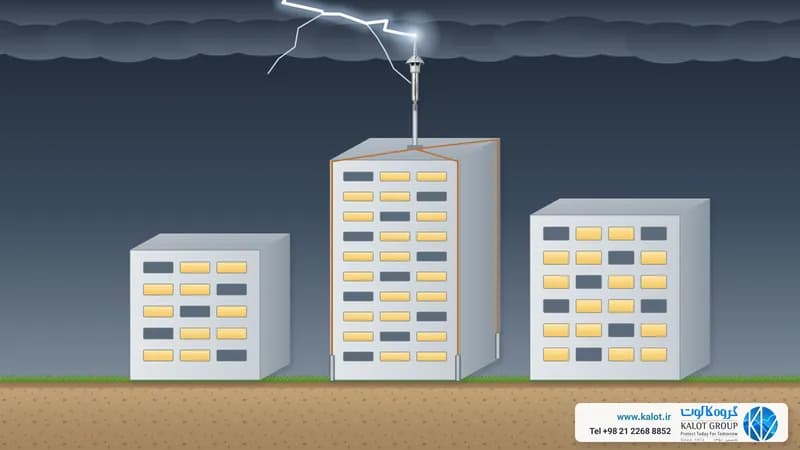
Short answer: "Primary protection" means the external lightning protection system, that is, the air terminal, down conductor and earthing system, which protects the building from fire and destruction. "Secondary protection" means internal protection: bonding of all metal parts and an SPD on the power and data lines, which protect the electrical and electronic equipment inside the building from lightning overvoltage (surge). An air terminal alone does not stop equipment from burning out.
Today's equipment, from servers and PLCs to CCTV cameras, solar inverters, medical equipment and smart building systems, is damaged by impulse voltages of a few kilovolts, even when lightning has not struck the building itself. In this guide we at KALOT Group explain where these overvoltages come from, and where and how SPDs should be installed.
Four ways lightning impulse voltage enters an installation
IEC 62305-1 distinguishes four sources of damage:
- S1, lightning to the building itself: part of the lightning current enters the power and data lines through the earthing and bonding system.
- S2, lightning near the building: the magnetic field of the lightning induces voltage in cable loops inside the building.
- S3, lightning to an incoming line: lightning current enters the building directly along the power, telephone or data cable.
- S4, lightning near an incoming line: overvoltage is induced on long overhead or underground lines, the most common cause of equipment burning out.
An air terminal only deals with S1. That is why risk assessment also counts more distant strikes: the 2010 edition of IEC 62305-2 includes strikes within 500 m of the building itself and, for incoming lines, strikes landing up to about 2 km on either side of the line. We explain the effects of lightning in types of lightning effects and air terminal selection in choosing an air terminal.
Switching overvoltage
Not all overvoltages come from lightning. Switching large loads such as motors, transformers and capacitor banks, a fuse blowing, and the clearing of a short circuit on the low-voltage network also create voltage impulses. Their amplitude is usually lower than lightning overvoltage, but they recur far more often and gradually wear out electronic equipment. IEC 60364-4-44 considers these overvoltages alongside lightning. Type 2 and Type 3 SPDs installed for lightning also protect against switching overvoltage.
What makes up secondary protection?
- Equipotential bonding: pipes, the metal structure, panel enclosures and cable shields are connected to a common earth bar at the building entry, so that no sparks or dangerous voltage differences occur between them during a strike (bonding and equipotentialisation).
- Coordinated SPDs: live conductors cannot be bonded directly, so at the moment of a strike the SPD connects them to the bonding bar for a few microseconds and keeps the voltage limited.
- Earthing system, shielding and correct cable routing: IEC 62305-4 groups these together with SPDs as "protection measures against the lightning electromagnetic impulse" (earthing, bonding and EMC and lightning protection zones).
When is an SPD needed?
- The building has an air terminal: a Type 1 (T1) SPD is needed at the power entry and on every other metal line entering the building, because part of the lightning current passes through these lines.
- The consequences of overvoltage are serious: IEC 60364-4-44 makes overvoltage protection mandatory where the consequence would be harm to people, interruption of public services, a stop to commercial and industrial activity, or a large gathering of people. In other cases, the decision rests on a risk assessment.
- Long overhead lines, cameras and outdoor equipment, and solar plants: these are exposed to S3 and S4 (protecting solar plants from lightning and surges).
Where should SPDs be installed?
- Incoming panel: a Type 1 or combined 1+2 SPD beside the earth and bonding bar, such as the combined Class 1+2+3 three-phase TNC SPD, the TNS version or the TT version.
- Sub-panels: a Type 2 SPD, especially when the panel is far from the incoming panel.
- Beside sensitive equipment: a Type 3 or socket-type SPD. If the equipment is far from the last SPD (usually more than about 10 m), the voltage oscillates in the cable and an SPD close to the equipment becomes necessary.
- Data and telecom line entries: data line SPDs, such as the data SPD with RJ45 connector.
- Cameras and outdoor equipment: a PoE SPD for network cameras and a BNC SPD for analogue cameras, at both ends of a long cable.
- Solar and special systems: photovoltaic DC SPD, fire alarm SPD and cathodic protection SPD.
We cover the difference between Type 1, 2 and 3 SPDs and how they coordinate in types of SPD.
How do you choose the right SPD?
- Protection level (Up): the voltage the SPD does not let a surge rise above. It must be lower, with a margin, than the impulse withstand voltage of the equipment (Uw). For a 230/400 V network, IEC 60364-4-44 gives these Uw values: metering and other equipment at the origin of the installation 6 kV, panels and fixed installations 4 kV, household appliances 2.5 kV, and sensitive electronic equipment 1.5 kV.
- Discharge current: for Type 1, the impulse current Iimp with a 10/350 µs wave, and for Type 2, the nominal discharge current In with an 8/20 µs wave. The value required depends on the lightning protection level and the number of conductors.
- Maximum continuous operating voltage (Uc): under IEC 60364-5-53, at least 1.1 times the phase-to-earth voltage. Common SPDs for a 230 V network have a Uc of about 275 V.
- Earthing arrangement: the SPD layout depends on the earthing arrangement, which is why our power SPDs are supplied under the names TNC, TNS and TT. If you do not know which one your building has, see TN-C-S, TN-S, TN-C and TT. In TT, a "1+1" (or "3+1") layout is used, with a spark gap between neutral and earth.
Installation and maintenance tips
- Run the SPD connecting leads short and straight, with a total length preferably no more than 0.5 m (IEC 60364-5-53).
- Choose the SPD's backup fuse or breaker according to the manufacturer's instructions.
- Check the SPD status indicator during periodic inspections and after every storm, and replace worn modules.
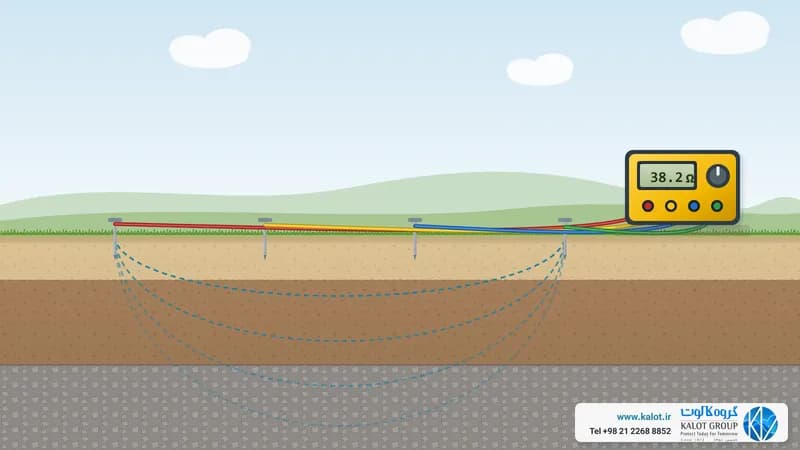
- An SPD does not work without sound bonding and a sound earthing system. Run its earth path with green and yellow earth conductor of adequate cross-section.
We supply all overvoltage and surge protection equipment and carry out overvoltage protection design and SPD selection, lightning risk assessment and SPD installation. To choose an SPD, send our specialists your single-line diagram, earthing arrangement and list of incoming lines, or call us through our contact us page.