Short answer: TN-S is one of the five earthing systems in IEC 60364. The transformer star point is connected directly to earth, and the neutral conductor (N) and the protective conductor (PE) run separately from source to load. The metal enclosures of all equipment are connected to PE, and in an enclosure fault the circuit breaker or fuse disconnects the circuit.
TN-S system structure
In TN-S, five conductors leave the source panel: three phases, neutral and the protective conductor. The protective conductor is not connected to neutral at any point after the source, so no current flows through it in normal operation and enclosures stay at the same potential as earth. This arrangement is usually found where a dedicated transformer sits inside or next to the building, as in factories, hospitals and large office buildings.
Protection against electric shock in TN-S
If a phase touches a metal enclosure, the fault current returns through PE to the transformer star point. This loop of phase, PE and transformer winding has low impedance, so the fault current is large and the circuit breaker or fuse trips quickly. The condition in IEC 60364-4-41 is:
Zs × Ia ≤ U0
where Zs is the fault loop impedance, Ia the current that operates the protective device within the permitted time, and U0 the phase-to-earth voltage (230 V). The disconnection time is 0.4 seconds for final circuits on a 230/400 V network and at most 5 seconds for distribution circuits. In long cable runs Zs grows, so the cable length and PE cross-section must be chosen so that this condition still holds. For additional protection, a 30 mA residual current device (RCD) is also used on sockets.
TN-S system pros and cons
- Good safety: PE carries no normal current, and automatic disconnection in a fault is fast.
- Better electromagnetic compatibility: because neutral current does not pass through the PE path or the building structure, there is less noise and stray current. See also earthing and EMC for sensitive equipment.
- The residual current device works correctly: because neutral and PE are separate.
- Higher cost: one more conductor is needed along the whole route.
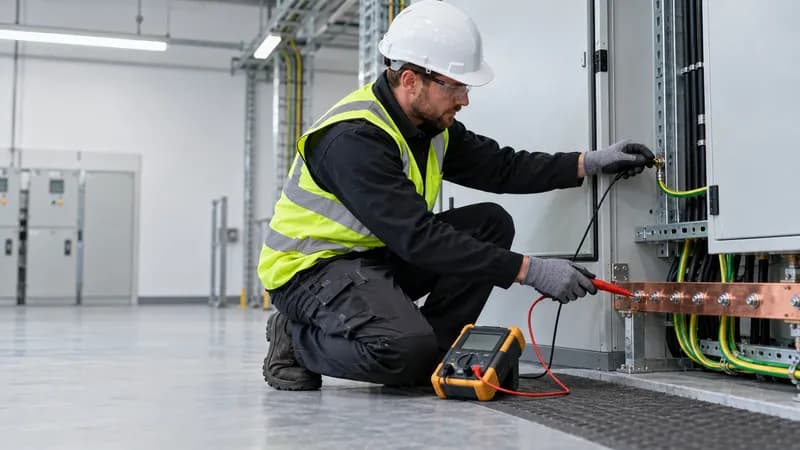
- PE continuity matters: a broken PE gives no sign in normal operation and is found only by a continuity test, so periodic inspection is necessary.
Where TN-S sits among earthing systems
Each system's name has two or three letters. The first letter says how the source (the transformer star point) relates to earth: T means directly earthed, and I means isolated from earth or earthed through a high impedance. The second letter says where the metal enclosures of equipment connect: N means to the earthed point of the source through a protective conductor, and T means to the site's own earth electrode. A third letter appears only in the TN family: S means neutral and protective conductor are separate, and C means both share one conductor, called PEN.
System | Neutral and protective conductor | Protection against electric shock | Where you find it |
|---|---|---|---|
TN-S | Separate from source to load | Circuit breaker or fuse, with Zs × Ia ≤ U0 | Factories and large buildings with their own substation |
One PEN conductor | Circuit breaker or fuse; a residual current device will not work | Distribution networks and older installations | |
PEN up to the intake, then separate | Circuit breaker or fuse, plus a residual current device after the split point | Most buildings fed from the public network | |
Neutral from the network; protective conductor to the site electrode | Residual current device, with RA × IΔn ≤ 50 V | Buildings and installations far from the network or on a separate earth | |
Source isolated from earth; enclosures on the site electrode | Insulation monitoring for the first fault, disconnection on the second | Operating theatres, mines and industries where sudden loss of power is not acceptable |
You will find an overview of all systems in types of earthing systems, and the difference between protective and electrical earth in protective earth and electrical earth. If your building's power arrives from the public network over a PEN, your system is probably TN-C-S, not TN-S.
At KALOT Group we carry out earthing and bonding design and earthing system measurement and testing, and we offer the components, from copper-bonded earth rods and earth bars to green and yellow earth conductors and polyethylene inspection pits. To choose the right system, send our engineers your single-line diagram and supply type, or get in touch through our contact page.