The short answer: there is no single "best" air terminal. The right one is the one that suits your project's standard and the shape of your building. A passive air terminal (conventional or Franklin) is a simple metal air rod, placed at several points on the roof in line with the international standard IEC 62305-3 using the rolling sphere, protection angle or mesh method. An ESE air terminal (also called active or electronic) is a head installed on a mast, for which the French standard NF C 17-102 calculates a larger protection radius. Both need down conductors, an earthing system, bonding and SPDs just as much.
At KALOT Group we offer both types: conventional air rods and Franklin France ESE air terminals. In this guide we explain impartially how each one works, which standard it is designed to and what to look at when choosing between them.
What do active and passive air terminals mean?
In the Iranian market these two families go by several names that all mean the same thing:
- Passive air terminal = conventional air terminal = Franklin air terminal = air rod (in standards: conventional air terminal, or Air Termination). It has no active parts and is made only of a conductive material (copper, stainless steel or aluminium).
- Active air terminal = electronic air terminal = ESE air terminal (Early Streamer Emission). It is a head with a pointed air rod and a body that has shown in the laboratory that it should start the upward leader earlier than a conventional air rod of the same size.
Both are only the upper part of the protection system. We explain the complete lightning protection system in our article The lightning protection system and its components.
How does an air terminal work?
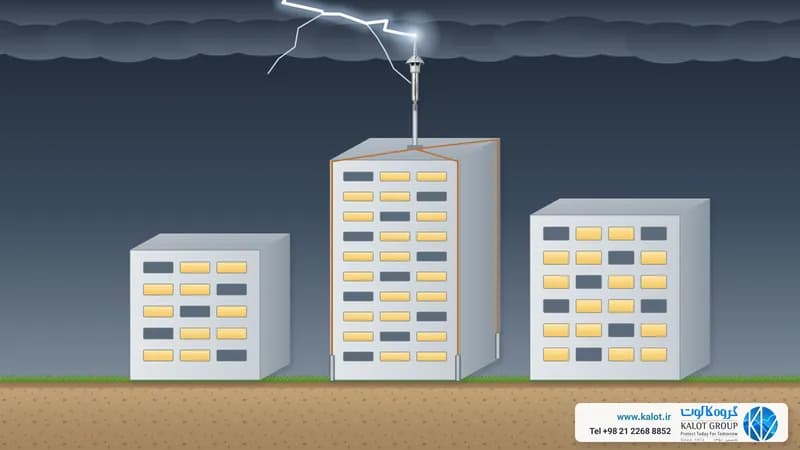
Before a strike, a charged channel called the stepped leader comes down from the cloud towards the ground in steps. When it nears the ground, another channel called the upward leader rises towards it from the tips of tall objects such as an air rod. Whichever upward leader reaches the stepped leader first completes the lightning path, and the current flows to earth from that point. The job of an air terminal is to take that point for itself, so that the lightning current reaches earth along a controlled path instead of through the roof, façade or equipment.
Passive (conventional) air terminals
A conventional air rod starts the upward leader naturally, purely because of its height and sharp tip. So the geometry of the building decides where the air rods go: there must be enough air rods and conductors on the roof to leave no point of the structure unprotected.
ESE air terminals
An ESE head is built to start the upward leader in the laboratory earlier than a conventional air rod of the same shape and height. This time lead is called ΔT (in microseconds). Under NF C 17-102, ΔT is measured in the laboratory test in Annex C of the same standard and is converted in design into a "lead length": ΔL = ΔT × 1 m/µs, meaning each microsecond of ΔT counts as one metre. The ΔT value used in calculation is at most 60 microseconds.
Today's ESE air terminals belong to this family, such as ACTIVE 1D+ with a ΔT of 12, 25, 45 or 60 microseconds, and ACTIVE 2D and ACTIVE 4D with 30 or 60 microseconds.
How is the protection zone of each method determined?
Conventional air terminals: rolling sphere, protection angle and mesh
IEC 62305-3 has three methods for positioning air terminals. In the rolling sphere method, we roll an imaginary sphere over the building and the ground around it, and every point the sphere touches must be protected by an air rod or conductor. The sphere's radius depends on the protection class: 20 m for Class I, 30 m for Class II, 45 m for Class III and 60 m for Class IV. In the mesh method, a network of conductors is laid over the roof, with a mesh size that also depends on the protection class, and the protection angle method is used for simpler structures.
ESE air terminals: protection radius Rp
In NF C 17-102, the protection zone of each ESE head is expressed as a protection radius Rp: the radius of a circle on a horizontal plane located a height h below the tip of the air terminal:
Rp(h) = √( 2·r·h − h² + ΔL·(2·r + ΔL) ) for h ≥ 5 m
In this formula, r is the 20, 30, 45 or 60 metres for protection levels I to IV, and ΔL is derived from ΔT. For heights below 5 metres, Rp falls from its 5-metre value in proportion to the height. For example, a head with a ΔT of 60 microseconds, with h at 5 metres, has by this formula a protection radius of about 79 metres at level I, about 87 metres at level II, about 97 metres at level III and about 107 metres at level IV. That is why, in a design to NF C 17-102, one or more heads on a mast take the place of many air rods on the roof. We cover the practical points of this standard in our article Key points of NF C 17-102.
Conventional and ESE air terminals compared
Topic | Conventional air terminal (passive) | ESE air terminal (electronic, active) |
|---|---|---|
Design standard | IEC 62305-3 (and NFPA 780 in the US) | NF C 17-102:2011 (France), UNE 21186:2011 (Spain) |
Determining the protection zone | Rolling sphere, protection angle or mesh | Protection radius Rp based on ΔT, height and protection level |
Number of terminals on the roof | Several air rods and roof conductors, depending on roof shape and protection class | Usually one or more heads on a mast |
Installation | Air rod on a base, roof conductor and connections | Head on a mast, at least 2 m above any part of the structure in the protection zone |
Down conductor | Number and spacing according to protection class and structure dimensions | At least two down conductors for each head |
Earthing system, bonding and SPD | Required | Required |
Inspection | Periodic inspection and after every strike | Periodic inspection and after every strike, plus a health test of the head |
Do all standards cover ESE air terminals?
No. The international IEC 62305 series and the American standard NFPA 780 describe conventional methods and do not include a way of calculating the ESE protection radius. France, on the other hand, has NF C 17-102:2011 and Spain has UNE 21186:2011 as dedicated national ESE standards. There is also debate in scientific circles over whether the lead measured in the laboratory enlarges the protection radius by the same amount in natural lightning. In 1995 the NFPA Standards Council concluded that ESE heads are at least equivalent to a conventional air rod of the same shape.
The practical conclusion is simple: choose your air terminal according to the standard required by the project specification, client, consultant or insurer, and do all the calculations to that same standard. We list the standards in this field in our article Lightning protection standards.
The air terminal is only one part of the system
Whether you choose a conventional or an electronic air terminal, only the air terminal itself differs. The rest of the system is needed in both cases:
- Air terminal: a conventional air rod such as a solid copper air rod or a stainless steel air rod on air rod bases, or an ESE air terminal head on a galvanised telescopic mast.
- Down conductor: copper tape or conductor, secured to the façade with clamps and fittings.
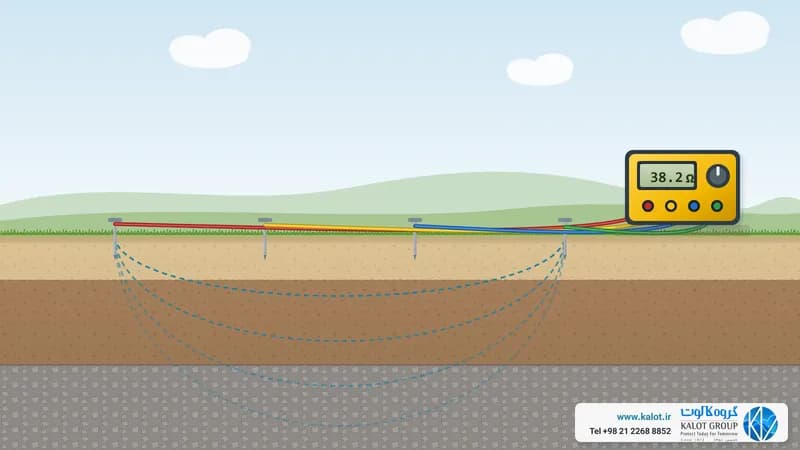
- Test joint: such as a brass test joint at the bottom of each down conductor, for disconnecting and measuring earth resistance.
- Earthing system: earth rods, plates and earthing equipment. To calculate electrode resistance, see our article Calculating earth electrode resistance.
- Bonding and SPDs: all metal parts are connected to the bonding bar (bonding and equipotentialisation) and an SPD is installed at the power intake, because lightning also does harm through indirect routes (types of lightning effects).
An expensive air terminal without a correct down conductor and a suitable earthing system does not protect the building.
What is a radioactive air terminal?
In past decades a type of air terminal was made with radioactive material (radium 226 or americium 241) in its head. Under regulations from 1983, France banned their installation and sale from the start of 1987, and they must only be dismantled by a company licensed for radiation work. If you find one of these on an old building, do not touch it yourself and raise the matter with the radiation safety authority. Today's ESE air terminals, including all the models we supply, are fully electronic.
Five steps to choosing the right air terminal
- Risk assessment: use IEC 62305-2 to establish whether the building needs protection and at what protection level (I to IV). Lightning risk assessment is one of our services.
- Project standard: check which standard the technical specification from the client, consultant or insurer requires: IEC 62305 or NF C 17-102.
- Shape and use of the structure: a large or complex roof, a tall structure, an open area, a tank or explosive hazard zone, the building façade and access for installation and inspection all affect the choice.
- Designing all the components: the number and position of terminals, down conductors, test joints, the earthing system, bonding and SPDs are designed together. We also provide lightning protection system consulting and design and installation of earthing, air terminals and SPDs.
- Inspection and maintenance: under NF C 17-102, visual inspection takes place every year for levels I and II and every two years for levels III and IV, full inspection every two and every four years respectively, and always after every strike. For an ESE air terminal, the health of the head is also tested from the ground with a remote tester, and a lightning strike counter records the number of strikes. We also carry out periodic testing and inspection.
What does the price of an air terminal depend on?
The price of a lightning protection system is not just the price of the head. For an ESE air terminal, the cost is set by its model and ΔT, the height and type of mast, the length and material of the down conductors and the type of earthing system. For a conventional system, it is set by the number of air rods and bases, the length of the roof and down conductors and the earthing system. For a fair comparison, set the total cost of both designs side by side for the same building and the same protection level.
For a price enquiry and advice, send our specialists the drawing or dimensions of the building, its use and height, the standard the project requires and the soil type or existing earthing system, or get in touch through our contact us page.