
Move your pointer over the image to zoom in
Complete Product Overview
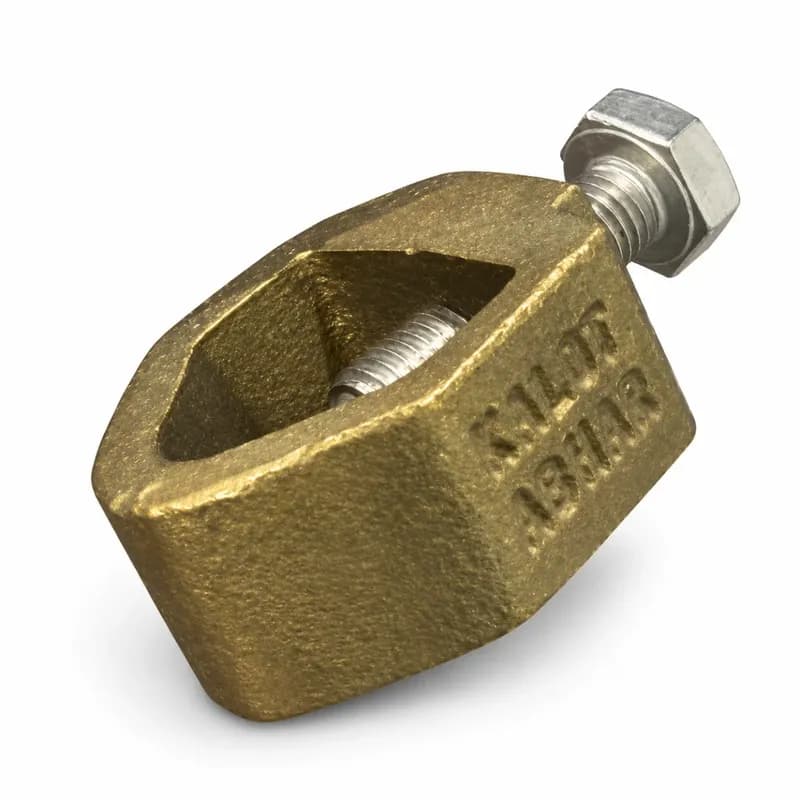
Clamp for connecting galvanised round wire to reinforcing bar
Last updated:
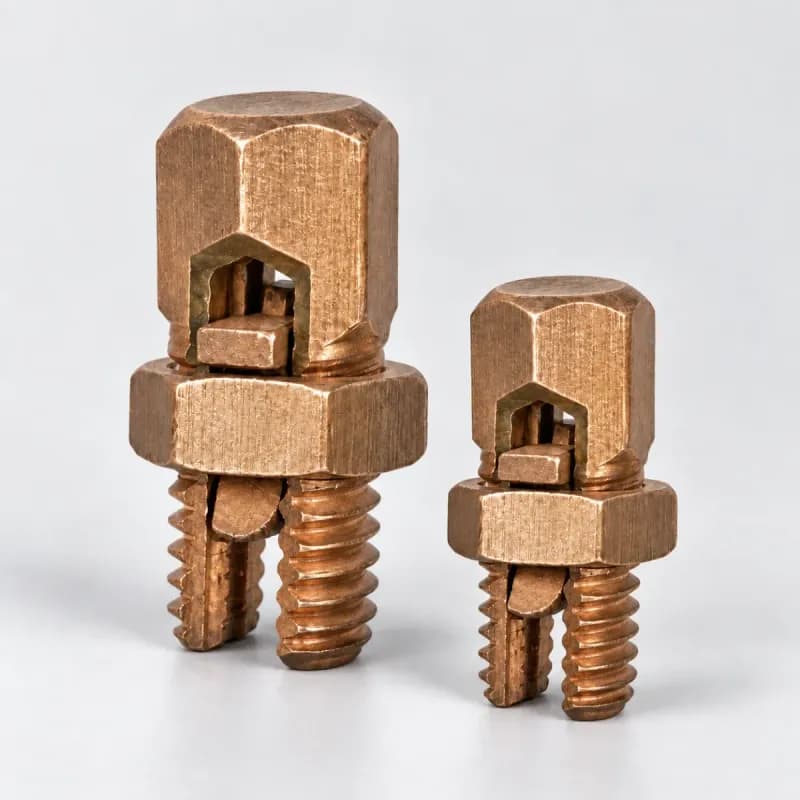
The KALOT Group clamp for connecting galvanised round wire to reinforcing bar fixes galvanised round wire in line with a reinforcing bar, in foundation earthing and bonding, before the pour. It has two saddle plates, one for the round wire and one for the reinforcing bar, and a flat middle plate that keeps the two conductors apart. Each conductor tightens in its own saddle, both pass between the two bolts, and neither is cut or drilled.
The same clamp also joins two galvanised round wires side by side and fixes round wire to a 16 mm stainless steel earth rod. Its material is compatible with galvanised round wire and reinforcing bar, but it is not used next to copper, because contact with copper can destroy the zinc coating. The clamp with code RRCG 1016 fixes 8 and 10 mm round wire to reinforcing bar up to 16 mm diameter over the ribs, meaning size 12 and thinner; for larger bars we recommend the galvanised U clamp. Our specialists are with you in choosing the size and enquiring about the price.
Connecting galvanised round wire to reinforcing bar, in line and without welding
To choose this clamp, check three things: the material of both conductors (galvanised round wire, reinforcing bar or stainless steel), the round wire diameter and the reinforcing bar diameter over the ribs, and the connection location (inside concrete or in air).
- Foundation earthing and bonding, inside concrete
- 8 and 10 round wire to reinforcing bar up to 16 diameter over the ribs
- Two saddle plates and a flat middle plate
- Galvanised steel, two M8 bolts
Each conductor in its own saddle
The round wire sits in the saddle of the top plate and the reinforcing bar in the saddle of the bottom plate, while the flat middle plate keeps them apart. As the two bolts tighten, each conductor is pressed separately across the full width of the plate. You can see the shape and order of the plates in the technical specifications tab.
Foundation electrode round wire, connected to the reinforcement
When a foundation earth electrode is built with galvanised round wire, the round wire runs as a closed loop in the building's foundation and is connected to the reinforcing bars before the pour, so that the reinforcement is also bonded to the earthing system. This clamp makes that same connection without welding and in a way you can inspect.
Material: galvanised steel, compatible with round wire and reinforcing bar
The plates, bolts and nuts are all galvanised steel. The clamp is the same material as galvanised round wire, is compatible with reinforcing bar, and can also be used with a stainless steel earth rod.
Code RRCG 1016 and drawings
Datasheet: clamp for connecting galvanised round wire to reinforcing bar (PDF)The dimensional drawing, technical drawing and exploded view show the structure of the two saddles and the middle plate; the installation schematic shows where the clamp goes in the foundation, and the installation steps show the order of work. You will find them all in the technical specifications tab, with PDF files, alongside this clamp's datasheet.
Advice from KALOT Group specialists
Send us the round wire and reinforcing bar diameters and the connection location; our specialists will tell you the right clamp and the price.
Technical Product Information
Click to view enlarged
Feature | Value |
|---|---|
Type | Three-plate bolted clamp for connecting galvanised round wire to reinforcing bar (round conductor to round conductor) |
Material | Galvanised steel (plates, bolts and nuts) |
Plates | Two saddle plates (top for the round wire, bottom for the reinforcing bar) and a flat middle plate, all three with one design and two bolt holes |
Saddle | Round and smooth, perpendicular to the plate's length, across its full width and between the two holes; the saddle of both plates faces outwards |
Bolts | Two M8 hexagon bolts, property class 8.8 |
Nuts | Two M8 hexagon nuts |
Suitable round wire | 8 and 10 mm galvanised steel round wire (about 50 and 78.5 mm²) |
Suitable reinforcing bar | Reinforcing bar of 8 to 16 mm diameter over the ribs, meaning sizes 8, 10 and 12 |
Other conductors in the bottom saddle | A second galvanised round wire (8 or 10 mm) or a 16 mm stainless steel earth rod |
Arrangement of the two conductors | In line or at a slight angle to each other; both pass between the two bolts |
Conductor route | Through-run or end connection; the round wire and reinforcing bar are not cut or drilled |
Do not use with | Conductor, earth rod or plate made of copper or coated with copper |
Connection type | Bolted, can be opened and refastened |
Main application | Foundation earthing and bonding, inside concrete |
Other locations | In air, where two galvanised round wires are joined side by side |
Code | RRCG 1016 |
Code and size range (RRCG)
Code | Round wire diameter (mm) | Reinforcing bar diameter over the ribs (mm) | Bolts and nuts | Number of plates |
|---|---|---|---|---|
RRCG 1016 | 8-10 | 8-16 | 2 × M8 | 3 |
Diameters are in millimetres, and the diameter of a ribbed reinforcing bar is measured over the ribs: a size 12 bar is about 14 mm over the ribs, and a size 14 bar exceeds 16 mm. Send us your project's round wire and reinforcing bar diameters so that our specialists can confirm the right clamp. Our products are continually improved and some dimensions may be updated; please confirm final dimensions with our specialists before you buy.
Dimensional drawing
Download the dimensional drawing (PDF)
Technical drawing
Download the technical drawing (PDF)
Exploded view
Download the exploded view (PDF)
Two saddle plates and a flat middle plate
Each saddle plate has a round saddle at its centre, formed smooth and perpendicular to the plate's length, across its full width and between the two bolt holes; the flat middle plate has the same design and size. The parts assemble in this order from the bolt heads: top saddle plate with its saddle facing outwards, round wire in the saddle, flat middle plate, reinforcing bar in the saddle of the bottom plate, bottom saddle plate with its saddle facing outwards, then the nuts. This leaves a round groove on each side of the middle plate. Each conductor sits in its own groove, both pass through the space between the two bolts, and the two conductors are not pressed against each other. In the simplified cross-section: 1 galvanised round wire, 2 reinforcing bar, 3 flat middle plate and 4 two bolts and nuts.
Click to view enlarged
Applications of the clamp for connecting galvanised round wire to reinforcing bar
- Foundation earthing: connecting the galvanised round wire of the foundation earth electrode to the foundation's reinforcing bars before the pour. Run the round wire in line with a bar, and for connections that stay in concrete, fix it with two clamps to two separate bars
- Structural bonding: connecting galvanised bonding round wire to the reinforcement of a column, wall or slab, for bonding the structure to the earthing system
- Joining two galvanised round wires: connecting two round wires side by side, where the foundation electrode loop is made of several lengths of round wire or a branch leaves the loop; each round wire sits in one of the two saddles
- Branch to test joint and down conductor: connecting the foundation loop round wire to a branch round wire that rises inside a concrete column or wall and reaches the test joint, the lightning protection system's down conductor or the main earth bar. Bring the galvanised branch out into the air on the surface of the column or wall or inside the building, not through soil
- Passing into soil with stainless steel: connecting galvanised round wire inside concrete to a 16 mm stainless steel earth rod or a stainless steel branch, inside the concrete, so that only stainless steel passes from concrete into soil. This is a joint between two dissimilar metals, so cover it completely with a moisture-proof compound or tape before the pour
- In air, on a roof or facade: joining two galvanised round wires of the air termination network or down conductor side by side, where both conductors are galvanised
Installation schematic
Download the execution schematic (PDF)
Connection modes: round wire to reinforcing bar, round wire to round wire, and round wire to earth rod
Download connection modes (PDF)
Installation steps for the clamp for connecting galvanised round wire to reinforcing bar
- Check the material and size of the conductors: the round wire must be galvanised steel, 8 or 10 mm, and the reinforcing bar up to 16 mm diameter over the ribs (size 12 and thinner). If you are fitting the clamp to an existing lightning protection system on a roof or facade, do not work during a thunderstorm, and leave the work to an installer familiar with earthing and lightning protection systems.
- Choose the clamp's position before fitting it: pick a reinforcing bar that runs in line with the round wire's route, and place the clamp between two cross bars so that the bolts and plates do not touch another bar. At the corners of the loop, bend the round wire rather than cutting and rejoining it.
- Secure the round wire with spacers or tying wire so that it does not lie on the formwork base or blinding concrete, and the concrete can fill around the round wire and clamp on all sides.
- Clean the connection point with a cloth or soft brush to remove mud, concrete slurry, loose rust, paint and grease. Do not scrape the zinc coating of the round wire or clamp.
- Undo the nuts and take the bottom saddle plate and the flat middle plate off the bolts; the bolts stay in the top saddle plate.
- Place the top saddle plate on the round wire so that the round wire sits in the saddle and the two bolts lie on either side of it. Then fit the flat middle plate onto the bolts from beneath the round wire.
- Place this assembly on the reinforcing bar so that the bar, in line with the round wire, lies under the middle plate and between the two bolts. Fit the bottom saddle plate onto the bolts from beneath the bar so that the bar sits in its saddle, and tighten the nuts by hand.
- Align the plates and tighten the nuts with a spanner, evenly and in turn, following the manufacturer's instructions. Then check that the round wire and the reinforcing bar each sit in their saddle across the full width of the plate. If the round wire ends at this clamp, leave its end protruding at least 2 cm beyond the edge of the clamp.
- Before the pour, measure the concrete cover from the nearest point of the clamp, meaning the bolt heads and nuts, to the floor and side of the formwork: at least 5 cm of structural concrete, which does not include blinding concrete. Make joints that stay in concrete with two clamps on two separate reinforcing bars, and photograph every joint.
Download the installation steps (PDF)
Installation tools
Two spanners matching the bolt head and nut are enough for installation: one holds the bolt head while the other turns the nut. This joint needs no welding, heat, electricity or drilling.
Pre-pour checks and inspection
Clamps inside concrete cannot be seen after the pour, so check each connection one by one before the pour, and once more just before the pour, when the steel fixers and formwork crews have finished. Rule out these mistakes: round wire or reinforcing bar outside the saddle; a loose nut; a bolt head or nut less than 5 cm from the base or side of the formwork; round wire lying on the base; a connection to the reinforcement with only one clamp; round wire crossing a structural expansion joint rigidly, because the designer provides separately for connecting the two sides of the joint; and a galvanised conductor passing from concrete into soil. Do not use the clamp to carry the weight or tension of the conductors. Mark the round wire's route so that it is not mistaken for a reinforcing bar, and mark and protect the end of every branch coming out of the concrete until the work is finished, so that it is not hidden under concrete or finishes, or cut. Photograph the whole route and every connection, with the axis number or a label next to the connection visible in the photo. Measure electrical continuity with an ohmmeter between the main earth bar terminal and all other terminals, and record it with the drawing and photos. Even if the clamps were fitted by the steel fixing crew, checking and documenting them is the job of the electrical or lightning protection specialist. See the details of the terminals in the section terminals and access for testing of the foundation earthing article. During periodic inspections, check exposed connections in air for tight nuts, a sound zinc coating and any sign of corrosion, such as a white layer of zinc oxide (white rust) or red rust on the steel. Open any loose or corroded connection, clean the contact surface and retighten it following the manufacturer's instructions. For measuring the resistance of the earth termination, use the terminals that come out of the foundation concrete.
Choosing and enquiring about the price of the round wire to reinforcing bar clamp
To estimate the quantity, count on the foundation earthing drawing every point where round wire connects to reinforcement (two clamps for a connection that stays in concrete), every joint between two round wires, every branch and every stainless steel earth rod, and keep a few extra clamps for changes on site. When you enquire, send us the round wire diameter, the type and diameter of the second conductor (reinforcing bar size, second round wire diameter or stainless steel earth rod), the connection location (inside concrete or in air), the quantity and, if you have one, the foundation earthing drawing. Our specialists will tell you the right clamp and its price.
Click to view enlarged
Wherever galvanised round wire meets a reinforcing bar or another round wire in an earthing or bonding system, mostly inside foundation concrete, this clamp is made for that connection. Each conductor is held in its own saddle and the middle plate keeps them apart, so a thinner round wire beside a thicker bar is still tightened on its own. The connection is bolted and needs no welding on the reinforcement, which would require the structural designer's agreement, and its material is compatible with galvanised round wire, reinforcing bar and stainless steel. Our recommendation: this clamp for galvanised round wire on reinforcing bar up to size 12; the galvanised tape-to-earth rod clamp for galvanised tape; the galvanised U clamp for larger bars; and our brass clamps for a copper system. We compare the materials side by side in the section earth clamp material: brass, copper or galvanised.
Advantages of this clamp for connecting round wire to reinforcing bar
- Each conductor in its own saddle: the round wire and reinforcing bar are each pressed in a separate groove; even when their diameters differ, each is held on its own.
- Can be checked before the pour: you see the joint before the pour, tighten it and photograph it, and if it is in the wrong place, it can be undone and moved.
- No welding or heat: the connection is made with two bolts and two spanners; nothing is welded onto the reinforcing bar and the round wire's zinc coating is not damaged.
- The through-run conductor is not cut: the round wire and reinforcing bar pass through the clamp and continue, or the round wire ends at this clamp; both pass between the two bolts, in line or at a slight angle.
- One clamp for reinforcing bar, round wire and earth rod: the bottom saddle takes a reinforcing bar, a second round wire or a 16 mm stainless steel earth rod.
- Same material as galvanised round wire: the plates, bolts and nuts are all galvanised steel, matching the galvanised round wire.
Comparison with the galvanised tape-to-earth rod clamp and the galvanised U clamp
Feature | This clamp | Galvanised tape-to-earth rod clamp | galvanised U clamp |
|---|---|---|---|
What it connects | Round wire to reinforcing bar, round wire or earth rod | Tape to round wire, reinforcing bar or earth rod | Round wire or tape to reinforcing bar or earth rod |
Material | Galvanised steel | Galvanised steel | Galvanised steel |
First conductor (mm) | 8 and 10 round wire | Tape 25 to 30, 3 to 3.5 thick | Round wire 50 to 95 mm² or tape up to 30 wide |
Second conductor (mm) | Reinforcing bar 8 to 16 over the ribs, round wire or earth rod 16 | Round conductor 8 to 16 | Earth rod or reinforcing bar 14 to 34 |
Structure | Two saddle plates, a flat middle plate and two M8 bolts | One saddle plate, two flat plates and two M8 bolts | U bolt, two plates and two M6 nuts |
Main joint location | Inside foundation concrete or in air | Inside foundation concrete or in air | On foundation reinforcing bar |
For a quick choice: galvanised round wire to reinforcing bar up to size 12, to another round wire or to a 16 stainless steel earth rod, in line or at a slight angle: this clamp. Galvanised tape to round wire, reinforcing bar or earth rod: the galvanised tape-to-earth rod clamp. Reinforcing bar or earth rod of 14 to 34 mm: the galvanised U clamp. At 14 to 16 mm over the ribs both clamps work, and our specialists will recommend one according to the connection location. Two galvanised round wires crossing at right angles: the galvanised cross clamp. Bonding large foundation reinforcing bars: the foundation earthing and bonding clamp. Copper conductor: our brass clamps. Exothermic welding makes a permanent, one-piece connection and needs a mould, powder and a trained installer; use it for any connection buried directly in soil or where the designer has asked for a permanent welded connection. Inside concrete, this bolted clamp makes the same connection without a mould or heat, and can be seen and checked before the pour.
If these conditions apply to you, see these clamps as well
Clamp | When |
|---|---|
Galvanised clamp for connecting tape to earth rod and round wire | When your conductor is galvanised tape rather than round wire. |
Galvanised U clamp for connecting conductor to earth rod and reinforcing bar | When you are fixing round wire to a larger reinforcing bar or earth rod, 14 to 34 mm. |
Galvanised cross clamp for conductor-to-conductor connections | When two galvanised round wires cross at right angles. |
When you are sourcing the galvanised round wire itself for the foundation electrode, down conductor or roof network. | |
When the earthing system has to pass from foundation concrete into soil. | |
When you are bonding a conductor to large foundation reinforcing bars. |
Compare all our earthing clamps in the "Which clamp should we choose?" table.
The KALOT Group clamp for connecting galvanised round wire to reinforcing bar is designed and made in line with IEC 62561-1, the standard that sets the requirements for connection components of lightning protection systems, including bolted clamps.
IEC 62305-3 recommends two clamps on two separate bars for a clamped connection to reinforcement, which can no longer be seen after the pour, and does not consider a connection made only with tying wire adequate for lightning current. According to the same standard, galvanised steel inside concrete can be connected directly to the reinforcing bars, and an electrode outside the concrete in soil should preferably be stainless steel or copper. Joints between dissimilar metals should be avoided or protected, and an electrode covered by at least 5 cm of suitable concrete is suitably protected against corrosion.
IEC 60364-5-54 accepts a clamp or mechanical connector, alongside exothermic welding and compression joints, for connecting an electrode and an earthing conductor, provided it is installed following the manufacturer's instructions and does not damage the electrode or conductor. The minimum in this standard for steel round wire inside concrete is a diameter of 10 mm, so use 10 mm round wire for the foundation electrode itself. The same standard recommends that only stainless steel should pass directly from foundation concrete into soil, and that a joint between two dissimilar metals should not be in contact with soil.
Part Thirteen of the Iranian National Building Regulations also counts the steel reinforcing bars inside reinforced concrete as earth electrodes and gives the same 10 mm round wire minimum for steel inside concrete. In this part's metal compatibility table, a small galvanised part on stainless steel is not suitable for a connection in soil. The safety code for earthing systems also requires the connection component's material to be compatible with the electrode and conductor. We give a fuller review of these regulations in the article standards for the design and installation of earthing systems.
Clamp for connecting galvanised round wire to reinforcing bar
Documents & Downloads
Catalogues & datasheets
Drawings & schematics
- Dimensional drawing of the clamp for connecting galvanised round wire to reinforcing barLanguage: Persian (opens in a new tab)
- Technical drawing of the clamp for connecting galvanised round wire to reinforcing barLanguage: Persian (opens in a new tab)
- Exploded view of the clamp for connecting galvanised round wire to reinforcing barLanguage: Persian (opens in a new tab)
- Installation schematic of the clamp for connecting galvanised round wire to reinforcing barLanguage: Persian (opens in a new tab)
- Connection modes of the clamp for connecting galvanised round wire to reinforcing barLanguage: Persian (opens in a new tab)
- Installation steps for the clamp for connecting galvanised round wire to reinforcing barLanguage: Persian (opens in a new tab)
Frequently Asked Questions
What is the clamp for connecting galvanised round wire to reinforcing bar (round wire to reinforcing bar clamp), and what does it join?
It is a bolted galvanised steel part that connects galvanised steel round wire to a reinforcing bar, running in line with it. It has two saddle plates, one for the round wire and one for the reinforcing bar, and a flat middle plate that keeps the two apart. The same clamp also joins two galvanised round wires side by side and connects round wire to a 16 mm stainless steel earth rod. It is used mostly in foundation earthing and bonding, inside the concrete and before the pour.
How do we connect galvanised foundation earthing round wire to reinforcing bars?
Run the round wire in line with one of the reinforcing bars and fit this clamp at the connection points set by the designer: the round wire in the saddle of the top plate, the flat middle plate beneath it, the reinforcing bar in the saddle of the bottom plate and the nuts under the bottom plate. Then tighten the nuts evenly and in turn, following the manufacturer's instructions. For connections that stay in concrete, fix the round wire with two clamps to two separate reinforcing bars and leave at least 5 cm of concrete cover around the clamp before the pour. Our galvanised steel round wire is the same material as this clamp.
Which round wire and reinforcing bar sizes does this clamp suit?
The clamp with code RRCG 1016 takes 8 and 10 mm galvanised round wire (about 50 and 78.5 mm²) in the top saddle and reinforcing bar of 8 to 16 mm diameter over the ribs in the bottom saddle. The diameter over the ribs is what counts, so size 8, 10 and 12 bars fall within this range and size 14 falls outside it. The minimum in the standards for steel round wire inside concrete is a diameter of 10 mm, and 8 mm round wire is used more for down conductors and roof networks. For larger reinforcing bars, see the galvanised U clamp (14 to 34 mm bars). If your project's sizes sit near the edge of these ranges, our specialists will recommend the right clamp.
How does this clamp differ from the galvanised tape-to-earth rod clamp?
Both belong to one family and share the same plates, bolts and nuts; the difference lies in how the plates are combined. The galvanised tape-to-earth rod clamp has one saddle plate and two flat plates and holds the tape between the flat plates. This clamp has two saddle plates and a flat middle plate and is made for joining two round conductors: round wire to reinforcing bar, round wire to round wire, or round wire to earth rod. If your foundation electrode is tape, choose that clamp; if it is round wire, choose this one.
Can this clamp connect round wire and reinforcing bar at right angles (crossed)?
No. The round wire and the reinforcing bar both pass through the space between the two bolts, so this clamp fixes them in line or at a slight angle to each other. In the reinforcement mesh, choose a bar that runs in line with the round wire's route; if needed, bend the round wire slightly at the connection so that it lies in line with the bar along the length of the clamp. For a 90-degree crossing of two galvanised round wires, see our galvanised cross clamp.
Why does this clamp have two saddles and a flat middle plate?
Because each conductor has its own groove. The round wire sits in the saddle of the top plate and the reinforcing bar in the saddle of the bottom plate, while the flat middle plate keeps them apart. As the bolts are tightened, each conductor is pressed separately between its own saddle and the middle plate. That is why a thinner round wire next to a thicker reinforcing bar is still held on its own, and the two conductors are not pressed against each other.
Should we tie the round wire to the reinforcing bar with tying wire, weld it, or connect it with a clamp?
Tying wire only holds the round wire in place until the pour. Lightning protection standards do not consider such a connection adequate for lightning current and call for an electrical connection made with a clamp or a weld. Welding on a reinforcing bar needs the structural designer's agreement and a skilled welder. This clamp is fitted beside the formwork and reinforcement with no welding and no heat, can be inspected before the pour, and can be opened and moved if it is in the wrong place. So secure the round wire along its route with tying wire and fit this clamp at the connection points set by the designer. If the designer has asked for a permanent welded connection, see connection by exothermic welding.
How many of these clamps does a building's foundation earthing need?
Count the quantity from the foundation earthing drawing: every point the designer has set for connecting round wire to reinforcement (two clamps on two bars for a connection that stays in concrete), every joint between two lengths of round wire, every branch leading to a down conductor or test joint, and every stainless steel earth rod. The designer sets the spacing of the connections to the reinforcement according to earthing and lightning protection standards. Keep a few extra clamps for changes on site.
Can this clamp connect galvanised round wire to a copper or copper-bonded earth rod, or to a copper conductor?
No. Connecting galvanised round wire to a copper-bonded earth rod or copper conductor is a common installation mistake. In damp conditions the zinc coating next to copper can corrode quickly, and fine particles coming off a copper part higher up can damage a galvanised part even without contact. You have two sound options: build the whole system in copper and use our brass clamps for it, or choose a stainless steel earth rod so that this same clamp can connect it to the galvanised round wire. We compare earth clamp materials here. To bring an existing copper system to the foundation, talk to our specialists before installation.
Can this clamp also be used with a stainless steel earth rod?
Yes. Unlike copper, stainless steel can be used next to galvanised steel in concrete and in air, and the standards recommend that an electrode passing from foundation concrete into the soil should be stainless steel. So you can fix galvanised round wire inside the concrete to a 16 mm stainless steel earth rod with this clamp, with the earth rod seated in the bottom saddle. This is a joint between two dissimilar metals: place it inside concrete or somewhere dry above ground level, not in soil, and cover it completely with a moisture-proof compound or tape, before the pour or in the open air. If the top of the earth rod is inside an inspection pit, do not make this joint there, because the pit is in contact with soil and moisture. Connect the galvanised round wire to a stainless steel branch inside the concrete, so that only stainless steel reaches the pit.
Can this clamp join two galvanised round wires?
Yes, side by side and in line: each round wire sits in one of the two saddles with the middle plate between them. This joint is used to connect two lengths of round wire in the foundation electrode loop or to take a branch from it, and in air for round wires in roof networks and down conductors. Bring the two round wires together along the width of the clamp and pass both between the two bolts. For two round wires crossing at right angles, we make our galvanised cross clamp.
Can this clamp be buried directly in soil?
No. We made this clamp for connections inside concrete and in air. A galvanised conductor or joint should not pass directly from concrete into soil; make any joint that must be buried in soil with exothermic welding. If your project is in a coastal area or has saline groundwater, talk to our specialists before using galvanised parts.
What is the code of the clamp for connecting galvanised round wire to reinforcing bar, and what should we send for a price enquiry?
The code of this clamp is RRCG 1016: RRCG marks the galvanised round conductor to round conductor clamp, 10 is the largest round wire diameter and 16 the largest reinforcing bar diameter over the ribs. When you enquire, send us the round wire diameter, the type and diameter of the second conductor (reinforcing bar size, second round wire diameter or stainless steel earth rod), the connection location (inside concrete or in air), the quantity and, if you have one, the foundation earthing drawing. Our specialists will tell you the right clamp and its price.
Have a Technical Question?
KALOT Group's technical experts are ready to answer your questions about lightning rods and earthing systems.