
Move your pointer over the image to zoom in
Complete Product Overview
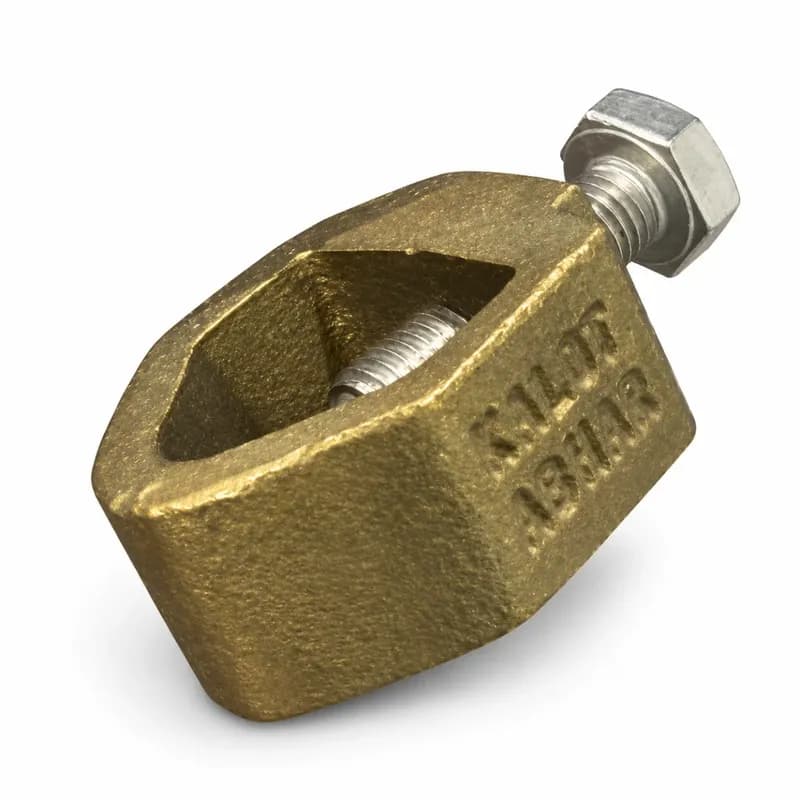
Brass split bolt for conductor-to-conductor connections (SBC)
Last updated:
The split bolt, also known as a split bolt connector, is the simplest clamp for joining two copper conductors: a slotted brass bolt with a single nut. The main and branch conductors sit side by side in the slot, and tightening the nut presses them together between the nut and the bottom of the slot. It takes a branch without cutting the main conductor and also joins two conductors in parallel.
The split bolt is meant for connections that stay accessible and may need opening for measurement or changes, and installation takes only a spanner. Choose the code by the cross-section of the main conductor: we offer 11 sizes from SBC 1010 to SBC 2424 for main conductors of 10 to 240 mm², and each size accepts a wide range of branch conductors. For a permanent connection without bolts, see the C clamp.
Branch and parallel joints of two conductors
A split bolt for branch and parallel joints of copper earth conductors, with one nut and an ordinary spanner.
- Branch and parallel joints of two conductors
- Installs with an ordinary spanner
- Can be opened and re-closed
- 11 sizes, conductors from 1.5 to 240
One size, several branch conductors
Each code takes a specific main conductor and accepts a wide range of branch conductors: for example, 2.5 to 70 mm² for a 70 main conductor.
No special tools
Installation in five steps (PDF)Installation takes only a spanner, so it opens and closes easily on site, inside panels and in inspection pits.
Material
Body, nut and pressure piece in brass, compatible with copper earth conductors.
11 standard codes
Download the datasheet (PDF)Codes SBC 1010 to SBC 2424. Choose the code by the cross-section of the main conductor.
Advice from KALOT specialists
When you enquire, tell us the cross-sections of the main and branch conductors and the quantity you need, and our specialists will recommend the right code.
Technical Product Information
Click to view enlarged
Feature | Value |
|---|---|
Type | Split bolt (slotted bolt and nut) |
Body and nut material | Brass |
Application | Branch and parallel joints of stranded copper conductors in earthing and bonding systems |
Main conductor (A) | 10 to 240 mm² (by code) |
Branch conductor (B) | 1.5 to 240 mm² (by code) |
Installation method | Spanner; no special tools needed |
Connection type | Can be opened and re-closed |
Codes | SBC 1010 to SBC 2424 |
Split bolt (SBC) codes and dimensions
Code | Main conductor A (mm²) | Branch conductor B (mm²) | H (mm) | S (mm) |
|---|---|---|---|---|
SBC 1010 | 10 | 1.5-10 | 20 | 4.1 |
SBC 1616 | 16 | 2.5-16 | 23 | 5.3 |
SBC 2525 | 25 | 2.5-25 | 28 | 6.8 |
SBC 3535 | 35 | 2.5-35 | 29 | 7.9 |
SBC 5050 | 50 | 2.5-50 | 35 | 9.5 |
SBC 7070 | 70 | 2.5-70 | 39 | 10.7 |
SBC 9595 | 95 | 2.5-95 | 45 | 13.5 |
SBC 1212 | 120 | 10-120 | 47 | 14.7 |
SBC 1515 | 150 | 10-150 | 51 | 16.2 |
SBC 1818 | 185 | 50-185 | 57 | 17.8 |
SBC 2424 | 240 | 95-240 | 64 | 19 |
Dimensions are in millimetres and cross-sections in square millimetres. H is the overall height of the split bolt and S is the width of the conductor slot. We keep improving our products and some dimensions may be updated, so please confirm the final dimensions with our specialists before you buy.
Dimensional drawing of the brass split bolt
Download the dimensional drawing (PDF)
Technical drawing of the split bolt
Download the technical drawing (PDF)
Click to view enlarged
Split bolt applications: a clamp for joining two earth conductors
- Taking a branch from the main bare copper conductor to connect equipment frames, panels and structures
- Parallel joints and run extensions of two copper conductors in earthing and bonding systems
- Connecting the bonding conductor of cable trays, pipes and metal frames to the main conductor
- Connections in panels and inspection pits that must open for measurement or changes
- On-site work and repairs where a C clamp press or exothermic welding equipment is not to hand
Execution schematic of a branch joint with a split bolt
Download the execution schematic (PDF)
Split bolt installation steps
- Choose the split bolt code by the cross-section of the main copper conductor (A) and make sure the branch conductor (B) is within the range of that code.
- Clean the strands of both conductors at the joint with a wire brush until bright copper shows.
- Remove the nut. Place the main conductor from one side and the branch conductor from the opposite side into the slot so that both pass fully through it.
- Tighten the nut by hand so the conductors stay in place.
- Hold the body with one spanner and tighten the nut with a second spanner, following the manufacturer's instructions.
- Check that both conductors reach the end of the slot, so the full clamp surface presses on them.
- If the conductors are insulated, strip the insulation just before installation without nicking the strands, and cover the joint with insulating tape after tightening.
Download the installation steps (PDF)
Split bolt installation tools
Installing a split bolt takes two spanners: one to hold the body and one to turn the nut, so that the bolt and conductors do not rotate. No special tools, press or electricity are needed. A torque wrench makes it easier to tighten every joint evenly.
Inspecting a split bolt connection
During periodic inspection of the earthing system, check that the split bolt and conductors are sound and free of corrosion or looseness. A properly tightened connection needs no periodic retightening. If you find any looseness, open the connection, clean it and close it again.
Split bolt enquiries
When you enquire, tell us the cross-sections of the main and branch conductors and the quantity you need, and our specialists will recommend the right code.
Click to view enlarged
The split bolt, also sold as a split bolt connector, is the simplest clamp for joining two copper conductors: one part, one nut and one spanner. Each size takes a wide range of branch conductors, fits in tight spaces, and can be opened and closed again whenever needed. The quality of the connection depends on tightening the nut correctly during installation, so the split bolt suits connections that stay accessible and open to inspection. For permanent branches in high-vibration locations, a compression C clamp is the better choice, and for buried connections, exothermic welding.
Advantages of the brass split bolt
- Simple, fast installation: only a spanner is needed, with no press, mould, flame or electricity.
- Removable: the connection can be opened and closed again for measurement, relocation or correction.
- Wide branch conductor range: each size accepts different branch conductors, which reduces the variety of parts in stock.
- Compact: fits in the tight spaces inside panels and pits.
- The main conductor stays continuous: the branch is taken without cutting the main conductor.
- Brass that suits copper: a brass body alongside a copper conductor makes a connection between metals of the same family.
Split bolt compared with the parallel clamp and C clamp
Feature | split bolt | Two-bolt parallel clamp | C clamp (compression) |
|---|---|---|---|
Connection type | Can be opened and re-closed | Can be opened and re-closed | Permanent |
Installation tools | Two spanners | Spanner | Press and die |
Main quality factor | Correct tightening of the nut during installation | Even tightening of the two bolts | The correct clamp, die and press, and a full press |
Conductor range per size | Wide (for example, branch 2.5 to 70 for main 70) | A defined range per code (for example, 25 to 70) | A defined range for main and branch conductors |
Space required | Low | Medium | Small, but room is needed for the press |
Behaviour under heavy vibration | Needs inspection | Needs inspection | Suitable; it has no bolt |
Best location | Panels, pits and accessible branches | Conductor runs and accessible branches | Permanent branches of the earthing network |
IEEE 837 and IEC 62561-1 judge a connection by its performance, not by how it is made. A bolted, compression or welded connection must each keep its permitted resistance after heating and cooling cycles, corrosion and short-circuit current. In a bolted connection, the most important factor is correct tightening during installation.
If these conditions apply to you, see these clamps as well
Clamp | When |
|---|---|
When you want a larger contact surface and the pressure of two bolts on the conductors. | |
Copper C clamp for branch and parallel earth conductor connections (CCC) | When the connection is permanent, you have a press, or the location has heavy vibration. |
Compare all our earthing clamps in the "Which clamp should we choose?" table.
Like all our earthing clamps, the KALOT split bolt is designed and made to IEC 62561-1, the standard that sets the requirements for connection components of lightning protection and earthing systems, including clamps. Under this standard, connection components are assessed for lightning current in two classes, H (heavy) and N (normal), after first being exposed to corrosive salt mist and a sulphurous atmosphere, so that the behaviour of the connection over time becomes clear.
IEC 62305-3 and BS 7430 call for periodic inspection of the earthing system, so bolted connections should sit where they can be seen, tightened and, if needed, opened for measurement, for example inside an inspection pit or on the structure.
NFPA 780 accepts connecting the down conductor to the earthing system by a suitable bolted, brazed, welded or compression connection. For mechanical and compression connections of power cables, IEC 61238-1 sets the thermal cycling and short-circuit tests.
Brass split bolt, wire to wire
Documents & Downloads
Catalogues & datasheets
Drawings & schematics
- Brass split bolt (SBC) dimensional drawing | Dimension table for 11 codesLanguage: Persian (opens in a new tab)
- Brass split bolt (SBC) technical drawingLanguage: Persian (opens in a new tab)
- Split bolt installation schematic | Branch and parallel connectionsLanguage: Persian (opens in a new tab)
- Split bolt installation in five stepsLanguage: Persian (opens in a new tab)
Frequently Asked Questions
Which clamp should we use to join two earth conductors?
If the connection must stay removable, choose a split bolt or a two-bolt parallel clamp. If it is permanent, choose a compression C clamp. The split bolt is the most compact option, and each size accepts a wide range of branch conductors.
What is a split bolt (split bolt connector)?
A slotted bolt with a single nut. The two conductors sit in its slot, and tightening the nut presses them together.
How do we choose the right split bolt size?
Choose by the cross-section of the main conductor (A). The branch conductor (B) must fall within the range of the same code. For example, for a 50 mm² main conductor and a 16 mm² branch, code SBC 5050 is the right fit.
What tools do we need to tighten a split bolt?
No. It installs with two spanners: one to hold the body and the other to tighten the nut.
Does a split bolt loosen over time?
Under heavy vibration and repeated heating and cooling, the nut of a split bolt can loosen, so the quality of the connection depends on correct tightening during installation. A properly tightened connection needs no periodic retightening: check its appearance during inspections, and if you find any looseness, open the connection, clean it and close it again. For permanent branches in high-vibration locations, a compression C clamp is the better choice.
What is the difference between a split bolt and a C clamp?
A split bolt can be opened and closed again and needs only a spanner. A C clamp is a permanent compression connection, better suited to permanent branches and high-vibration locations.
Is the brass split bolt also suitable for aluminium conductors?
The KALOT brass split bolt is made for copper conductors. For aluminium conductors, please speak to our specialists.
Have a Technical Question?
KALOT Group's technical experts are ready to answer your questions about lightning rods and earthing systems.