
Move your pointer over the image to zoom in
Complete Product Overview
Stainless steel bonding point (reinforcing bar bonding plate)
Last updated:
The KALOT Group stainless steel bonding point creates a fixed earthing point on the face of a concrete structure, connected to the reinforcement inside. Its round plate stays flush with the concrete, and the earthing or bonding conductor is fastened to its M10 bolt with a cable lug. Inside the concrete, a green and yellow conductor joined by exothermic welding to the end of the stem behind the plate is fastened to the reinforcing bar with a galvanised U clamp.
All parts are stainless steel: the 80 mm plate, the threaded sleeve and the 10 mm stem, with an overall length of 232.5 mm. The bonding point is nailed to the formwork before the pour, and once the formwork is struck, a clean, ready connection point remains on the wall or column. To learn more about bonding and foundation earthing, see our related articles.
Connecting reinforcement to the earthing system from the concrete face
The bonding point is fitted to the formwork before the pour. Afterwards, the earthing or bonding conductor connects to the structure's reinforcement with no drilling and no breaking out of concrete.
- A fixed earth connection point on the concrete face
- All stainless steel
- M10 threaded hole for the cable lug
- 10 mm stem for connection to the reinforcement
Flush with the concrete face
The plate is nailed to the formwork and, once the formwork is struck, stays smooth and flush with the wall or column. Nothing protrudes and no concrete needs breaking out.
Inspectable connection
The external conductor is fastened to the M10 bolt with a cable lug and comes off easily for measurement or replacement.
Material: stainless steel
The plate, threaded sleeve and stem are all stainless steel, and the face of the plate, which stays outside the concrete, does not rust.
Drawings and datasheet
Stainless steel bonding point datasheet (PDF)You will find the dimensional drawing, technical drawing, exploded view, installation schematic, installation location, installation steps and three-dimensional view on this page, as PDF files, alongside the bonding point datasheet.
Advice from KALOT Group specialists
When you enquire, send us the number of connection points, the type of structure and the diameter of the reinforcing bar at the connection point, and our specialists will also recommend the right reinforcing bar clamp and cable lug.
Technical Product Information
Click to view enlarged
Feature | Value |
|---|---|
Type | Fixed earthing point (bonding point) for concrete structures |
Material | Stainless steel: plate, threaded sleeve and stem |
Plate | Round, Ø80 × 2.5 mm, with the earth symbol and the KALOT name |
Mounting holes | 3 × Ø4.5 mm for nailing the plate to the formwork |
External connection | M10 × 1.25 threaded hole in the centre of the plate, for the cable lug bolt |
Stem | Ø10 × 195 mm, screws into the sleeve behind the plate |
Overall length | 232.5 mm |
Weight | About 262 g |
Connection to reinforcing bar | A green and yellow conductor is joined to the end of the stem by exothermic welding, and its other end is fastened to the reinforcing bar with a galvanised U clamp |
Installation location | Surface of concrete columns, walls, foundations and beams |
Dimensions
Plate D × t (mm) | Overall length L (mm) | Stem d (mm) | Connection thread | Fixing hole | Weight (g) |
|---|---|---|---|---|---|
80 × 2.5 | 232.5 | 10 | M10 × 1.25 | 3 × Ø4.5 | 262 |
Dimensions are in millimetres and weight in grams; the depth of the external connection thread is about 20 mm. Our products are continually improved and some dimensions may be updated, so please confirm final dimensions with our specialists before you buy.
Dimensional drawing
Download the dimensional drawing (PDF)
Technical drawing
Download the technical drawing (PDF)
Exploded view
Download the exploded view (PDF)
Structure and components
The bonding point is made of three stainless steel parts: an 80 mm round plate, a threaded sleeve welded to the back of the plate, and a 10 mm stem that screws into the sleeve. The plate sits flush with the concrete face, and the M10 threaded hole in its centre takes the cable lug bolt of the external conductor. Three small holes at the plate's edge are for nailing it to the formwork before the pour. Inside the concrete, a green and yellow conductor joined to the end of the stem by exothermic welding is fastened to the reinforcing bar with a galvanised U clamp.
Click to view enlarged
Applications of the bonding point
- Concrete columns and walls: a bonding point connecting the reinforcement of concrete columns and walls to the earth bar and the building's main bonding.
- Foundations and basement walls: an outlet on the wall for the foundation earth electrode and foundation reinforcement, for connection to the earth bar and for measurement.
- Lightning protection down conductors: connecting the down conductor of a lightning protection system to column reinforcement, in structures where the reinforcement forms part of the lightning current path.
- Electrical and plant rooms: bonding points for equipment, cable trays and metal enclosures on the concrete walls of electrical rooms and plant rooms.
Installation schematic
Download the execution schematic (PDF)
Installation positions
Download connection modes (PDF)
Bonding point installation steps
- Screw the stem fully into the sleeve behind the plate.
- Nail the plate to the inside face of the formwork with three nails through the edge holes, and close the threaded hole with a cap or tape to keep concrete slurry out.
- Join a green and yellow insulated copper conductor to the end of the stem by exothermic welding, and fasten its other end to the nearest reinforcing bar with a galvanised U clamp. The concrete cover over the stem, weld and clamp must be complete.
- After the pour and striking of the formwork, remove the cap from the threaded hole; the plate stays flush with the concrete face.
- Fasten the cable lug of the earthing or bonding conductor to the plate with an M10 × 1.25 bolt and washer, and tighten the bolt following the manufacturer's instructions.
- Measure the electrical continuity between the bonding point and the reinforcement or earth bar, and record the result.
Download the installation steps (PDF)
Installation tools
For installation you need a hammer and nails for the formwork, a mould and weld powder for the exothermic weld between the conductor and the end of the stem, and a spanner for the galvanised U clamp and the cable lug bolt.
Checks and measurement
Before the pour, check that the plate is firmly fixed to the formwork and that the exothermic weld at the end of the stem and the U clamp on the reinforcing bar are sound. After the pour, measure the electrical continuity between the bonding points and the earth bar (earth resistance measurement) and record the result.
Requesting a bonding point price
To request a bonding point price, send our specialists the number of connection points, the type of structure (column, wall, foundation) and the diameter of the reinforcing bar at the connection point, and they will also recommend the right reinforcing bar clamp.
Click to view enlarged
In a concrete building, the reinforcement is part of the earthing and bonding system, but it is out of reach once the concrete is poured. The bonding point connects to the reinforcement before the pour and leaves a connection point on the concrete face, so the earthing or bonding conductor can be fastened to it with one bolt whenever needed, without breaking out any concrete.
Advantages of the stainless steel bonding point
- No breaking out of concrete: the connection to the reinforcement is made before the pour.
- All stainless steel: the plate face outside the concrete does not rust.
- Flush and clean: the plate is nailed to the formwork and stays smooth on the wall.
- Inspectable connection: the cable lug opens and closes with one bolt.
- Reliable connection to the reinforcement: the conductor joins the stem by exothermic welding and the reinforcing bar with a galvanised U clamp.
Stainless steel bonding point or brass plate?
Feature | Stainless steel bonding point | Brass reinforcing bar bonding plate |
|---|---|---|
Material | Stainless steel | Brass |
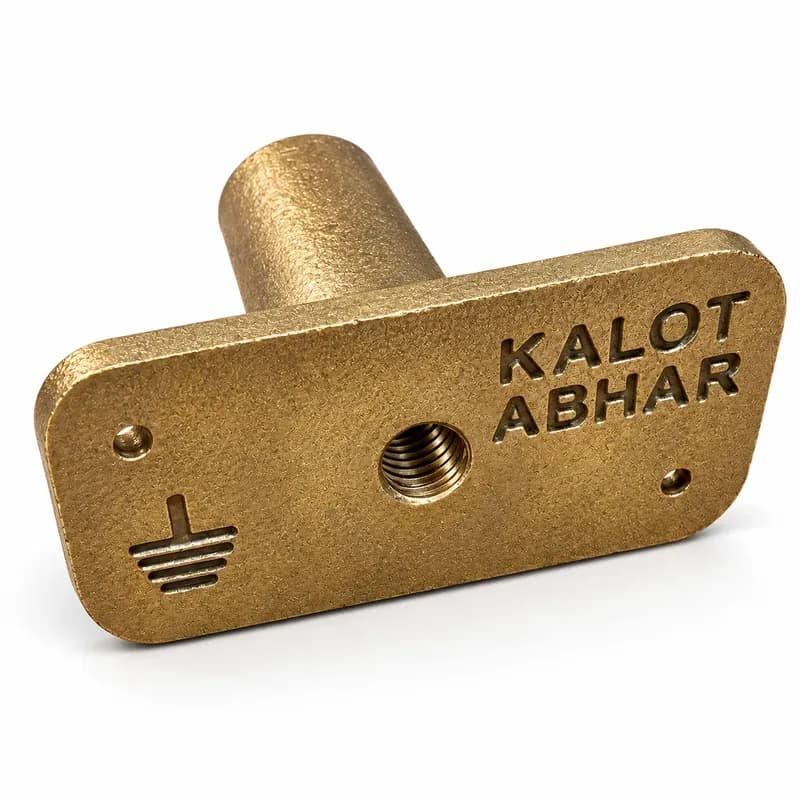
Plate shape | Round, 80 mm in diameter | Rectangular, 80 × 40 or 70 × 40 |
Connection to reinforcing bar | Green and yellow conductor welded to the stem, with a galvanised U clamp | Copper conductor from the plate's shank to the reinforcement |
External connection | One M10 × 1.25 bolt | One or two M10 bolts |
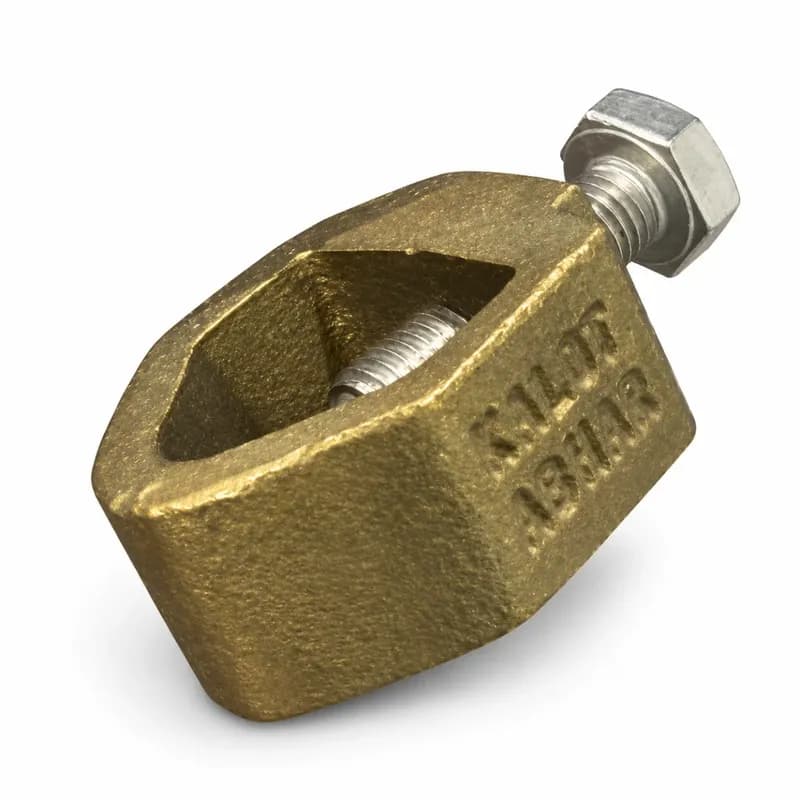
For brass plates, see the reinforcing bar bonding plate and the reinforcing bar bonding plate with conductor.
If this matches your situation, see these products too
Product | When |
|---|---|
Galvanised U clamp for connecting conductor to earth rod or reinforcing bar | For fastening the bonding point's conductor to the reinforcing bar. |
For joining the conductor to the end of the bonding point's stem. | |
For the end of the external conductor. | |
For gathering bonding conductors together. | |
When you need several connection bolts. | |
For metal structures. |
Compare all earthing and bonding clamps in the "Which clamp should we choose?" table.
The KALOT Group bonding point is designed and manufactured in line with IEC 62561-1, the standard that sets requirements for the connection components of lightning protection and earthing systems.
IEC 62305-3 treats the reinforcement of a concrete structure as a natural component of the lightning protection system and requires its continuity and connection to the earthing system. IEC 60364-5-54 also counts foundation reinforcement as an earth electrode.
Part Thirteen of the Iranian National Building Regulations counts foundation reinforcement among the components of a building's main bonding.
The location of the connection points, the conductor cross-sections and the connection method are decided by the earthing system designer. To learn more, see standards for the design and installation of earthing systems.
Three-dimensional view of bonding point installation
Documents & Downloads
Catalogues & datasheets
Drawings & schematics
- Stainless steel bonding point dimensional drawingLanguage: Persian (opens in a new tab)
- Stainless steel bonding point technical drawingLanguage: Persian (opens in a new tab)
- Stainless steel bonding point exploded viewLanguage: Persian (opens in a new tab)
- Stainless steel bonding point installation schematicLanguage: Persian (opens in a new tab)
- Stainless steel bonding point connection modesLanguage: Persian (opens in a new tab)
- Stainless steel bonding point installation stepsLanguage: Persian (opens in a new tab)
Frequently Asked Questions
What is a bonding point?
A bonding point (a fixed earthing point) is a plate that sits on the face of a concrete column or wall, flush with the concrete, and is connected from behind to the reinforcement inside. The earthing or bonding conductor is fastened to its bolt with a cable lug, so the structure's reinforcement connects to the earthing system without breaking out any concrete.
What is the KALOT Group bonding point made of, and what are its dimensions?
All parts are stainless steel. The round plate is 80 mm in diameter and 2.5 mm thick, and the stem is 10 mm in diameter, with an overall length of 232.5 mm. The connection thread is M10 × 1.25 and the weight is about 262 g.
How is a bonding point installed?
The stem screws into the sleeve behind the plate, the plate is nailed with three nails to the inside face of the formwork, and the green and yellow conductor, exothermically welded to the end of the stem, is fastened to the reinforcing bar with a galvanised U clamp. After the pour and striking of the formwork, the plate stays flush with the concrete and the conductor's cable lug is bolted onto it.
How does a bonding point connect to the reinforcement?
A green and yellow insulated copper conductor is joined by exothermic welding to the end of the 10 mm stem, and its other end is fastened to the reinforcing bar with a KALOT Group galvanised U clamp.
What size is the cable lug bolt?
The thread of the hole in the centre of the plate is M10 × 1.25. Choose a stainless steel cable lug bolt with this thread and tighten it following the manufacturer's instructions.
How does the stainless steel bonding point differ from the brass plate?
The stainless steel bonding point has a round plate and a 10 mm stem, and connects to the reinforcement through a welded conductor and a galvanised U clamp. The brass reinforcing bar bonding plate is rectangular, connects to the reinforcement with a copper conductor and has one or two connection bolts.
Where should a bonding point be installed?
On concrete columns and walls, basement walls and foundations, near the earth bar, or wherever a bonding conductor, lightning protection down conductor or equipment must connect to the reinforcement. The earthing system design drawing sets the exact position.
What checks are needed after the concrete is poured?
Remove the cap from the threaded hole, check that the thread is clean, then measure the electrical continuity between the bonding point and the reinforcement or earth bar with a low-resistance ohmmeter and record the result.
What information should we send for a quote?
Send us the number of connection points, the type of structure and the diameter of the reinforcing bar at the connection point, and our specialists will recommend the right reinforcing bar clamp and cable lug and give you a price.
Have a Technical Question?
KALOT Group's technical experts are ready to answer your questions about lightning rods and earthing systems.