
Move your pointer over the image to zoom in
Complete Product Overview
Reinforcing bar bonding plate with conductor for concrete structures
Last updated:
The KALOT Group reinforcing bar bonding plate with conductor is a brass bonding plate with one metre of 70 mm² green and yellow sheathed copper conductor connected to its stem at the factory. The plate stays flush with the surface of the concrete column or wall, while the other end of the conductor is clamped to the reinforcing bar inside the concrete, so no welding is needed on site.
The body has two M10 threaded holes 40 mm apart, one for the earth conductor's cable lug and the other for a second conductor or tape. If you prefer to connect the conductor to the plate yourself, see our brass reinforcing bar bonding plate. To learn more about bonding and foundation earthing, read our related articles.
Ready to install, with no welding on site
The conductor comes connected to the plate from the factory. On site, you simply fix the plate to the formwork and clamp the conductor end to the reinforcing bar.
- 70 mm² copper conductor, connected at the factory
- No welding on site
- Two M10 threaded holes
- One-piece brass body
Conductor ready to use
One metre of 70 mm² copper conductor with a green and yellow sheath comes connected to the plate's stem from the factory.
Two connection points
Two M10 holes on the face, one for the earth conductor's cable lug and one for a second conductor or tape.
Material: brass and copper
The body is a single piece of brass and the conductor is copper with a green and yellow PVC sheath. Brass is compatible with copper conductors and cable lugs.
Drawings and datasheet
Reinforcing bar bonding plate with conductor datasheet (PDF)The dimensional drawing, technical drawing, exploded view, installation schematic, installation steps and connection modes are all here on this page and as PDF files, alongside the datasheet.
Advice from KALOT Group specialists
When you enquire, send the number of points, the type of structure, the distance from the plate to the nearest reinforcing bar and its diameter, and our specialists will recommend the right clamp and cable lug.
Technical Product Information
Click to view enlarged
Feature | Value |
|---|---|
Type | Bonding plate (fixed earthing point) with copper conductor, for concrete structures |
Body material | Brass, one-piece |
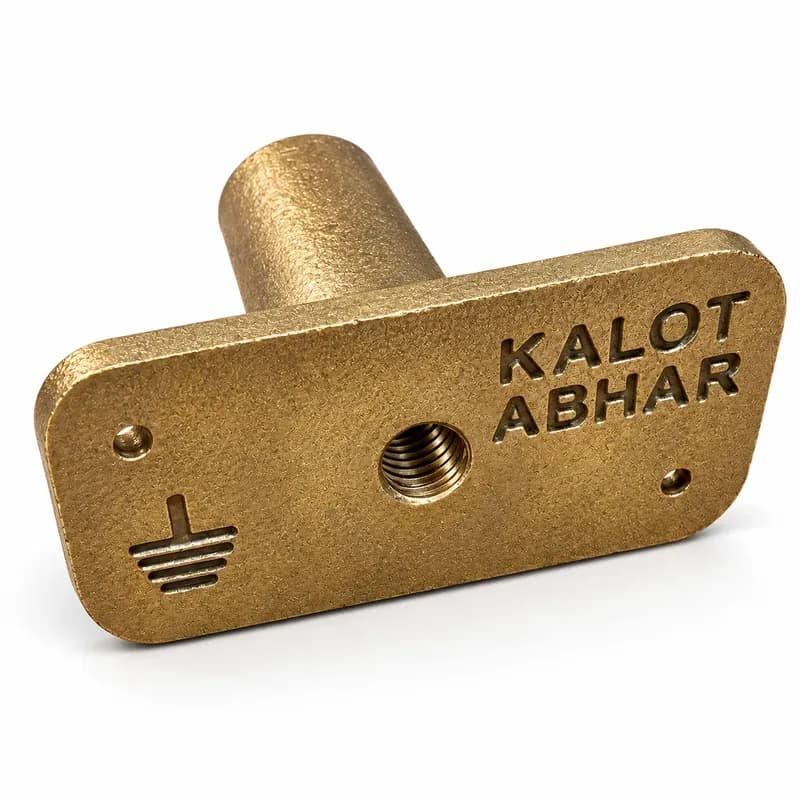
Plate | 70 × 40 × 5 mm, with the earth symbol and the KALOT name |
Connection hole | 2 × M10 (standard thread), 22 mm deep, 40 mm apart |
Stem | Ø15 up to 40 mm, then Ø8; overall body length 100 mm |
Conductor | Copper, 70 mm², green and yellow PVC sheath, length 1000 mm |
Conductor-to-stem connection | At the factory, with a bush on the end of the stem |
Connection to reinforcing bar | Bare conductor end to the reinforcing bar with a U clamp |
External connection | Cable lug or tape with an M10 bolt |
Installation location | Surface of concrete columns, walls, foundations and beams |
Sizes
Model | Plate (mm) | Connection hole | Body length L (mm) | Conductor | Body weight (g) |
|---|---|---|---|---|---|
Two-hole with conductor | 70 × 40 × 5 | 2 × M10 | 100 | 70 mm² × 1000 mm | 242 |
Dimensions are in millimetres and the weight of the brass body without the conductor is in grams. Both holes have M10 threads about 22 mm deep and are 40 mm apart. We are always improving our products and some dimensions may be updated, so please confirm the final dimensions with our specialists before you buy.
Dimensional drawing
Download the dimensional drawing (PDF)
Technical drawing
Download the technical drawing (PDF)
Exploded view
Download the exploded view (PDF)
Plate structure
The body is a single piece of brass: a plate that stays flush with the concrete surface, two bosses behind the threaded holes, a central boss 15 mm in diameter reaching 40 mm from the face, and then a stem 8 mm in diameter reaching 100 mm from the face. The copper conductor is connected at the factory with a bush on the end of the stem. The free end of the conductor is clamped to the reinforcing bar inside the concrete, and the two M10 holes on the face take the earth conductor's cable lug or a tape.
Click to view enlarged
Applications of the bonding plate with conductor
- Concrete columns and walls: a bonding point connecting the reinforcement in columns and walls to the earth bar and the building's main bonding.
- Foundations and basement walls: an outlet on the wall for the foundation earth electrode and foundation reinforcement, for connection to the earth bar and for measurement.
- Lightning protection down conductors: connects the down conductor of the lightning protection system to the column reinforcement, leaving the second hole free for another conductor or tape.
- Projects with many points: when there are many bonding points and welding on site is difficult or time-consuming.
Installation schematic
Download the execution schematic (PDF)
Connection modes
Download connection modes (PDF)
Installation steps for the bonding plate with conductor
- Strip the sheath from the free end of the conductor to the length of the clamp.
- Fix the plate to the inner face of the formwork so that its face sits tight against the formwork, for example with two M10 bolts passed through holes in the formwork and into its threads. These same bolts seal the threads until the concrete has been poured, keeping cement slurry out of them.
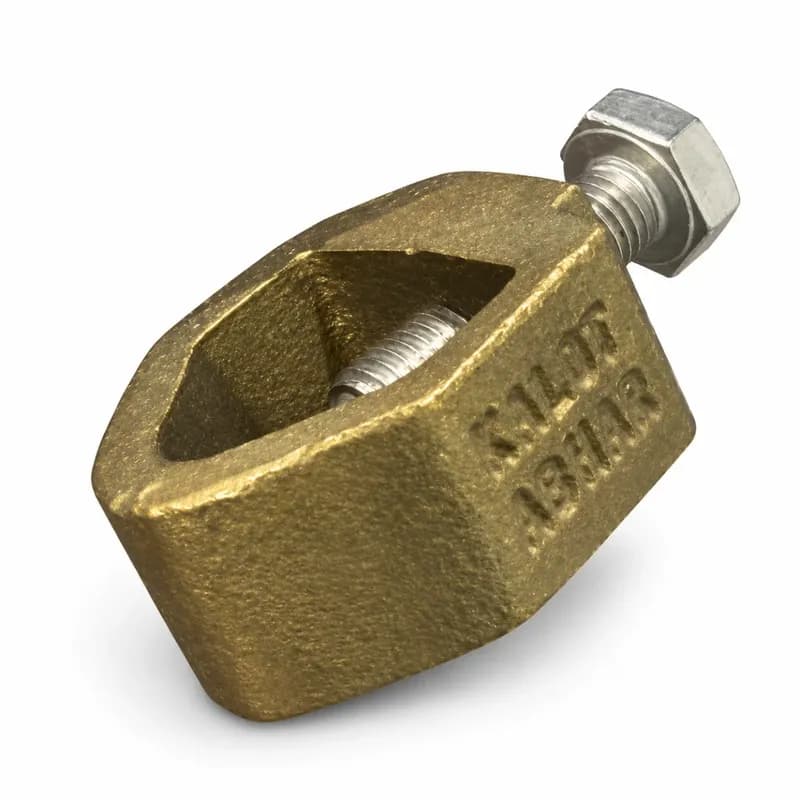
- Take the conductor to the nearest reinforcing bar and fix its bare end with the U clamp for connecting conductor to earth rod and reinforcing bar. Choose the clamp to suit the diameter of the reinforcing bar, and make sure the conductor and clamp are fully covered by concrete.
- After the concrete is poured, undo the bolts holding the plate and remove the formwork. The plate stays flush with the concrete surface.
- Fix the cable lug of the earth conductor, or a tape, to the plate with an M10 bolt and washer, and tighten the bolt according to the manufacturer's instructions.
- Measure the electrical continuity between the plate and the reinforcement or earth bar with a low-resistance ohmmeter and record the result.
Download the installation steps (PDF)
Installation tools
For installation you will need a wire stripper, a spanner (for the formwork bolts, the U clamp and the cable lug bolt) and a low-resistance ohmmeter.
Checks and measurement
Before pouring, check that the plate is firmly fixed to the formwork and the conductor clamp is tight on the reinforcing bar. After pouring, measure the electrical continuity between the plates and the earth bar with a low-resistance ohmmeter and record the results. You can also read our article on earth resistance measurement.
Selection and price enquiry
For a price on the reinforcing bar bonding plate with conductor, send our specialists the quantity, the type of structure, the distance from the plate to the nearest reinforcing bar and its diameter.
Click to view enlarged
In a concrete building, the reinforcement can form part of the earthing and bonding system, provided it is reliably connected, yet it is out of reach once the concrete is poured. The bonding plate with conductor brings this connection to site ready to use: the conductor is connected to the plate at the factory, and on site only its end needs clamping to the reinforcing bar. On projects with many bonding points, this shortens installation time and no welding is needed on site.
Advantages of the bonding plate with conductor
- No welding on site: the conductor is connected to the plate at the factory.
- Quick installation: the plate is fixed to the formwork and the conductor end is clamped to the reinforcing bar.
- 70 mm² conductor: with a green and yellow sheath that identifies the earth conductor.
- Two connection points: two M10 holes for a cable lug and a tape.
- No breaking into concrete: the connection to the reinforcement is made before the concrete is poured.
Bonding plate with or without conductor?
Feature | Bonding plate with conductor | Brass bonding plate (without conductor) |
|---|---|---|
Connection to reinforcing bar | 70 mm² conductor connected at the factory, and a U clamp | Copper conductor exothermically welded to the stem, and a U clamp |
Welding on site | Not needed | To connect the conductor to the stem |
Models | Two-hole, 70 × 40 | One-hole 80 × 40 (horizontal and vertical) and two-hole 70 × 40 |
Stem | Ø8, overall length 100 | Tapered, overall length 55 or 40 |
If you connect the conductor to the plate yourself, see our brass reinforcing bar bonding plate, and for a weld-free connection using a steel bar, see our stainless steel bonding point.
If this matches your situation, see these products too
Product | When |
|---|---|
U clamp for connecting conductor to earth rod and reinforcing bar | For clamping the conductor end to the reinforcing bar. |
When you connect the conductor to the plate yourself. | |
When you want a weld-free connection using a steel bar. | |
For the end of the external conductor. | |
For gathering bonding conductors together. |
Compare all earthing and bonding clamps in the "Which clamp should we choose?" table.
The KALOT Group bonding plate is designed and made in accordance with IEC 62561-1, the standard that sets the requirements for connection components of a lightning protection system, including its earthing system.
IEC 62305-3 treats the reinforcement of a concrete structure, provided it is electrically continuous, as a natural component of the lightning protection system and requires it to be connected to the earthing system. IEC 60364-5-54 also recognises foundation reinforcement (except in prestressed concrete), when reliably connected, as an earth electrode.
Part Thirteen of the National Building Regulations requires main bonding in all buildings and lists the steel reinforcing bars inside reinforced concrete among the types of earth electrode.
The location of the connection points, the conductor cross-sections and the connection method are decided by the earthing system designer. To learn more, see standards for the design and installation of earthing systems.
Reinforcing bar bonding plate with conductor for concrete structures
Documents & Downloads
Catalogues & datasheets
Drawings & schematics
- Reinforcing bar bonding plate with conductor dimensional drawingLanguage: Persian (opens in a new tab)
- Reinforcing bar bonding plate with conductor technical drawingLanguage: Persian (opens in a new tab)
- Reinforcing bar bonding plate with conductor exploded viewLanguage: Persian (opens in a new tab)
- Reinforcing bar bonding plate with conductor installation schematicLanguage: Persian (opens in a new tab)
- Reinforcing bar bonding plate with conductor connection modesLanguage: Persian (opens in a new tab)
- Reinforcing bar bonding plate with conductor installation stepsLanguage: Persian (opens in a new tab)
Frequently Asked Questions
What is a reinforcing bar bonding plate with conductor?
It is a brass bonding plate whose copper conductor is connected to the stem at the factory. The plate stays flush with the concrete surface, the conductor end inside the concrete is clamped to a reinforcing bar, and the earth or bonding conductor is fixed to the plate with a cable lug and an M10 bolt.
What are the specifications of the conductor?
A 70 mm² copper conductor with a green and yellow PVC sheath, one metre long, connected to the plate at the factory with a bush on the end of the stem.
What are the plate's dimensions and material?
The body is one-piece brass. The plate measures 70 × 40 and is 5 mm thick, with two M10 threaded holes 40 mm apart. The overall body length to the end of the stem is 100 mm.
How is the bonding plate with conductor installed?
Strip the sheath from the conductor end, fix the plate to the inner face of the formwork (for example with M10 bolts from behind the formwork) and clamp the bare conductor end to the nearest reinforcing bar with a U clamp. After pouring the concrete and removing the formwork, fix the earth conductor's cable lug to the plate.
Which clamp connects the conductor to the reinforcement?
With KALOT Group's U clamp for connecting conductor to earth rod and reinforcing bar, which grips the bare conductor end firmly on the reinforcing bar.
How does it differ from the brass bonding plate without a conductor?
With the brass reinforcing bar bonding plate, the conductor is joined to the stem on site by exothermic welding, and that plate comes in one-hole and two-hole models. With the bonding plate with conductor, the conductor is already connected at the factory, so no welding is needed on site.
What size is the cable lug bolt?
M10 with a standard thread. Use stainless steel bolts and washers, and tighten the bolt according to the manufacturer's instructions.
What checks are needed after the concrete is poured?
Check that the threads are clean, then measure the electrical continuity between the plate and the reinforcement or earth bar with a low-resistance ohmmeter and record the result.
What information should we send for a quote?
Send us the quantity, the type of structure, the distance from the plate to the nearest reinforcing bar and its diameter, and our specialists will recommend the clamp and cable lug and give you a price.
Have a Technical Question?
KALOT Group's technical experts are ready to answer your questions about lightning rods and earthing systems.