Short answer: the international standard for ground improvement materials is IEC 62561-7, whose latest edition was published in 2024. It requires specific documents and marking from the manufacturer and assesses the material with five tests: leaching, sulphur content, resistivity, pH and corrosion. In Iran, the "Earthing System Safety Regulation" (1401), binding on workplaces covered by the Labour Law, states in Article 63 that all additive compounds for earthing must be tested to Iranian national standard INSO 18499-7.
We at KALOT Group have been producing ground improvement materials for more than 20 years. In this guide we explain in plain language what these standards ask for and which documents help you recognise a standard material. If you want to know what makes a good material and how to choose one, also read our article on the specifications of standard ground improvement materials.
What is IEC 62561-7?
IEC 62561-7 is Part 7 of the "Lightning protection system components" series of standards and is titled "Requirements for earthing enhancing compounds" (Earthing Enhancing Compounds). It sets the requirements and tests for materials placed between the earth electrode and the soil to lower the resistance of the earthing system.
- First edition: 2011; second edition: 2018; third and current edition: February 2024.
- The 2024 edition adds pH measurement to the tests and marking, and simplifies the chart used for the corrosion test.
- Its European version, EN IEC 62561-7:2024, has replaced the older EN 50164-7:2008. So a document that still cites EN 50164-7 or BS EN 50164-7 is referring to an old standard.
What does IEC 62561-7 require of a ground improvement material?
The standard has two groups of requirements. The first covers documents and marking. The second covers type tests, which are carried out on three samples of each material and repeated only if the materials, design or manufacturing method change.
Documents and marking
- Product documents (clause 4.2): preparation instructions, installation instructions, the resistivity value with the test method used to measure it, and a declaration of compliance with IEC 62561-7.
- Marking (clause 4.4): the manufacturer's name or trademark, the product identification mark, the type or batch number, resistivity and pH. The batch number, resistivity and pH may appear in the accompanying documents instead of on the pack.
The five tests
Test | Method | Acceptance criterion |
|---|---|---|
Leaching (clause 5.2) | EN 12457-2: measuring iron, copper, zinc, nickel, cadmium, cobalt and lead in water | According to each country's national or international regulations |
Sulphur content (clause 5.3) | ISO 4689-3 | Less than 2% in each sample; the value is declared in the product documents |
Resistivity (clause 5.4) | Four-electrode soil box to ASTM G57 | No fixed figure; the manufacturer declares the value |
pH (clause 5.5) | Measuring the pH of the sample | As set out in clause 5.5 of the standard |
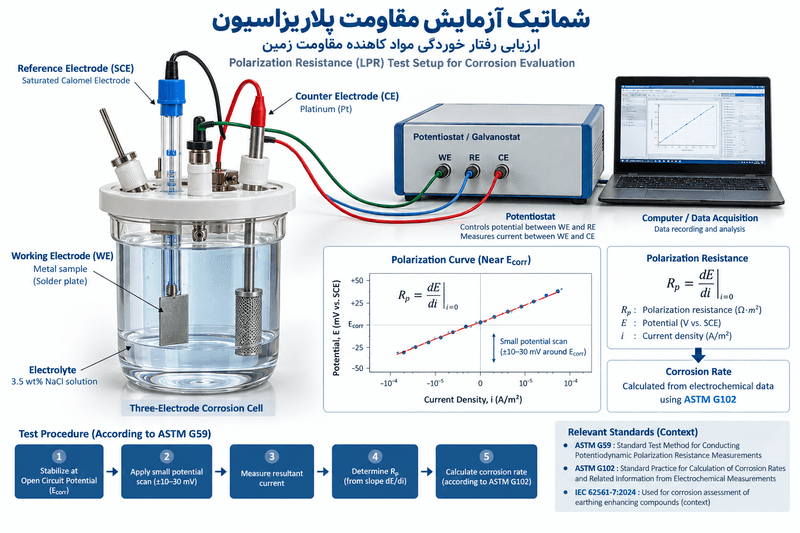
Corrosion (clause 5.6) | Polarisation resistance of the electrode in the material, to ASTM G59 and ASTM G102 | As set out in clause 5.6 of the standard |
How is resistivity measured?
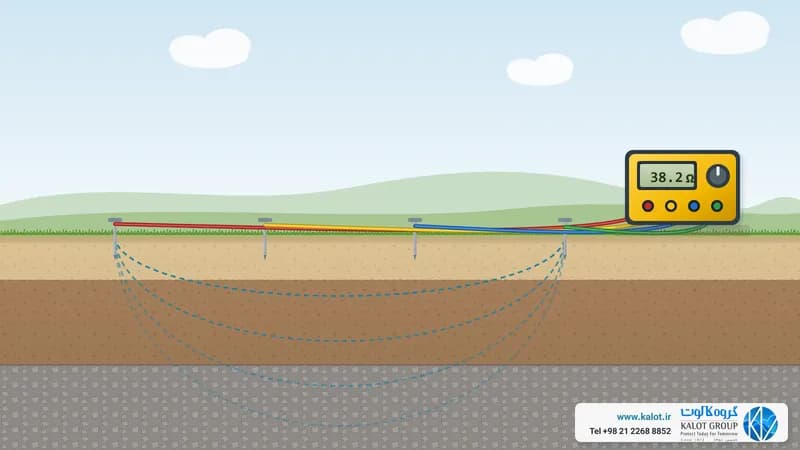
A sample of the material is prepared according to the manufacturer's instructions and, after the declared curing time, tested in a four-electrode soil box: two plates at the ends of the box inject the current and two pins in the middle measure the voltage. Resistivity is calculated from ρ = R · A / a. Since the standard sets no limit value for resistivity, when comparing two materials make sure both figures were measured by this same method and after curing.
Why does the corrosion test matter?
A ground improvement material stays in contact with the electrode for years, and if it is corrosive it will destroy the electrode before the end of its service life. The corrosion test measures the polarisation resistance of the electrode in the material: the higher this figure, the slower the corrosion. For corrosive environments and copper electrodes, reputable manufacturers work to a polarisation resistance above 8 Ω·m². For more on how these materials affect corrosion, see our article Do ground improvement materials prevent corrosion of the earthing system?
What is required of ground improvement materials in Iran?
The "Earthing System Safety Regulation" was approved in the Iranian year 1401 by the Supreme Council for Technical Protection and the Minister of Labour (Circular No. 236822). Under Articles 85, 86 and 91 of the Labour Law, it is binding on all employers whose workplaces are covered by that law. Article 63 of the regulation permits electrolyte in soils with high resistivity, on these conditions:
- it must be safe for people and the environment;
- all additive compounds for earthing must be tested to Iranian national standard INSO 18499-7 (latest revision);
- it must offer properties such as low resistivity, very low corrosivity, long life, environmental compatibility, moisture absorption, resistance to wash-out by surface and ground water, and good adhesion to the electrode. We explain these properties one by one in our article on the specifications of standard ground improvement materials.
Before this regulation, domestic references such as Publication 110, the National Building Regulations and Ministry of Energy publications only mentioned that these materials exist, along with older types such as salt and charcoal or bentonite, and required no specific properties. In gas industry projects, the IGS-I-EL-001 standard is also applied.
Note that these rules do not make the use of a ground improvement material mandatory, but if you do use one, it must be tested and meet the standard. Which soils need such a material is covered in our article Should ground improvement materials always be used, in every soil?
How to recognise a valid test report
"Complies with IEC 62561-7" on a brochure is not enough. Ask the seller for a test report from an accredited laboratory and check that it shows the following:
- the names of the laboratory and the manufacturer, a description of the sample and the test date;
- the edition of the standard the test was carried out to (preferably 2024);
- the numerical result of each test and a "pass" or "fail" verdict for each one;
- for workplaces covered by the Labour Law in Iran, testing to INSO 18499-7.
Commercial bentonite, salt and charcoal are not usually assessed with these tests and, in our view, cannot pass the corrosion test. We give the details in our articles on salt and charcoal and bentonite. On leaching and pollution, see also Are ground improvement materials pollutants?
GIM materials and the standards
We produce the GIM family of ground improvement materials in line with IEC 62561-7 and IGS-I-EL-001. To give our customers confidence, we ask laboratories to take test samples from our warehouse unannounced. Test reports on resistivity, polarisation resistance, sulphur content and leaching from Tarbiat Modares University, Amirkabir University of Technology and the Razi Metallurgical Laboratory are on each product's page:
- GIM: a carbon-based material for highly corrosive soils and environments, with resistivity below 0.5 Ω·m, polarisation resistance above 8 Ω·m² and sulphur below 1.2%.
- GIM LIGHT: for normal environments and conditions.
- ECO GIM: with its own dedicated installation method.
To estimate the quantity of material, use our GIM calculator, and to calculate the resistance of an electrode in the material, see our article on calculating earth electrode resistance. We also carry out earthing system design and earthing system resistance measurement. For a quote, send our specialists the soil type, the dimensions of the pit or trench and the target resistance, or get in touch through our contact page.