
Move your pointer over the image to zoom in
Complete Product Overview
Two-bolt parallel conductor-to-conductor clamp (PCC)
Last updated:
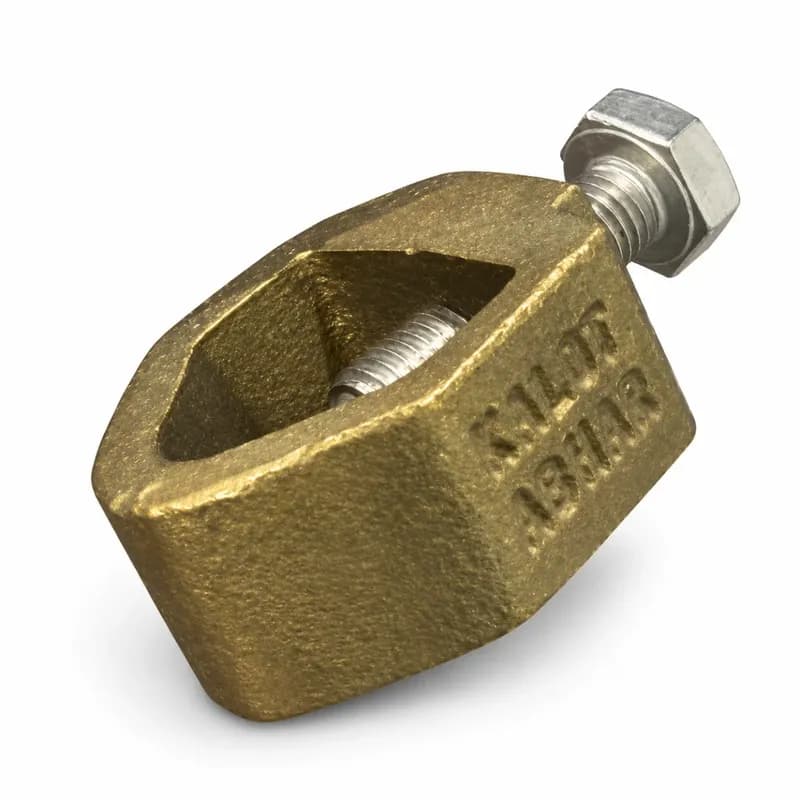
The two-bolt parallel clamp from KALOT Group (code PCC), known in the market as the "two-bolt clamp", joins two copper earth conductors side by side, in parallel. The body is two cast brass jaws: the upper jaw has two semicircular grooves with edges bent over the conductors, and the lower jaw has two shallow grooves. Two stainless steel bolts on the centre line of the clamp, between the two conductors, draw the jaws together and press each conductor into its own groove.
With this clamp you can take a branch from the main conductor of an earthing network without cutting it, join two conductors along a run, or bond two parallel conductors at one point. The joint is bolted, so it can be opened and closed again for inspection and measurement. We offer four codes: PCC 35 and PCC 50 for 25 to 70, PCC 70 for 70 to 95, and PCC 95 for 95 to 185 mm². Our specialists are here to help you choose the code and get a price.
Two-bolt clamp for the parallel joint of two earth conductors
To choose a two-bolt parallel clamp, check the cross-section of both conductors. Both must fall within the range of the same code.
- Parallel joint of two copper conductors, with two bolts
- Conductors from 25 to 185 mm² in four codes
- Two-jaw brass body, stainless steel bolts and nuts
- Branch without cutting the main conductor, removable
Two bolts, pressure over a longer length
Two bolts at the two ends of the clamp draw the jaws together over a longer length of conductor, so the pressure on the conductors is more even.
The main conductor stays uncut
The main conductor runs through one groove and the branch conductor is clamped in the other, so the branch is taken without interrupting the earthing network.
Material: brass and stainless steel
The two jaws of the clamp are cast brass, and the two bolts, two washers and two nuts are stainless steel. Brass is compatible with a copper conductor and the bolts resist corrosion.
Four PCC codes and drawings
Two-bolt parallel clamp datasheet (PDF)You will find codes PCC 35 to PCC 95, with conductor range, length, width and bolt size, in the technical specifications tab, and the shape of the clamp in the dimensional drawing, technical drawing, exploded view and datasheet of the two-bolt parallel clamp.
Advice from KALOT Group specialists
When you enquire, send us the cross-section of both conductors, the type of joint (branch, continuation or two through-run conductors), the installation location and the quantity you need, and our specialists will advise the right code and the price.
Technical Product Information
Click to view enlarged
Feature | Value |
|---|---|
Type | Two-bolt parallel clamp (two-bolt clamp) for the parallel joint of two copper conductors |
Body | Two cast brass jaws: upper jaw with two semicircular grooves and bent edges, lower jaw with two shallow grooves |
Bolt, washer and nut | Stainless steel: two hexagon bolts with washers and two nuts, on the centre line of the clamp between the two conductors |
Suitable conductor | Stranded copper conductor: main and branch conductors, both within the range of the same code |
Conductor range | 25 to 185 mm² in four codes |
Dimensions | Length 50 to 65 and width 40 to 57 mm, depending on the code (see the code table) |
Bolts | Two M8 × 35 bolts for PCC 35 and PCC 50; two M10 × 45 bolts for PCC 70 and M10 × 55 for PCC 95 |
Arrangement | Two parallel conductors, on either side of the bolts |
Connection type | Bolted, can be opened and refastened |
Installation location | Accessible locations: on a wall or cable tray, inside a panel or in an inspection pit |
Codes | PCC 35, PCC 50, PCC 70 and PCC 95 |
Codes and dimensions of the two-bolt clamp (PCC)
Code | Nominal conductor (mm²) | Main and branch conductor range (mm²) | L (mm) | W (mm) | Bolt |
|---|---|---|---|---|---|
PCC 35 | 35 | 25-70 | 50 | 40 | 2 × M8 × 35 |
PCC 50 | 50 | 25-70 | 50 | 40 | 2 × M8 × 35 |
PCC 70 | 70 | 70-95 | 54 | 45 | 2 × M10 × 45 |
PCC 95 | 95 | 95-185 | 65 | 57 | 2 × M10 × 55 |
Cross-sections are in square millimetres and dimensions in millimetres. L is the length of the clamp along the conductors and W is its width. The "conductor range" applies to both grooves of the clamp. The main and branch conductors need not be the same size, as long as both fall within the range of the same code. We continually improve our products and some dimensions may be updated, so please confirm the final dimensions with our specialists before you buy.
Dimensional drawing
Download the dimensional drawing (PDF)
Technical drawing
Download the technical drawing (PDF)
Exploded view
Download the exploded view (PDF)
Conductor grooves and bolts
Each jaw of the clamp has two grooves, one on each side of the centre line. When the jaws close on each other, each pair of grooves forms a channel for one conductor. The two bolts pass through both jaws on the centre line, between the two channels. As the nuts tighten, the bent edges of the upper jaw press the conductors into the grooves of the lower jaw. Because the bolts pass beside the conductors and not over them, the main conductor runs through the clamp without being cut or opened.
Click to view enlarged
Applications of the two-bolt parallel clamp
- Taking a branch from the main conductor of the earthing network of a building, plant or substation and running it to an earth bar, panel or piece of equipment, without cutting the main conductor
- Joining two copper conductors along the run of an earth or bonding conductor, where a conductor falls short or the route changes
- Bonding two parallel conductors at one point, such as two bonding conductors or two parallel earth conductors on a wall or cable tray or in an inspection pit
- Connecting the bonding conductor of metal structures and equipment to the main earth conductor
Installation schematic
Download the execution schematic (PDF)
Connection modes
Download connection modes (PDF)
Installation steps for the two-bolt clamp
- Choose the clamp code by the conductor cross-sections. Both conductors must fall within the range of the same code.
- Clean oxide, grease and paint off both conductors at the clamp position with a wire brush.
- Loosen the nuts until the two jaws move apart. The bolts do not need to come out completely.
- Lay the two conductors in the two grooves, one on each side of the bolts, so they sit fully in the grooves. Let the end of the branch conductor stick out slightly from the clamp.
- Tighten the two nuts first by hand, then alternately and evenly following the manufacturer's instructions, so the jaws press both conductors at the same time.
- Check that the clamp does not move on the conductors and that the joint stays in an accessible place.
Download the installation steps (PDF)
Installation tools
For installation, two spanners that fit the bolt head and nut and a wire brush are all you need. This joint requires no crimping tool or heat.
Inspection and measurement
During periodic inspections of the earthing system, check the clamp for looseness, corrosion and conductor damage. If the joint has loosened or the contact point has corroded, undo the nuts, clean the contact surface and close it again following the manufacturer's instructions. For earth resistance measurement, the test joint or disconnect link of the earthing system is opened. Measure the resistance of the joint itself with a micro-ohmmeter across the clamp, with the clamp closed. If it is high, open, clean and close the clamp again in the same way.
Choosing and getting a price for a two-bolt clamp
When you enquire, send us the cross-section of both conductors, the type of joint (branch, continuation or two through-run conductors), the installation location and the quantity you need, and our specialists will advise the right code and the price.
Click to view enlarged
When you need to take a branch from the main earth conductor or join two conductors side by side, and the joint must stay removable, the two-bolt parallel clamp is a simple choice: the main conductor stays uncut, installation takes only a spanner, and the two bolts spread the pressure over a longer length of conductor. Lightning protection and earthing standards accept bolted joints and require them to be firm, not to loosen, to be protected against corrosion and to remain accessible for inspection. To compare clamp materials, see Earth clamp materials: brass, copper or galvanised.
Advantages of the two-bolt parallel clamp
- Two bolts, two pressure points: pressure is applied at the two ends of the clamp and the conductors have more contact area with the jaws.
- No cutting of the main conductor: the main conductor runs through the clamp and the branch is taken at the same point.
- A conductor range for each code: each code covers a range of cross-sections, so the main and branch conductors need not be the same size.
- Removable: for inspection, measurement or a change of route, you undo the nuts and close them again.
- No special tools: installation takes two spanners and needs no crimping or welding equipment.
Two-bolt clamp, split bolt or C clamp?
Feature | Two-bolt clamp (PCC) | Split bolt (SBC) | C clamp (CCC) | Single-bolt parallel clamp (PTEC) |
|---|---|---|---|---|
What it connects | Two conductors to each other | Two conductors to each other | Two conductors to each other | Two conductors to each other and to the structure |
Fixing method | Two bolts and two jaws | One bolt | Crimped with a tool | One bolt through the structure |
Can be opened and re-closed | Yes | Yes | No, permanent | Yes |
Conductor cross-section (square millimetres) | 25 to 185 (four codes) | 1.5 to 240 | 1.5 to 240 | 120 to 300 |
Body | Two-plate brass | Brass | Copper | Two-plate brass |
If the joint must be permanent and a crimping tool is available, see the C clamp. For tight spots or smaller conductors, the split bolt is more compact. If the two conductors must also connect to a metal structure, the single-bolt parallel clamp is the right choice. For joints buried in soil, we recommend exothermic welding.
If these conditions apply to you, see these clamps as well
Clamp | When |
|---|---|
Brass split bolt for conductor-to-conductor connections (SBC) | When space is tight or the conductors are smaller and one bolt is enough. |
Copper C clamp for branch and parallel earth conductor connections (CCC) | When you want a permanent crimped joint that will not be opened. |
Single-bolt parallel clamp for connecting two conductors to metal structures and towers (PTEC) | When the two conductors must also connect to a structure or tower. |
When the branch must leave the main conductor at a right angle, in a T shape. | |
When the connection is buried in soil or a permanent connection without bolts is needed. |
Compare all our earthing clamps in the "Which clamp should we choose?" table.
KALOT Group's two-bolt parallel clamp is designed and made to IEC 62561-1, the standard that sets the requirements for connection components of lightning protection and earthing systems, including parallel connectors. Under this standard, connection components are assessed for lightning current in two classes, H (heavy) and N (normal), after first being exposed to corrosive salt mist and a sulphurous atmosphere, to show how the joint behaves over time.
IEC 62305-3 accepts bolted joints for the conductors of a lightning protection system, asks that the number of joints be kept to a minimum, and does not permit joints in soil without effective protection against corrosion. Periodic inspection of joints and retightening of loose parts are also part of system maintenance. In the same standard, the minimum cross-section of stranded copper conductor for air-termination conductors, down conductors and earth electrodes is usually 50 mm², and less for bonding conductors.
IEC 60364-5-54 requires protective conductor joints to remain accessible for inspection and testing, except in cases such as welded or brazed, crimped, compound-filled or encapsulated joints. BS 7430, for its part, calls for measuring the resistance across joints with a micro-ohmmeter when maintaining substation earthing systems, and a joint with high resistance should be opened, cleaned and closed again, or replaced.
In Iran, Topic 13 of the National Building Regulations requires earthing system joints to be reliable and firm and the materials of joint components to be compatible with the conductor. The new draft of this topic also calls for checking the tightness and corrosion of joints during periodic inspections. To learn more, see Standards for the design and installation of earthing systems.
Two-bolt parallel clamp, wire to wire
Documents & Downloads
Catalogues & datasheets
Drawings & schematics
- Two-bolt parallel clamp dimensional drawing (PCC)Language: Persian (opens in a new tab)
- Two-bolt parallel clamp technical drawingLanguage: Persian (opens in a new tab)
- Two-bolt parallel clamp exploded viewLanguage: Persian (opens in a new tab)
- Two-bolt parallel clamp installation schematicLanguage: Persian (opens in a new tab)
- Two-bolt parallel clamp connection modesLanguage: Persian (opens in a new tab)
- Two-bolt parallel clamp installation stepsLanguage: Persian (opens in a new tab)
Frequently Asked Questions
What is a two-bolt clamp (two-bolt parallel clamp) and what is it used for?
The two-bolt clamp is a two-jaw brass clamp with two stainless steel bolts that joins two copper earth conductors side by side, in parallel. It is mostly used to take a branch from the main conductor of an earthing network without cutting it, to join two conductors along a run, and to bond two parallel conductors.
How do I join two earth conductors with a two-bolt clamp?
Clean the surface of both conductors with a wire brush and loosen the nuts. Lay the two conductors in the two grooves of the clamp, one on each side of the bolts, then tighten the two nuts alternately and evenly, following the manufacturer's instructions. You will find the full steps, with figures, in the "Application and installation" tab.
What conductor sizes does the two-bolt clamp take?
Choose the code by the conductor cross-section: PCC 35 and PCC 50 for 25 to 70, PCC 70 for 70 to 95, and PCC 95 for 95 to 185 mm². If your conductor sits on the boundary between two codes, send the details to our specialists.
Do the two conductors in a two-bolt clamp have to be the same size (same cross-section)?
Not necessarily. Each code covers a range of cross-sections, so the main conductor and the branch conductor only need to fall within the range of the same code, for example a 50 and a 35 mm² conductor with code PCC 50.
What is the KALOT two-bolt clamp made of: copper or brass?
The body of our clamp is cast brass, and the bolts, washers and nuts are stainless steel. Brass is a copper alloy, so the material is compatible with a copper conductor.
What is the difference between a two-bolt clamp and a split bolt?
Both join two conductors. The two-bolt clamp has two jaws and two bolts and spreads the pressure over a longer length of conductor. The split bolt has a single bolt, is more compact, and also comes in models for tight spots and smaller conductors.
Which is better: a two-bolt clamp or a crimped C clamp?
A two-bolt clamp is closed with a spanner and can be opened for inspection and measurement. A C clamp is closed with a crimping tool and makes a permanent joint that can no longer be opened. The choice depends on whether the joint needs to stay removable.
Two-bolt or single-bolt parallel clamp: which should I choose?
The two-bolt parallel clamp only joins two conductors to each other. If the two conductors must also connect to a metal structure, an equipment base or a tower, see the single-bolt parallel clamp.
Can a two-bolt clamp be buried in soil?
No. The two-bolt clamp is made for accessible joints, such as on a wall, on a cable tray, inside a panel or in an inspection pit, where it can be seen and opened for measurement. For joints buried in soil, we recommend exothermic welding.
How often should the bolts of a two-bolt clamp be retightened?
A bolted connection that has been fastened correctly does not need periodic tightening. During periodic earthing system inspections, check the clamp for looseness and corrosion; if it has come loose, open it, clean it and close it again following the manufacturer's instructions.
Is the two-bolt clamp also suitable for aluminium conductors?
Our two-bolt clamp is made for the copper conductors of earthing and bonding systems, and it differs from the aluminium two-bolt clamps used on overhead lines. For aluminium conductors, please talk to our specialists.
Have a Technical Question?
KALOT Group's technical experts are ready to answer your questions about lightning rods and earthing systems.