
Move your pointer over the image to zoom in
Complete Product Overview
Three-way conductor-to-conductor clamp
Order Code: TC 50070 · TC 95120
Last updated:
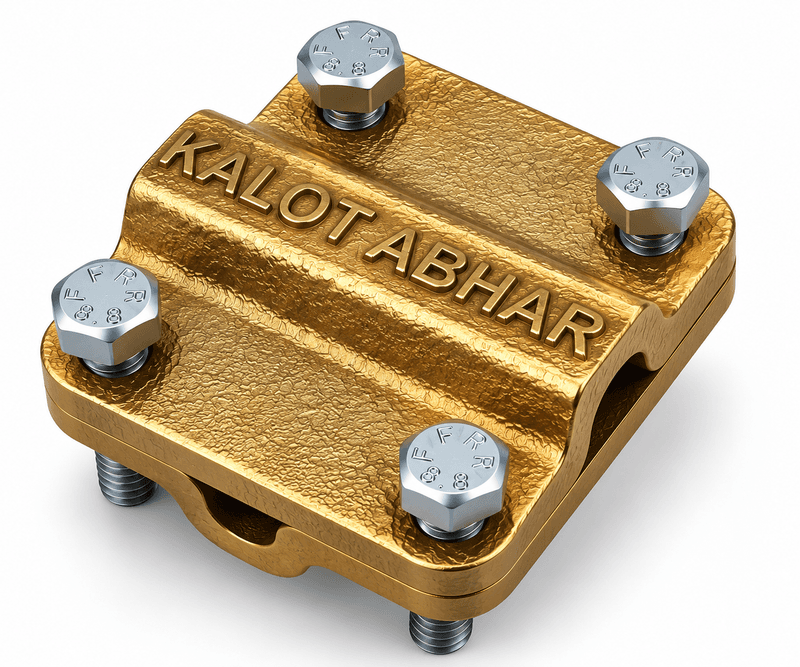
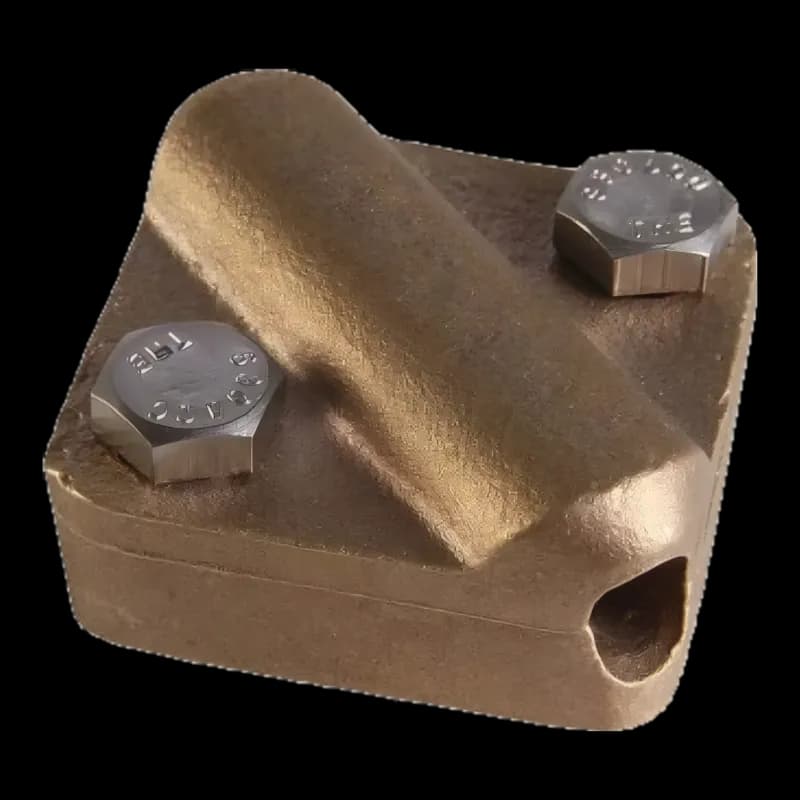
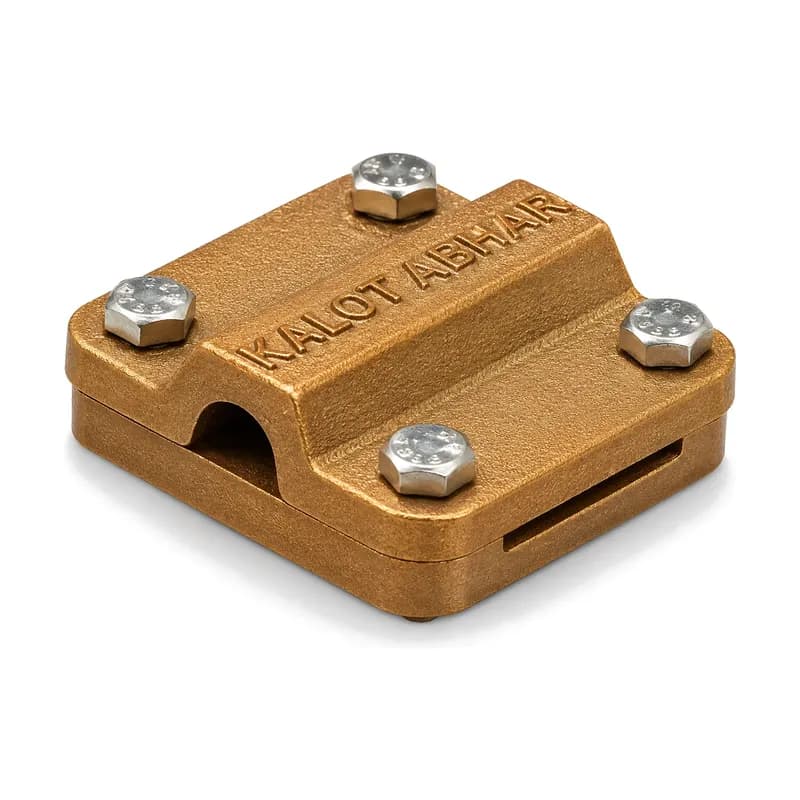
The KALOT three-way conductor-to-conductor clamp (T-Clamp) makes T joints and branches from round stranded copper conductors in lightning protection and earthing systems. The main conductor runs through the clamp without a break and the branch conductor connects to it in the same clamp.
The clamp consists of two brass halves that close with one stainless steel bolt: the main conductor sits in the round passage at the wide edge and the branch conductor enters from the narrow edge, between the two halves.
Two models: TC 50070 for 50 to 70 mm² conductors and TC 95120 for 95 to 120 mm² conductors; dimensions 54 × 41 × 7 mm.
We offer this clamp for clean, reliable branching from the copper conductor network on your project.
Branching from a round copper conductor without interrupting the main run
In lightning protection and earthing systems, round copper conductors often need a branch partway along their run, for example to connect a secondary conductor to a ring or roof conductor network, or to bond a metal body to the main conductor. This clamp makes the T joint mechanically with a bolt. The main conductor runs through it without a break and does not need to be cut.
T joint without cutting the main conductor
The main conductor runs through the round passage at the wide edge of the clamp and keeps its continuity, while the branch connects to it at the same point.
Two halves and one bolt
The two halves of the clamp close with one stainless steel bolt, and tightening that single bolt secures both conductors.
Two models for two conductor ranges
Model TC 50070 for 50 to 70 mm² conductors and model TC 95120 for 95 to 120 mm² conductors.
Brass body, stainless steel bolt
We chose a brass body with a stainless steel bolt to reduce the risk of corrosion at the joint and keep the connection durable over time.
Inspectable mechanical connection
The joint is bolted, with no welding. During periodic inspection you can check bolt tightness, conductor condition and electrical continuity.
Technical Product Information
Feature | Value |
|---|---|
Product type | Three-way conductor-to-conductor clamp (T-Clamp) |
Connection type | T joint: one main through-run conductor and one branch conductor |
Conductor | Round stranded copper conductor |
Conductor cross-section range | TC 50070: 50 to 70 mm²; TC 95120: 95 to 120 mm² |
Body material | Brass |
Bolt | One, stainless steel (with nut and washer, as in the product photo) |
Structure | Two halves; round passage at the wide edge for the main conductor; branch conductor enters from the narrow edge, between the two halves |
Dimensions (both models) | L = 54 mm, W = 41 mm, H = 7 mm |
Order code | TC 50070 , TC 95120 |
Order code | Conductor cross-section (mm²) | L (mm) | W (mm) | H (mm) | Material |
|---|---|---|---|---|---|
TC 50070 | 50 to 70 | 54 | 41 | 7 | Brass, stainless steel bolt |
TC 95120 | 95 to 120 | 54 | 41 | 7 | Brass, stainless steel bolt |
The positions of L, W and H are shown in the "Technical drawing and dimensions" tab. Choose the model by the conductor cross-section. If the main and branch conductors do not fall in the same range, please talk to us before ordering.
Click to view enlarged
The KALOT three-view drawing shows the front, side and underside of the clamp: the two halves, the central bolt, the round main conductor passage at the wide edge and the branch conductor entry at the narrow edge. Dimensions for both models: L = 54 mm · W = 41 mm · H = 7 mm. This is not a manufacturing drawing and the views are not to scale. Its PDF and SVG files are in the "Documents and downloads" section of this page.
Click to view enlarged
Application
This clamp makes T joints in round stranded copper conductors. Its main uses are taking branches from the main conductor, bonding metal equipment and meshing buildings with conductors. For example:
- connecting a secondary conductor to the roof or facade conductors of a lightning protection system;
- taking a branch from the main conductor to bond metal bodies and equipment;
- making T joints along round copper earthing conductors, at points where the designer has allowed a bolted joint.
The KALOT installation drawing shows two layouts: a horizontal main conductor with an upward branch, and a vertical main conductor with a horizontal branch.
Choosing among KALOT conductor clamps
- T joint and branch from a round copper conductor without cutting the main conductor: this clamp, TC 50070 / TC 95120.
- Four-way (cross) or straight joint of round conductors: four-way conductor-to-conductor clamp.
- End-to-end joint of two round conductors, separable during measurement (test clamp): two-way conductor-to-conductor clamp.
- Connecting a round conductor to copper tape: four-way conductor-to-tape clamp.
Installation sequence
- Choose the model by the conductor cross-section: 50 to 70 mm² for TC 50070 and 95 to 120 mm² for TC 95120.
- Clean dirt, oxide and oil from the conductor surfaces at the joint to ensure reliable electrical contact.
- Loosen the bolt until the two halves of the clamp open far enough.
- Without cutting the main conductor, place it in the round passage at the wide edge of the clamp.
- Following the KALOT installation drawing, place the branch conductor from the narrow edge of the clamp, between the two halves.
- Tighten the bolt gradually until both conductors are held evenly between the two halves.
- After installation, check the tightness of the connection and the electrical continuity of the path.
Technical notes and limitations
- This clamp is for round stranded copper conductors. For tape or other conductors, use a clamp matched to that conductor.
- In KALOT brass clamps, a stainless steel bolt helps reduce the risk of corrosion at the joint and maintain its mechanical stability, especially in damp or corrosive environments.
- Direct contact between aluminium or galvanised steel conductors or parts and copper or brass, particularly where there is moisture, can worsen galvanic corrosion. The system designer should decide material compatibility.
- For joints buried in soil or inside concrete, the system designer should decide the connection method. In many designs, buried joints are made with exothermic welding.
Inspection and maintenance
During periodic inspections of the lightning protection and earthing system, check this joint for a loose bolt, slipped or shifted conductors, corrosion and mechanical damage, and measure the electrical continuity of the route if needed. After every opening and closing, tighten the bolt evenly again.
The following standards are listed to help you understand the requirements for this type of part and its place in a lightning protection system.
System design standard: IEC 62305-3
This standard covers the design, installation, inspection and maintenance of lightning protection systems for structures. Joints along the conductor route must be electrically and mechanically reliable and kept as few as possible, and bolted joints must be checked during periodic inspections. The system designer decides the branch locations and the joint type.
T clamp for wire and two-way clamp for tape
Documents & Downloads
Catalogues & datasheets
Drawings & schematics
Similar & Complementary Products
Frequently Asked Questions
What is a three-way conductor-to-conductor clamp used for?
For making T joints in round stranded copper conductors, that is, taking a branch from a main conductor without cutting it. This clamp is used for branches from the main conductor, bonding metal equipment and meshing buildings with conductors.
Which model should I choose for my conductor size?
Model TC 50070 for 50 to 70 mm² conductors and model TC 95120 for 95 to 120 mm² conductors. If the main and branch conductors do not fall in the same range, please talk to us before ordering.
Do I have to cut the main conductor to fit this clamp?
No. The main conductor runs through the round passage at the wide edge of the clamp and stays continuous. Only the branch conductor enters from the narrow edge, between the two halves.
What are the clamp and bolt made of?
The clamp body is brass and its bolt is stainless steel; each clamp has one bolt. This combination helps reduce the risk of corrosion at the joint.
How does this clamp differ from the four-way and two-way conductor-to-conductor clamps?
The three-way clamp is for T joints and branches from a main conductor. The four-way conductor-to-conductor clamp is for cross or straight joints of round conductors, and the two-way conductor-to-conductor clamp (test clamp) joins two conductors end to end and lets you separate them during measurement.
Is this clamp suitable for copper tape as well?
No. This clamp is for round stranded copper conductors. To connect a round conductor to a tape, we recommend KALOT conductor-to-tape clamps.
Can this connection be inspected?
Yes. The joint is bolted and mechanical, so bolt tightness, conductor condition, corrosion and electrical continuity can all be checked during periodic inspection.
Have a Technical Question?
KALOT Group's technical experts are ready to answer your questions about lightning rods and earthing systems.