
Move your pointer over the image to zoom in
Complete Product Overview
Single-bolt parallel clamp for connecting two conductors to metal structures and towers (PTEC)
Last updated:
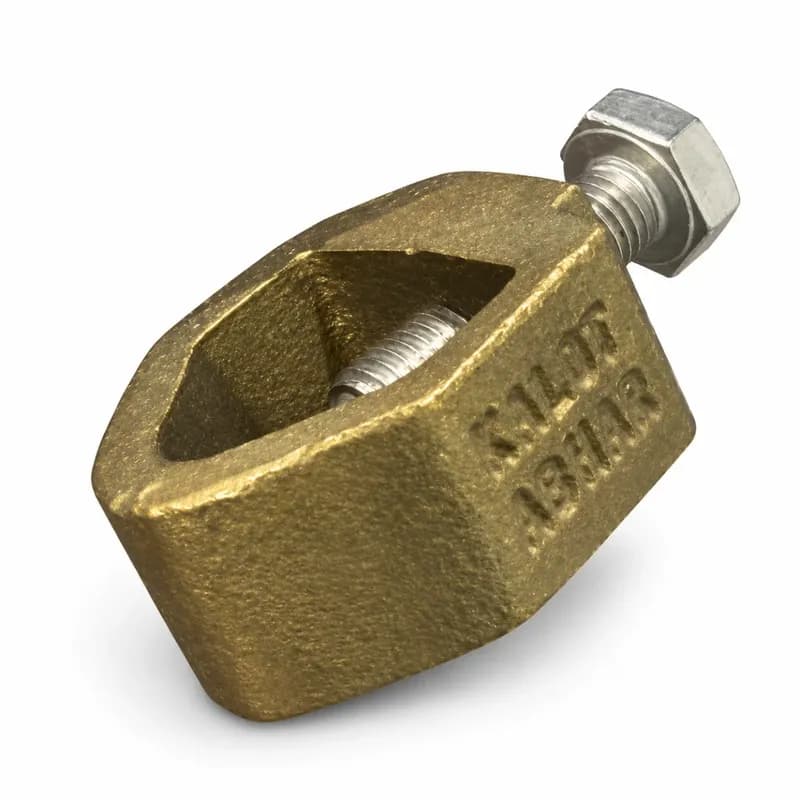
The KALOT Group single-bolt parallel clamp (code PTEC) uses one bolt to connect two copper earth conductors side by side, both to each other and to a steel plate, column or angle. The brass body has two halves, each with two semicircular grooves. The two conductors sit in these grooves, and a stainless steel bolt passing through both halves and the hole in the structure presses the conductors between the halves and the whole clamp onto the structure.
This clamp belongs mainly in electrical substations, transmission and distribution line towers and industrial steel structures, where the main earth grid conductor runs past a structure and a branch from it reaches the structure or equipment at that point, or where two earth conductors connect to the base of a structure at one point. With one hole and one bolt, both conductors are bonded to the structure at the same time, without being cut. We offer two standard models, PTEC 1212 for two 120 to 185 mm² conductors and PTEC 2424 for 240 to 300 mm², and for smaller conductors, from 35 mm², we make this clamp to order. Our specialists are here to help you choose and to answer your enquiry.
Single-bolt parallel clamp for bonding two conductors to structures and towers
To choose this clamp, check the cross-section of the two conductors, the type of structure (plate, column or tower angle) and the diameter of the hole to be made in the structure.
- Two parallel conductors to a structure, with one bolt
- 120 to 300 mm² copper conductors, smaller sizes to order
- Two-piece brass body, stainless steel bolt
- Electrical substations, tower bases and steel structures
Two conductors, one bolt, one hole
The two conductors sit in the grooves of the two halves of the clamp, either side of the bolt. As the single bolt tightens, the conductors are pressed between the halves and the lower half seats on the structure: two connections at one point, with one hole.
Structure bonding without cutting the main conductor
The main earth grid conductor passes through the clamp and continues onwards. The second conductor can be a branch leading to equipment or another structure, or another conductor arriving from the other side of the grid.
Material: brass and stainless steel
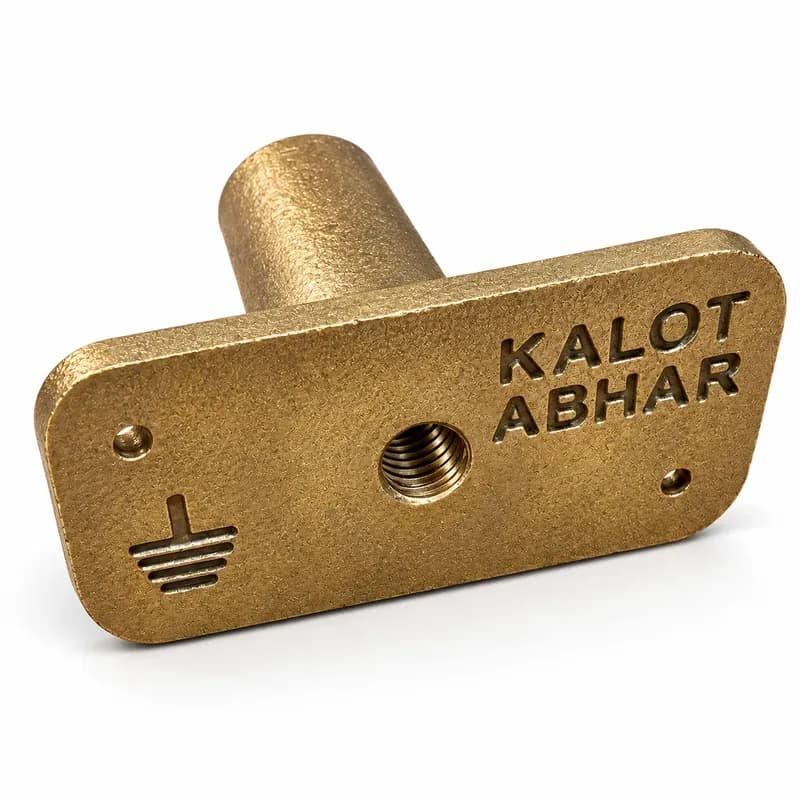
The two-piece body is cast in brass and the bolt, nut and washer are stainless steel. Brass is compatible with copper conductors. The KALOT ABHAR name and the conductor range are cast into the body.
PTEC codes and drawings
Single-bolt parallel clamp datasheet (PDF)You will find codes PTEC 1212 and PTEC 2424 in the technical specifications tab, and the dimensions of PTEC 2424 in the dimensional drawing, technical drawing, exploded view and datasheet of the single-bolt parallel clamp.
Advice from KALOT Group specialists
When you enquire, send us the cross-section of both conductors, the type and thickness of the structure (plate, column or tower angle, and whether it is galvanised), the installation location and the quantity you need. Our specialists will confirm the right code and price.
Technical Product Information
Click to view enlarged
Feature | Value |
|---|---|
Type | Two-piece cast clamp for the parallel connection of two copper conductors to a metal structure, with one bolt |
Body | Cast brass: upper and lower halves, each with two semicircular grooves |
Bolt, nut and washer | Stainless steel (bolt marked A2-70): hex bolt M12 × 60 for PTEC 1212 and M14 × 60 for PTEC 2424 |
Suitable conductor | Stranded copper conductor, both conductors within the range of the same code |
Conductor cross-section | 120 to 185 or 240 to 300 mm², depending on the code, from 35 mm² to order |
Arrangement | Two parallel conductors, either side of the bolt |
Structure | Plate, column, tower base angle or steel equipment support, with one hole to suit the bolt diameter |
PTEC 2424 dimensions | Width 70.9 mm and depth 40 mm, each half 14 mm thick, overall height with bolt 79.3 mm |
PTEC 2424 conductor channel | 23 mm in diameter, formed by two semicircular grooves with an 11.5 mm radius |
PTEC 2424 bolt hole | 14.5 mm at the joint face, with a casting draft up to 16 mm |
PTEC 2424 gap between halves | 4 mm in the assembly drawing. This gap allows the bolt to press the conductors. |
PTEC 2424 weight | 431 g (complete assembly): upper half 207 g and lower half 203 g |
Marking | KALOT ABHAR and the conductor range, cast into the body |
Connection type | Bolted, can be opened and refastened |
Main application | Electrical substations, tower bases and steel structures |
Codes | PTEC 1212 and PTEC 2424, smaller sizes to order |
Single-bolt parallel clamp codes (PTEC)
Code | Main conductor (mm²) | Branch conductor (mm²) | Bolt |
|---|---|---|---|
PTEC 1212 | 120-185 | 120-185 | M12 × 60 |
PTEC 2424 | 240-300 | 240-300 | M14 × 60 |
Cross-sections are in mm² and dimensions in mm. "Main conductor" and "branch conductor" are the two conductors that sit in the clamp's two grooves. We continually improve our products and some dimensions may be updated, so please confirm final dimensions with our specialists before you buy.
Dimensional drawing
Download the dimensional drawing (PDF)
Technical drawing
Download the technical drawing (PDF)
Exploded view
Download the exploded view (PDF)
Conductor grooves and bolt
Each half of the clamp has two semicircular grooves, one either side of the bolt hole. When the two halves close face to face, each pair of grooves forms a round channel for one conductor, and a small gap remains between the halves so that the bolt can press the conductors. The bolt hole passes through both halves and, after going through the hole in the structure, the bolt is tightened with a washer and nut behind the structure.
Click to view enlarged
Applications of the single-bolt parallel clamp
- Bonding substation equipment supports and steel structures to the conductors of the substation earth grid
- Connecting earth conductors to the base angles of transmission and distribution line towers and telecom towers
- Taking a branch from the main earth conductor, without cutting it, at the same point where the conductor connects to the structure
- Connecting two earth conductors or two lightning protection down conductors to a column or the steel frame of a building or industrial shed
- Bonding industrial steel structures, cable trays and metal supports to the earth grid
Installation schematic
Download the execution schematic (PDF)
Connection modes
Download connection modes (PDF)
Single-bolt parallel clamp installation steps
- Choose the clamp code by the cross-section of the two conductors. Both conductors must fall within the range of that code.
- Mark the clamp position on the structure and make a hole to suit the bolt diameter of that code.
- Remove paint, rust and grease from the contact surface of the structure and from the conductors, back to clean metal.
- Place the lower half on the structure, lay the two conductors in its grooves and seat the upper half over them.
- Pass the bolt through the two halves and the hole in the structure, fit the washer and nut behind the structure, and tighten the bolt to the manufacturer's instructions.
- On galvanised steel or in damp outdoor locations, cover the joint with paint or a moisture-proof compound after tightening, so that the brass-to-steel contact stays away from moisture.
- Check that both conductors are seated along the full depth of the grooves and that the clamp does not move on the structure.
Download the installation steps (PDF)
Installation tools
For installation, all you need is a drill with a bit to suit the bolt diameter and two spanners to fit the bolt and nut. This connection needs no welding or heat on the structure.
Inspection and measurement
During periodic inspections of the substation, tower or structure, check the clamp for looseness, corrosion and conductor damage. If the joint has loosened or the contact has corroded, open it, clean the contact surface, retighten to the manufacturer's instructions and renew the protective coating. The continuity of the structure's connection to the earth grid can also be checked by measuring the joint resistance.
Choosing and requesting a price for the single-bolt parallel clamp
When you enquire, send us the cross-section of both conductors, the type and thickness of the structure (plate, column or tower angle, and whether it is galvanised), the installation location and the quantity you need. Our specialists will confirm the right code and price.
Click to view enlarged
When an earth conductor runs past a structure or tower and has to be bonded to it at that point, or when two conductors from two sides of the earth grid reach one base, a single-bolt parallel clamp connects both conductors to the structure at one point, instead of two separate clamps and two holes. The main conductor is not cut and the connection stays tidier and shorter. Earthing standards for power installations require joints to carry fault current without excessive heating, stay tight and be protected against corrosion. The brass body is compatible with copper conductors and the stainless steel bolt resists corrosion. To compare clamp materials, see Earth clamp materials: brass, copper or galvanised.
Advantages of the single-bolt parallel clamp
- Two connections with one bolt: both conductors and the clamp itself fix to the structure with one bolt and one hole, for faster installation and less drilling.
- The main conductor is not cut: it passes through the clamp's groove and continues onwards, with branching and bonding done at the same point.
- Conductors from 120 to 300 mm²: two standard models for the large earth grid conductors of substations and towers, with smaller sizes to order.
- Brass body, stainless steel bolt: the body material is compatible with copper conductors, and the bolt, nut and washer resist corrosion.
- No welding on the structure: the connection is bolted and needs no heat, power or welding on galvanised or painted structures.
- Can be opened and retightened: for inspection, measurement or repair, simply undo the bolt and tighten it again.
Single-bolt parallel clamp, single-conductor structure clamp or two-bolt parallel clamp?
Feature | Single-bolt parallel clamp (PTEC) | One-piece conductor-to-structure clamp (TECS) | Two-piece conductor-to-structure clamp (TECD) | Two-bolt parallel clamp (PCC) |
|---|---|---|---|---|
What it connects | Two conductors to each other and to the structure | One conductor to a structure | One conductor to a structure | Two conductors to each other |
Connection to the structure | Yes, with one bolt | Yes, with one bolt | Yes, with one bolt | No |
Conductor cross-section (square millimetres) | 120 to 300 (two models), smaller to order | 16 to 185 (two sizes) | 16 to 185 (two sizes) | 25 to 185 (four models) |
Body | Two-piece brass | One-piece brass | Two-piece brass | Two-piece brass |
Number of bolts | One | One | One | Two |
If only one conductor connects to the structure, a one-piece or two-piece conductor-to-structure clamp is enough. If two conductors only need to connect to each other, see the two-bolt parallel clamp. For connections buried in soil, we recommend exothermic welding.
If these conditions apply to you, see these clamps as well
Clamp | When |
|---|---|
One-piece clamp for connecting conductor to plates and metal structures (TECS) | When only one conductor connects to a plate or structure. |
Two-piece clamp for connecting conductor to plates and metal structures (TECD) | When one conductor has to be fixed to the structure between two clamping plates. |
When two conductors only connect to each other and no connection to a structure is needed. | |
When the connection is buried in soil or a permanent connection without bolts is needed. |
Compare all our earthing clamps in the "Which clamp should we choose?" table.
KALOT Group's single-bolt parallel clamp is designed and manufactured to IEC 62561-1, the standard that sets the requirements for connection components of lightning protection and earthing systems, including clamps.
EN 50522, the standard for earthing power installations exceeding 1 kV, requires earthing system joints to have good electrical continuity so that fault current does not overheat them, to stay tight and to be protected against corrosion. Earth conductors should connect to each metal part with a suitable connector, and where two dissimilar metals are joined, the joint should stay away from contact with moisture and electrolyte. The same standard points out that the current-carrying capacity of joints, especially bolted ones, must be considered in the design, and that large metal structures must connect to the earthing system at enough points. In this standard, the minimum cross-section of a copper earth conductor is 16 mm², and the actual cross-section of each conductor is calculated from the fault current and its duration.
IEC 62305-3 provides for bonding structures and metal parts to the lightning protection system and for periodic inspection of connections. A bolted joint should be placed where it can be seen and, if needed, tightened. For connecting a copper conductor to galvanised steel, BS 7430 also recommends tinning the conductor and covering the joint with a protective coating.
In Iran, Part Thirteen of the National Building Regulations requires earthing system connections to be reliable and secure, with galvanic corrosion taken into account when joining dissimilar metals. The earthing system safety code also requires the connection material to be compatible with the conductor. To learn more, see Standards for the design and installation of earthing systems.
Single-bolt parallel clamp, two wires to metal structures and towers
Documents & Downloads
Catalogues & datasheets
Drawings & schematics
- Single-bolt parallel clamp dimensional drawing (PTEC 2424)Language: Persian (opens in a new tab)
- Single-bolt parallel clamp technical drawing (PTEC 2424)Language: Persian (opens in a new tab)
- Single-bolt parallel clamp exploded viewLanguage: Persian (opens in a new tab)
- Single-bolt parallel clamp installation schematicLanguage: Persian (opens in a new tab)
- Single-bolt parallel clamp connection modesLanguage: Persian (opens in a new tab)
- Single-bolt parallel clamp installation stepsLanguage: Persian (opens in a new tab)
Frequently Asked Questions
What is a single-bolt parallel clamp and what is it used for?
The single-bolt parallel clamp is a two-piece brass component that uses one bolt to connect two copper earth conductors side by side, both to each other and to a steel plate, column or angle. It is most widely used in electrical substations, tower bases and steel structures, where the earth conductor has to continue onwards and be bonded to the structure at the same time.
Why connect two conductors to a structure with one clamp?
When the main earth grid conductor runs past a structure and a branch is needed from that same point, or when two conductors from two sides of the grid reach one base, a single clamp and a single hole are enough. The main conductor is not cut and there is less drilling in the structure.
Which single-bolt parallel clamp code should we choose?
Choose the code by conductor cross-section: PTEC 1212 for two 120 to 185 mm² conductors with an M12 × 60 bolt, and PTEC 2424 for two 240 to 300 mm² conductors with an M14 × 60 bolt. For 35 to 95 mm² conductors, we make the single-bolt parallel clamp to order.
Do the two conductors have to be the same size?
Not necessarily. It is enough for the cross-section of both conductors to fall within the range of the same code, for example one 120 and one 150 mm² conductor with code PTEC 1212. If the two conductors fall in different ranges, our specialists will suggest the right solution.
What cross-section do earth conductors have in substations and towers?
In EN 50522, the minimum cross-section of a copper earth conductor is 16 mm², but the actual cross-section of each conductor is calculated from the fault current at that point and its duration, which is why substation earth grids usually use larger conductors. Our single-bolt parallel clamp is made for 120 to 300 mm² conductors, and we make smaller sizes to order.
Can this clamp be used on towers and galvanised structures too?
Yes, it also installs on tower angles and galvanised structures. Since brass and galvanised steel are dissimilar metals, clean the contact surface and, after tightening, cover the joint with paint or a moisture-proof compound to protect it from galvanic corrosion.
A single-bolt parallel clamp or two separate single-conductor clamps?
If two conductors reach the structure at one point, the single-bolt parallel clamp fixes both with one hole. If only one conductor connects to the structure, a one-piece conductor-to-structure clamp or a two-piece conductor-to-structure clamp is enough.
Single-bolt parallel clamp or two-bolt parallel clamp?
The single-bolt parallel clamp connects the two conductors both to each other and to the structure. The two-bolt parallel clamp joins the two conductors to each other only and does not connect to the structure.
Which is better, a single-bolt parallel clamp or exothermic welding?
Both are accepted connection methods. A bolted clamp suits accessible connections on structures and towers, and it can be opened for inspection and measurement. For connections buried in soil, we recommend exothermic welding.
Have a Technical Question?
KALOT Group's technical experts are ready to answer your questions about lightning rods and earthing systems.