
Move your pointer over the image to zoom in
Complete Product Overview
Two-piece clamp for connecting conductor to plates and metal structures (TECD)
Last updated:
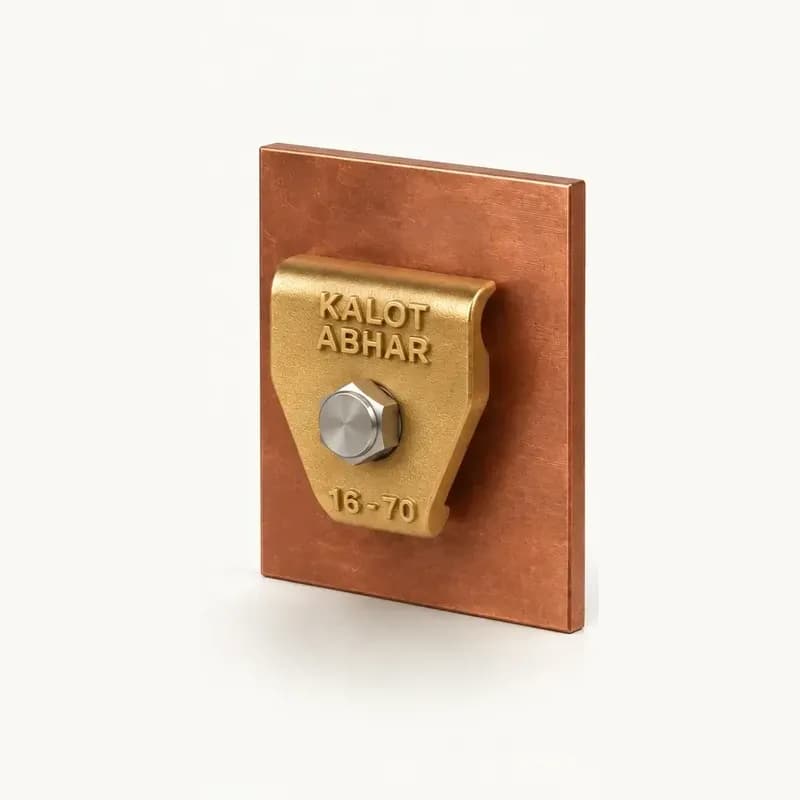
The two-piece clamp for connecting conductor to plates and metal structures from KALOT Group (code TECD), known in the market as the "mast clamp" or "tower clamp", connects a copper earth conductor or lightning protection conductor to a plate, column, beam, tower angle or any other steel structure. The conductor sits in the hook-like groove of the inner jaw, the outer jaw rests on top of it, and one stainless steel bolt passes through both jaws and the hole in the structure, pressing everything together and against the structure.
Because the conductor is held between two brass jaws and does not sit directly on the surface of the structure, the joint depends less on the condition of that surface and the clamp stays compact and firm. It also suits places where wall cladding or a covering will be fitted over the structure. We make the two-piece clamp in two sizes: for 16 to 70 mm² conductors with an M8 bolt, and for 95 to 185 with an M10 bolt. If you want the conductor pressed directly onto the plate or structure, see the one-piece conductor-to-structure clamp (TECS).
Two-piece clamp for connecting an earth conductor to a metal structure
To choose a two-piece clamp, you need the conductor cross-section and the structure thickness: the code follows from the conductor and the bolt length from the thickness of the structure.
- Connects one copper conductor to a plate or steel structure, with one bolt
- Conductors from 16 to 185 mm² in two sizes
- Two cast brass jaws, stainless steel bolt and nut
- Conductor between two jaws, away from the structure's surface
Conductor between two brass jaws
The conductor sits in the groove of the inner jaw and the outer jaw covers it, so the conductor-to-clamp connection does not depend on the condition of the structure's surface.
One hole, one bolt
Installation only needs one hole of bolt diameter in the plate, angle or column, with no welding on the structure.
Material: brass and stainless steel
Both jaws are cast brass and the bolt and nut are stainless steel. Brass is compatible with a copper conductor and the bolt resists corrosion.
Two TECD sizes and drawings
Two-piece clamp datasheet (PDF)You will find codes TECD 1670 and TECD 9518, with conductor range, conductor diameter and bolt size, in the technical specifications tab, and the shape of the clamp in the dimensional drawing, technical drawing, exploded view and datasheet of the two-piece clamp.
Advice from KALOT Group specialists
When you enquire, send us the conductor cross-section, the type and thickness of the structure the clamp will fix to (plate, angle, column or beam), whether it is painted or galvanised, and the quantity you need, and our specialists will advise the right code, bolt length and price.
Technical Product Information
Click to view enlarged
Feature | Value |
|---|---|
Type | Two-piece clamp for connecting one copper conductor to a plate or steel structure (mast clamp) |
Body | Two cast brass jaws: inner jaw with a hook-like groove for the conductor, trapezoidal outer jaw that closes over the conductor |
Bolts and nuts | Stainless steel: one hexagon bolt passing through both jaws and the hole in the structure, with a nut behind the structure |
Suitable conductor | Stranded or solid copper conductor: earth conductor, bonding conductor or lightning protection down conductor |
Conductor range | 16 to 70 and 95 to 185 mm², in two sizes |
Bolts and nuts | M8 × 35 for TECD 1670 and M10 × 45 for TECD 9518 |
Installation location | Plates, columns, beams, tower angles, tank bodies, equipment bases and accessible steel structures |
Connection type | Bolted, can be opened and refastened |
Codes | TECD 1670 and TECD 9518 |
Sizes and codes of the two-piece clamp (TECD)
Code | Conductor cross-section (mm²) | Conductor diameter on the drawing (mm) | Bolts and nuts |
|---|---|---|---|
TECD 1670 | 16-70 | 5.1-10.7 | M8 × 35 |
TECD 9518 | 95-185 | 12.6-17.6 | M10 × 45 |
Cross-sections are in square millimetres. "Conductor diameter on the drawing" is the diameter of the conductors drawn for each size in our manufacturing drawings. The bolt length of each size is set for the usual thickness of plates and angles. If your structure is thicker, tell us its thickness when you enquire. We continually improve our products and some dimensions may be updated, so please confirm the final dimensions with our specialists before you buy.
Dimensional drawing
Download the dimensional drawing (PDF)
Technical drawing
Download the technical drawing (PDF)
Exploded view
Download the exploded view (PDF)
KALOT AutoCAD drawing
Download the AutoCAD drawing (PDF)
The two-jaw structure and the conductor seat
The clamp is made of two cast pieces. The inner jaw, which rests on the structure, has a hook-like groove along its wider edge where the conductor sits. The outer jaw is trapezoidal and its edge closes over that groove. One bolt passes through the central hole of both jaws and the hole in the structure, and the nut is fitted behind the structure. As the nut tightens, the two jaws press the conductor between them and the whole clamp is pressed against the structure. The conductor has no direct contact with the surface of the structure, and the current path runs from the conductor to the brass and then to the structure.
Click to view enlarged
Applications of the two-piece conductor-to-structure clamp
- Bonding steel frames: connecting the earth conductor to the columns, beams and column plates of industrial sheds and steel buildings, so the structure is bonded to the earthing system
- Towers: connecting the earth conductor to the base angle of telecom towers and power line towers
- Substations and industrial facilities: connecting the earthing network conductor to the bases and steel structures of equipment, tanks, platforms and skids
- Connection plates: connecting the earth conductor to the steel plate at a column foot, an equipment connection plate or a plate provided on the structure for the earth connection
- Lightning protection system: connecting a down conductor or bonding conductor to the columns and metal structure of a building
- Covered structures: where wall cladding or a covering goes over the structure after installation and a compact, firm joint is needed
Installation schematic
Download the execution schematic (PDF)
Connection modes
Download connection modes (PDF)
Installation steps for the two-piece clamp
- Choose the clamp code by the conductor cross-section and make sure the bolt is long enough for the thickness of the structure.
- Mark the clamp position on the structure and drill a hole slightly larger than the bolt diameter. Deburr the edge of the hole.
- Clean paint, rust and grease from around the hole, over the area where the inner jaw sits, until you reach bare metal. On a galvanised structure, only remove dirt and do not scrape off the zinc coating.
- Clean the conductor at the joint, lay it in the groove of the inner jaw and place the outer jaw over it.
- Pass the bolt through the two jaws and the hole in the structure, fit the nut behind the structure by hand, then tighten it following the manufacturer's instructions.
- Check that the conductor sits in the groove and that the clamp does not move on the structure. Then cover the area around the joint and the cleaned surface of the structure with paint or a moisture-proof compound.
Download the installation steps (PDF)
Installation tools
For installation, a drill with a bit of bolt diameter, two spanners that fit the bolt head and nut, and a wire brush are all you need. This joint requires no welding or crimping tool.
Inspection and measurement
During periodic inspections of the earthing and lightning protection system, check the clamp for looseness, corrosion and conductor damage and, if necessary, close it again following the manufacturer's instructions. For earth resistance measurement, the test joint or disconnect link of the earthing system is opened. Check the continuity of the conductor-to-structure connection with a low-resistance ohmmeter, between the conductor and the structure, with the clamp closed.
Choosing and getting a price for a two-piece clamp
When you enquire, send us the conductor cross-section, the type and thickness of the structure the clamp will fix to (plate, angle, column or beam), whether it is painted or galvanised, and the quantity you need, and our specialists will advise the right code, bolt length and price.
Click to view enlarged
When an earth conductor has to reach a steel structure, the two-piece clamp makes a compact bolted joint that holds the conductor in brass and needs only one hole in the structure, with no welding on a painted or galvanised structure and no separate cable lug and bolt. The closed jaws grip the conductor from every side, and because the conductor is not pressed directly onto the structure, the quality of the surface has less effect on the conductor connection. If the surface is clean and flat and you want direct contact between conductor and structure, the one-piece clamp (TECS) is simpler, and if two conductors reach the structure at one point, see the single-bolt parallel clamp (PTEC). To compare clamp materials, see Earth clamp materials: brass, copper or galvanised.
Advantages of the two-piece clamp
- The conductor is held in brass: the conductor is clamped between two brass jaws, so the conductor-to-clamp connection does not depend on paint or unevenness on the structure's surface.
- One hole and one bolt: installation takes one hole in the structure, with no welding, heat or cable lug.
- Conductors from 16 to 185 mm²: two sizes, 16 to 70 with an M8 bolt and 95 to 185 with an M10 bolt, for common earthing and lightning protection conductors.
- Brass body, stainless steel bolt: the body material is compatible with a copper conductor, and the bolt and nut resist corrosion.
- Compact: the clamp is low in volume and also fits where a covering or wall cladding goes over the structure.
- Removable: for inspection, measurement or repair, you undo the nut and close it again.
Two-piece, one-piece or single-bolt parallel clamp?
Feature | Two-piece clamp (TECD) | One-piece clamp (TECS) | Single-bolt parallel clamp (PTEC) |
|---|---|---|---|
What it connects | One conductor to a structure | One conductor to a structure | Two conductors to each other and to the structure |
Conductor position | Between two brass jaws | Between the jaw and the structure's surface | Between two brass halves |
Conductor contact with the structure | Indirect, through the brass | Direct | Indirect |
Conductor cross-section (square millimetres) | 16 to 185 (two sizes) | 16 to 185 (two sizes) | 120 to 300 (two codes) |
Number of bolts | One | One | One |
All three clamps fix to the structure through one hole. If the conductor should be held in brass and involve the structure's surface less, choose the two-piece clamp. If direct contact between the conductor and a clean plate is enough, choose the one-piece clamp. If two conductors reach the structure at one point, choose the single-bolt parallel clamp. For joints buried in soil, we recommend exothermic welding.
If these conditions apply to you, see these clamps as well
Clamp | When |
|---|---|
One-piece clamp for connecting conductor to plates and metal structures (TECS) | When the conductor must be pressed directly onto a clean plate or structure. |
When two conductors reach a structure or tower base at one point. | |
When the conductor is a tape rather than a stranded or solid conductor. | |
When two conductors only connect to each other and no connection to a structure is needed. | |
When the connection is buried in soil or a permanent connection without bolts is needed. |
Compare all our earthing clamps in the "Which clamp should we choose?" table.
KALOT Group's two-piece clamp is designed and made to IEC 62561-1, the standard that sets the requirements for connection components of lightning protection and earthing systems, including clamps.
IEC 62305-3 regards metal parts of a building, such as the steel frame, as natural components of the lightning protection system if they are electrically continuous, and it provides for bonding them to the earthing system and inspecting the joints periodically. A bolted joint should be placed where it can be seen and, if needed, closed again.
EN 50522, the standard for earthing of installations above 1 kV, requires earthing system joints to have good electrical continuity, not to loosen and to be protected against corrosion, and where two dissimilar metals are joined, the joint must be kept away from moisture. BS 7430 also recommends covering the joint with a protective coating when a copper conductor is connected to steel.
In Iran, Topic 13 of the National Building Regulations requires earthing system joints to be reliable and firm and galvanic corrosion to be taken into account when dissimilar metals are joined. To learn more, see Standards for the design and installation of earthing systems.
Two-piece clamp, wire to metal plates and structures
Documents & Downloads
Catalogues & datasheets
Drawings & schematics
- Dimensional drawing of the two-piece clamp for connecting conductor to structures (TECD)Language: Persian (opens in a new tab)
- Technical drawing of the two-piece clamp for connecting conductor to structuresLanguage: Persian (opens in a new tab)
- Exploded view of the two-piece clamp for connecting conductor to structuresLanguage: Persian (opens in a new tab)
- Installation schematic of the two-piece clamp for connecting conductor to structuresLanguage: Persian (opens in a new tab)
- Connection modes of the two-piece clamp for connecting conductor to structuresLanguage: Persian (opens in a new tab)
- Installation steps for the two-piece clamp for connecting conductor to structuresLanguage: Persian (opens in a new tab)
- AutoCAD drawing of the two-piece clamp for connecting conductor to structures (TECD)Language: Persian (opens in a new tab)
Frequently Asked Questions
What is a two-piece conductor-to-structure clamp?
It is a two-piece brass clamp that holds one copper earth or lightning protection conductor between its two jaws and connects it to a plate, column, beam or tower angle with one stainless steel bolt passing through a hole in the structure. In the market it is also called a "mast clamp" or "tower clamp".
What is the difference between the two-piece and the one-piece clamp?
In the two-piece clamp, the conductor is held between two brass jaws and has no direct contact with the structure. In the one-piece clamp, one jaw presses the conductor directly against the surface of the plate or structure. The two-piece clamp depends less on the condition of the structure's surface, while the one-piece clamp is simpler and thinner.
Which size of two-piece clamp should I choose?
Choose the size by the conductor cross-section: TECD 1670 for 16 to 70 mm² conductors with an M8 × 35 bolt, and TECD 9518 for 95 to 185 with an M10 × 45 bolt.
What conductor diameters is the two-piece clamp made for?
In our manufacturing drawings, the 16 to 70 size is drawn for conductors of about 5 to 11 mm in diameter and the 95 to 185 size for conductors of about 13 to 18 mm. If your conductor falls between these two ranges, or you do not know its diameter, tell our specialists its cross-section and type.
How thick can the structure be for this clamp?
The bolt passes through both jaws and through the structure itself, so the thicker the structure, the longer the bolt it needs. The bolt length of each code is set for common plates and angles. If your column or plate is thick, tell us its thickness when you enquire and we will suggest a suitable bolt.
How do I install it on a painted or galvanised structure?
On a painted structure, clean the area around the hole down to bare metal, as far as the seating surface of the clamp. On a galvanised structure, only remove dirt and do not scrape off the zinc coating. After tightening, cover the area around the joint with paint or a moisture-proof compound, because brass and steel are dissimilar metals and moisture corrodes their contact point.
Is the two-piece clamp suitable for a tower base?
Yes. It fits on the base angle of telecom towers and power line towers, using one hole in the angle, and connects the earth conductor to the tower structure. If two conductors reach one point at the tower base, the single-bolt parallel clamp fixes both with one bolt.
Can this clamp be buried underground?
No. The two-piece clamp is for accessible joints on a structure, where it can be seen, opened and closed again. For joints buried in soil, we recommend exothermic welding.
Is this clamp also suitable for aluminium conductors?
The two-piece clamp is made for stranded and solid copper conductors. If your conductor is aluminium or another material, please talk to our specialists before you buy.
Which is better: a two-piece clamp or welding the conductor to the structure?
Both are accepted methods of connection. A bolted clamp needs no welding or heat on a painted or galvanised structure and can be opened for inspection and measurement. Exothermic welding makes a permanent joint and suits underground connections.
Have a Technical Question?
KALOT Group's technical experts are ready to answer your questions about lightning rods and earthing systems.