
Move your pointer over the image to zoom in
Complete Product Overview
G-type clamp for connecting conductor to earth rod (ERCC)
Last updated:
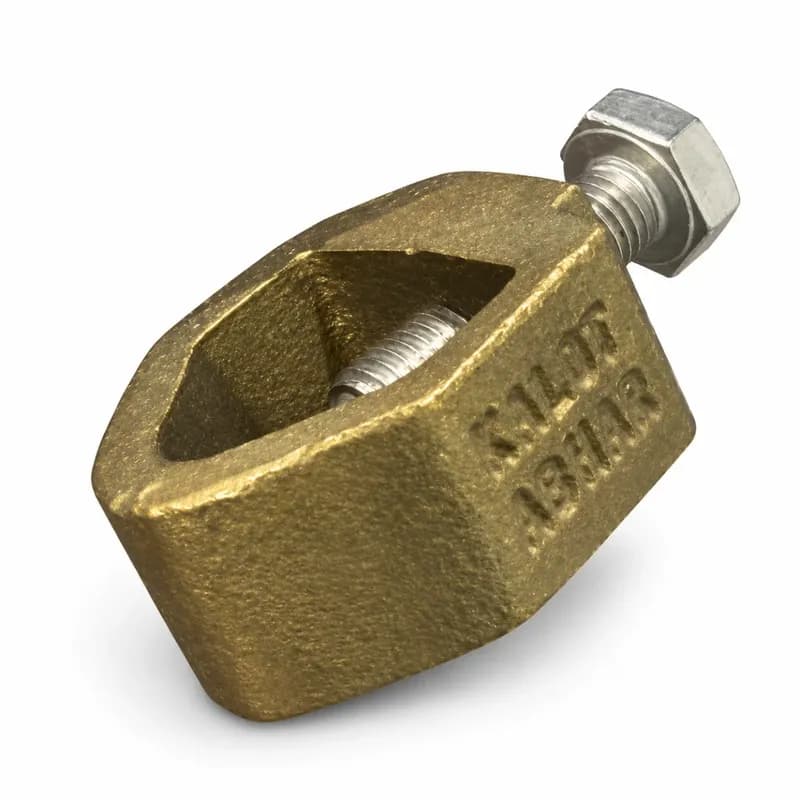
The KALOT Group G-type clamp (code ERCC) connects a copper earth conductor to the top of an earth rod with one bolt. The clamp body is a one-piece cast brass ring with a threaded bolt boss at one end and a V-shape at the other. The earth rod and conductor pass side by side through the clamp opening; as the stainless steel bolt tightens, the earth rod is pushed towards the V-shaped end and the conductor is pressed between the earth rod and the V-shaped wall of the body.
This small, simple clamp is the usual way to connect an earth conductor to the top of a copper-bonded or copper earth rod inside an inspection pit, where the connection stays visible and can be opened and closed again to measure earth resistance. We make the clamp body in two sizes: G 5/8 for 5/8 inch earth rods (code ERCC 1416, conductor 16 to 70) and G 3/4 for 16 to 20 mm and 3/4 inch earth rods (codes ERCC 1695 and ERCC 2070, conductor up to 120 mm²). Our specialists are here to help you choose the code and get a price.
G-type clamp for connecting an earth conductor to the top of an earth rod
To choose a G-type clamp, check the earth rod diameter and conductor cross-section; the clamp body has to slide onto the earth rod from its free end.
- Copper conductor to the top of an earth rod, with one bolt
- 5/8 and 3/4 inch earth rods; 16 to 120 conductor
- One-piece brass body, stainless steel bolt
- Inside the inspection pit, easy to open and close
One-piece ring, one bolt
The clamp body is a single casting with no separate parts. The bolt passes through the threaded boss of the body, pushes the earth rod and presses the conductor into the V-shaped end of the body; installation takes one spanner.
Deeper V-shaped end
The V-shaped wall of the body keeps the conductor centred, and this part of the body is made deeper than the rest of the ring (22 mm on G 5/8 and 28 mm on G 3/4), so the conductor is in contact with the body and the earth rod over a greater length.
Material: high-copper brass and stainless steel
Body chemical composition test report (PDF)Website membership required · Sign in or joinThe body is a cast copper alloy (high-copper brass, 85 percent copper according to the chemical composition test report) and the bolt is stainless steel. The body material is compatible with copper conductors and copper or copper-bonded earth rods.
Two bodies, three ERCC codes
G-type clamp datasheet (PDF)You will find codes ERCC 1416, ERCC 1695 and ERCC 2070 in the technical specifications tab, and the dimensions of both bodies in the dimensional drawing, technical drawing and datasheet of the G-type clamp.
Advice from KALOT Group specialists
When you enquire, send us the earth rod diameter and material, the conductor cross-section, the installation location and the quantity you need, and our specialists will advise the right code and price.
Technical Product Information
Click to view enlarged
Feature | Value |
|---|---|
Type | One-piece cast clamp (G-type) for connecting a copper conductor to the top of an earth rod with one bolt |
Body | Cast copper alloy (high-copper brass); closed ring with a threaded bolt boss at one end and a V-shaped end at the other |
Bolt | Stainless steel hexagon bolt |
Matching earth rod | Copper-bonded (copper-coated), copper or stainless steel earth rod; 14 to 20 mm depending on code |
Suitable conductor | Copper conductor; 16 to 120 mm² depending on code |
G 5/8 body | For 5/8 inch earth rods (14.2 mm); width 25, height 39 and depth 15 mm (22 mm at the V-shaped end); inner opening 19 mm wide; body weight 48.7 g |
G 3/4 body | For 16 to 20 mm and 3/4 inch (17.2 mm) earth rods; width 28, height 44 and depth 17 mm (28 mm at the V-shaped end); inner opening 22 x 33.5 mm; body weight 66.3 g |
V-shaped end | Inner angle of 90 degrees on G 5/8 and 102 degrees on G 3/4 |
Bolt boss | Diameter 13 mm on G 5/8 and 17 mm on G 3/4 |
Marking | Cast into the body: "K.A" and "5/8" on G 5/8; "KALOT ABHAR" and "3/4" on G 3/4 |
Connection type | Bolted, can be opened and refastened |
Installation location | Top of the earth rod, inside an inspection pit or at an accessible point |
Codes | ERCC 1416, ERCC 1695 and ERCC 2070 |
G-type clamp (ERCC) codes
Code | Body | Earth rod diameter (mm) | Conductor cross-section (mm²) |
|---|---|---|---|
ERCC 1416 | G 5/8 | 14-14.2 (5/8") | 16-70 |
ERCC 1695 | G 3/4 | 16 | 16-95 |
ERCC 2070 | G 3/4 | 17.2-20 (3/4") | 70-120 |
Earth rod diameter and dimensions are in millimetres and conductor cross-section in square millimetres; the "Body" column shows which body each code is built on. We keep improving our products and some dimensions may be updated, so please confirm the final dimensions with our specialists before you buy.
Dimensional drawing
Download the dimensional drawing (PDF)
Technical drawing
Download the technical drawing (PDF)
Exploded view
Download the exploded view (PDF)
Opening and V-shaped end
The clamp opening is large enough for the earth rod and conductor to pass through side by side. The bolt enters the opening through the threaded boss and bears on the earth rod, while the conductor sits in the V-shaped end, opposite the bolt. The V-shaped wall keeps the conductor centred, and because this part of the body is deeper, the conductor is pressed between earth rod and body over a greater length. The body ring is closed, so the clamp slides onto the earth rod from its free end and the conductor is passed through the opening.
Click to view enlarged
Applications of the G-type clamp
- Connecting an earth conductor to the top of an earth rod inside an inspection pit in the earthing systems of buildings, panels and equipment
- Connecting the earthing conductor of a lightning protection system to an earth rod
- Connecting a conductor to several earth rods driven in a row or a triangle and joined together by conductor
- Earthing systems of distribution substations, telecoms towers, generators and industrial facilities that use rod electrodes
Installation schematic
Download the execution schematic (PDF)
Connection modes
Download connection modes (PDF)
G-type clamp installation steps
- Choose the clamp code by earth rod diameter and conductor cross-section.
- After driving the earth rod, remove the driving head and clean the top of the earth rod and the end of the conductor with a wire brush to remove soil, oxide and grease; do not scrape the copper coating of the earth rod.
- Loosen the bolt to clear the opening and slide the clamp over the top of the earth rod; the earth rod sits on the bolt side.
- Pass the conductor through the clamp opening beside the earth rod until it seats in the V-shaped end of the body.
- Tighten the bolt following the manufacturer's instructions, so the earth rod is pushed towards the conductor and the conductor is pressed between the earth rod and the V-shaped wall.
- Check that the conductor is seated in the V-shaped end and that the clamp does not move on the earth rod; the connection should stay accessible inside the inspection pit.
Download the installation steps (PDF)
Installation tools
For installation, an open-ended or ring spanner matching the bolt head and a wire brush are all you need; this connection requires no heat or press tool.
Inspection and measurement
During periodic earthing system inspections, check the clamp for looseness, corrosion and conductor damage. If the connection has come loose or the contact point has corroded, undo the bolt, clean the contact surface and close it again following the manufacturer's instructions. To measure earth resistance, undoing the bolt separates the conductor from the earth rod, and it is closed again after the measurement.
Choosing the G-type clamp and getting a price
When you enquire, send us the earth rod diameter and material, the conductor cross-section, the installation location and the quantity you need, and our specialists will advise the right code and price.
Click to view enlarged
When the earth conductor is a wire and the connection is made on top of an earth rod inside an inspection pit, the G-type clamp has the fewest parts: one cast body and one bolt, with no nut or loose part to lose in the pit. Its small size takes up little room in the pit and makes it easy to inspect and open for measurement. Because the body ring is closed, the clamp slides onto the earth rod from its free end; if the connection has to be made partway along the earth rod or on a reinforcing bar, or the conductor is larger than 120 mm², choose a U clamp. Earthing standards require earth rod clamps to be of a non-ferrous alloy, secure and inherently corrosion-resistant; the high-copper brass body of this clamp is compatible with copper conductors and copper-bonded earth rods. To compare clamp materials, see Earth clamp materials: brass, copper or galvanised.
Advantages of the G-type clamp
- One piece and one bolt: the one-piece body has no separate parts and installs with one spanner, so nothing can get lost inside the pit.
- Conductor in the V-shaped end: the V-shaped wall keeps the conductor centred and the deeper part of the body increases its contact length.
- Suited to inspection pits: it is small and visible, and opens and closes for earth resistance measurement.
- High-copper brass and stainless steel: the body is a copper alloy with 85 percent copper and the bolt is stainless steel, suitable for copper conductors and copper or copper-bonded earth rods.
- Two body sizes: G 5/8 for 5/8 inch earth rods and G 3/4 for 16 to 20 mm and 3/4 inch earth rods.
G-type clamp, U clamp or A-type clamp?
Feature | G-type clamp (ERCC) | U clamp (UBDV) | A-type clamp (ERTC) |
|---|---|---|---|
What it connects | Conductor to top of earth rod | Conductor to earth rod or reinforcing bar | Tape to earth rod |
Fastening point | Top of the earth rod | Anywhere along the earth rod or reinforcing bar | Top of the earth rod |
Earth rod diameter (millimetres) | 14 to 20 | 9.5 to 20 | 16 to 25 |
Conductor | Conductor 16 to 120 mm² | Conductor 6 to 300 mm² | Tape 25 to 50 mm |
Fixing method | One bolt | U-bolt, two nuts | One bolt |
Body | One-piece brass | Two-plate brass | One-piece brass |
If the conductor is tape, see the A-type clamp; if the connection has to be made partway along the earth rod, on a reinforcing bar or with a conductor larger than 120 mm², the U clamp is the better fit. For connections buried in soil, we recommend exothermic welding.
If these conditions apply to you, see these clamps as well
Clamp | When |
|---|---|
U clamp for connecting conductor to earth rod and reinforcing bar | When the connection is partway along the earth rod or on a reinforcing bar, or the conductor is larger than 120 mm². |
When the conductor is tape. | |
Galvanised U clamp for connecting conductor to earth rod or reinforcing bar | When the earth rod or reinforcing bar is steel or galvanised and the conductor is galvanised round wire or tape. |
When the connection is buried in soil or a permanent connection without bolts is needed. |
Compare all our earthing clamps in the "Which clamp should we choose?" table.
The KALOT Group G-type clamp is designed and made in line with IEC 62561-1, the standard that sets the requirements for connection components of lightning protection and earthing systems, including clamps connecting conductors to earth electrodes. Under this standard, connection components are assessed for lightning current in two classes, H (heavy) and N (normal), after first being exposed to the corrosive conditions of salt mist and a sulphurous atmosphere, which shows how the connection behaves over time.
BS 7430, the code of practice for earthing, requires the earth conductor to be connected to the electrode with secure non-ferrous clamps that are inherently corrosion-resistant and, if made of a copper alloy, contain no more than 15 percent zinc. The same standard notes that in large earthing installations, such as main substations, groups of earth rods are usually connected to the main earth grid for electrode testing through a bolted joint in a box below ground level, beside the electrodes.
IEC 62305-3 provides for periodic inspection of the earthing system and its connections. The test joint must be opened with a tool for measurement and stay closed in normal operation, and in an earth grid with both earth rods and a ring electrode, separation and measurement in an inspection pit are recommended.
In Iran, Part Thirteen of the National Building Regulations requires earthing system connections to be reliable and secure, and galvanic corrosion to be taken into account when joining dissimilar metals. To learn more, see Standards for earthing system design and installation.
G-type clamp, wire to earth rod
Documents & Downloads
Catalogues & datasheets
Drawings & schematics
- G-type clamp dimensional drawing (G 5/8 and G 3/4)Language: Persian (opens in a new tab)
- G-type clamp body technical drawingLanguage: Persian (opens in a new tab)
- G-type clamp exploded viewLanguage: Persian (opens in a new tab)
- G-type clamp installation schematicLanguage: Persian (opens in a new tab)
- G-type clamp connection modesLanguage: Persian (opens in a new tab)
- G-type clamp installation stepsLanguage: Persian (opens in a new tab)
Certificates & test reports
- Chemical composition test report for G-type earthing clamp | Razi Metallurgical Research Centre 2012Persian · 2012
Frequently Asked Questions
What is a G-type clamp and what is it used for?
The G-type clamp (G clamp) is a one-piece cast brass clamp with one stainless steel bolt that connects a copper earth conductor to the top of an earth rod. It is most often found inside the inspection pit of an earthing system: the earth rod and the conductor pass side by side through the clamp opening, and the bolt presses them together.
What other names is the G-type clamp known by?
G-type is the common name for this earth rod clamp model in industry catalogues. In the market it is also called a G clamp, a G-type earth clamp, an earth rod clamp or a conductor-to-earth rod clamp.
Which G-type clamp code should we choose?
Choose the code by earth rod diameter and conductor cross-section: ERCC 1416 for a 5/8 inch earth rod and 16 to 70 conductor, ERCC 1695 for a 16 mm earth rod and 16 to 95 conductor, and ERCC 2070 for a 3/4 inch to 20 mm earth rod and 70 to 120 mm² conductor. If you are unsure between two codes, send the details to our specialists.
How is a G-type clamp installed on an earth rod?
After driving the earth rod and removing the driving head, clean the top of the earth rod and the conductor, slide the clamp over the top of the earth rod, pass the conductor through the clamp opening beside the earth rod until it seats in the V-shaped end, and tighten the bolt following the manufacturer's instructions. If the earth rod has no free end or the connection is partway along it, use a U clamp.
What is the body of the G-type clamp made of?
The body is a cast copper alloy (high-copper brass). According to the chemical composition test report from the Razi Metallurgical Research Centre (1391), this alloy contains 85 percent copper, 6.5 percent lead, 5.6 percent zinc and 2.3 percent tin. The bolt is stainless steel.
Is the G-type clamp used with galvanised earth rods?
This clamp is made for copper-bonded (copper-coated), copper and stainless steel earth rods. For steel or galvanised earth rods or reinforcing bars with galvanised round wire or tape, see the galvanised U clamp.
Can a G-type clamp be buried in soil?
The G-type clamp is made for accessible connections, such as the top of an earth rod inside an inspection pit, so it can be seen and opened for measurement. For connections buried in soil, we recommend exothermic welding.
G-type clamp or U clamp?
Both connect a conductor to an earth rod. The G-type clamp is one piece, fastens with one bolt on the free end of the earth rod and takes conductors up to 120 mm². The U clamp, with a U-bolt and two plates, fastens anywhere on the earth rod or a reinforcing bar and also has models for conductors up to 300 mm².
How often does the G-type clamp bolt need tightening?
A bolted connection that has been fastened correctly does not need periodic tightening. During periodic earthing system inspections, check the clamp for looseness and corrosion; if it has come loose, open it, clean it and close it again following the manufacturer's instructions.
Have a Technical Question?
KALOT Group's technical experts are ready to answer your questions about lightning rods and earthing systems.