Short answer: ground improvement material is not needed everywhere, but it is useful in high-resistivity, rocky or dry soils, or where the electrode cannot be driven deeper. That is because it completes the contact between electrode and soil, enlarges the effective diameter of the electrode and, if it meets the standard, keeps resistance more stable in dry seasons. The material does not replace proper design, and it does not change the resistivity of the soil further from the electrode.
How does ground improvement material work?
Current flowing from the electrode into the earth passes through a small area in the first few tens of centimetres around the electrode. That is why a large share of earth resistance sits in this nearby zone. Ground improvement material fills exactly this zone:
- Full contact: in rocky or coarse-grained soil, air voids remain between the earth rod and the soil. The material fills these voids.
- Larger effective diameter: the column of material, far more conductive than the soil, acts like a thicker electrode.
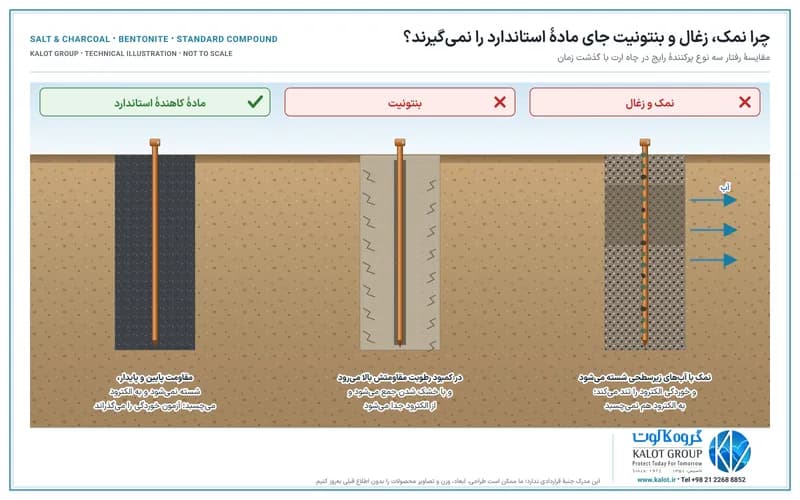
- Stability: a standard material retains its moisture and conductivity and does not dissolve or wash away, so resistance rises less in the dry season.
How much does the material lower resistance?
The resistance of an earth rod is calculated with the Dwight formula: R = ρ/(2πL) · (ln(8L/d) − 1). Here ρ is the soil resistivity, L the length of the earth rod and d its diameter. Ground improvement material only enlarges d, and d sits inside the logarithm, so its effect is limited. For example, a 3 m copper-bonded earth rod of 14.2 mm diameter in 100 ohm-metre soil has a resistance of about 34.1 ohms. With a 10 cm diameter column of material it falls to about 23.8 ohms (30% less), and with a 20 cm column to about 20.1 ohms (41% less). Driven to 6 m, the same earth rod reaches about 18.9 ohms without any material (45% less).
The takeaway: wherever you can drive the electrode deeper or install several electrodes with enough spacing, that usually has a greater effect. Ground improvement material is most valuable when depth or space is limited, the soil is rocky, or stable resistance throughout the year matters. We give more precise calculations in earth termination resistance calculations with ground improvement materials.
Benefits of a standard ground improvement material
- Lower resistance at the same depth: especially in rocky and coarse-grained soil, where contact is poor.
- More stable resistance: less change between wet and dry seasons, which matters for staying within the permitted value all year.
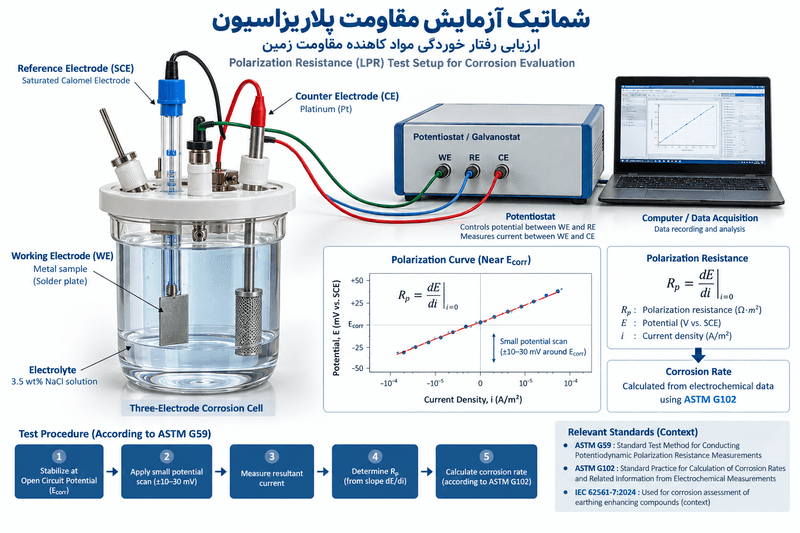
- Electrode protection: a standard material is non-corrosive and is tested for corrosion under IEC 62561-7. Salt and charcoal do the opposite and increase corrosion (Do ground improvement materials prevent corrosion?).
- Lower lifetime cost: less need for watering, adding salt or installing extra electrodes in later years.
What does ground improvement material not do?
- It does not change the resistivity of the soil further from the electrode. In very high-resistivity soil, a grid or more electrodes are needed.
- It does not replace measurement. Resistance has to be measured after installation (measuring earth resistance).
- Not every material helps: salt, charcoal and materials without test evidence are corrosive or unstable. Ordinary bentonite may also shrink as it dries and pull away from the electrode. See the material standards in standards for ground improvement materials, the selection criteria in specifications of standard ground improvement materials and a comparison of the types in ground improvement material comparison table.
We also explain where the material is not needed in Should ground improvement materials always be used?
KALOT ground improvement material
We produce GIM ground improvement material for earth pits and trenches, and offer it together with threaded copper-bonded earth rods and polyethylene inspection pits. Before design we measure the soil resistivity, and after installation we test the resistance of the earthing system. To estimate the quantity of material and the type of electrode, send your soil measurement results or the site address to our specialists, or reach us through the contact us page.