
Move your pointer over the image to zoom in
Complete Product Overview
Two-piece brass air rod base for flat surfaces
Last updated:
The KALOT two-piece brass air rod base does two jobs at once: it holds a conventional air rod on a flat roof and connects the roof conductor to it right there. The round conductor passes through the arch of the upper body and a second conductor through the groove of the lower plate, so a straight, three-way or four-way connection is made on the base itself. The body and plate are cast brass and are joined by four stainless steel bolts.
The air rod and roof conductors, on one base
In the KALOT two-piece brass base, the arch of the upper body and the groove of the lower plate run at right angles. The roof conductor can pass straight through the base or form a three-way or four-way joint right there, while the air rod screws into the threaded socket of the same body.
- Made for flat roofs and level surfaces
- Straight, three-way or four-way conductor connection
- Round conductor 50 to 95, or 30 by 3 tape
- Cast brass with stainless steel bolts
Two routes at right angles
The arch of the upper body and the groove of the lower plate run at right angles, so two conductors can cross or branch on the base with no extra clamp.
Air rod and conductor at one point
The air rod sits in the threaded socket of the body and the conductors between the two brass parts, giving the shortest path from the air rod to the roof conductor network.
Conductor or tape
Round conductors of 50 and 70 mm² in the arch and groove, and 30 by 3 mm tape between the two rails of the plate. The sizes are marked on the body itself.
Brass and stainless steel
Cast brass body and plate with stainless steel bolts: durable on the roof and compatible with copper conductors and copper air rods.
Made by KALOT ABHAR
Designed and made from our own production drawings: six codes covering three conductor cross-sections and two air rod thread sizes.
Technical Product Information
Click to view enlarged
Feature | Value |
|---|---|
Product type | Two-piece base for conventional air rods with a conductor connection point |
Installation location | Flat roofs and level surfaces (concrete, membrane-waterproofed, parapets and similar) |
Conductor connection | Straight, three-way or four-way, with the arch of the upper body and the groove of the lower plate at right angles |
Connectable conductor | Round conductor of 50, 70 or 95 mm² (according to code) or 30×3 mm tape |
Air rod thread | M16 or M20 (according to code) |
Lower plate | 6 mm thick, four Ø6.6 countersunk holes at the corners |
Base height | 61 mm to the top of the socket |
Upper body | 60 by 60 mm plate, conical socket with a 28 mm top diameter |
Material | Body and plate: cast brass · Bolts: stainless steel |
Joining the two parts | Four M8 hex bolts |
Matching air rod | Conventional air rod up to 2000 mm long with a threaded end matching the code |
Codes | ARCS 1650 to ARCS 2095 |
Reference standards | IEC 62305-3 (system design), IEC 62561-1 (connection components) and IEC 62561-2 (air rods and conductors) |
Codes and dimensions
Code | Round conductor (mm²) | Air rod thread |
|---|---|---|
ARCS 1650 | 50 | M16 |
ARCS 1670 | 70 | M16 |
ARCS 1695 | 95 | M16 |
ARCS 2050 | 50 | M20 |
ARCS 2070 | 70 | M20 |
ARCS 2095 | 95 | M20 |
Our products are continually improved and some dimensions may be updated; please confirm the final dimensions with our specialists before you buy.
Click to view enlarged
This drawing is based on KALOT production drawings: a 6 mm thick lower plate with four countersunk holes at the corners, an overall height of 61 mm to the top of the socket and a socket top diameter of 28 mm. View A shows the base along the arch of the upper body and view B along the groove of the lower plate.
Download the drawing: PDF · SVG (vector)
Codes and dimensions
Code | Round conductor (mm²) | Air rod thread |
|---|---|---|
ARCS 1650 | 50 | M16 |
ARCS 1670 | 70 | M16 |
ARCS 1695 | 95 | M16 |
ARCS 2050 | 50 | M20 |
ARCS 2070 | 70 | M20 |
ARCS 2095 | 95 | M20 |
Click to view enlarged
Base and connection point in one part
In a lightning protection system with conventional (passive) air rods, each air rod must stand firmly on the roof and connect to the roof conductor network by the shortest path. In the mesh method under IEC 62305-3, roof conductors form a network with mesh cells from 5×5 to 20×20 metres (depending on the protection level), and air rods usually sit on this network, at corners, edges and conductor crossings.
The KALOT two-piece base is made for exactly these points. The arch of the upper body and the groove of the lower plate run at right angles. One conductor passes through the arch and the other through the groove, and both are clamped between the two brass parts under the pressure of four bolts, while the air rod screws into the threaded socket of the same body. The result is one firm connection point for a conventional air rod and two conductors, with no extra clamp on the roof.
Conductor connection modes
- Straight through: a 50 or 70 mm² round conductor passes through the arch of the upper body. This suits air rods that sit on the route of a single conductor.
- Three-way branch: the main conductor passes through the arch and the branch conductor leaves the base through the groove of the lower plate, at right angles to it. An example is the roof edge, where the conductor heads towards the down conductor.
- Four-way crossing: two conductors at right angles, one in the arch and the other in the groove, cross on the base. This suits the intermediate nodes of the mesh network.
- Tape: 30×3 mm tape sits on the lower plate between its two rails, and the upper body clamps it from above.
The sizes "50 - 70" and "30 X 3 mm" are marked on the cast body itself, so the matching conductor can be identified at a glance on site.
Base components
- Upper brass body: a conical socket with the air rod thread, an arch for the conductor and four bolt holes. The name KALOT ABHAR is cast on it.
- Lower brass plate: a square plate with four countersunk holes for roof mounting, a conductor groove and two rails that locate the upper body and the tape.
- Four stainless steel hex bolts: they join the two parts and press the conductors between them.
Why brass?
The base stays on the roof for years, exposed to rain, sun and pollution, and lightning current reaches the roof conductor through it. Brass is stable against atmospheric corrosion and forms a compatible metal pairing with copper conductors and copper air rods. The stainless steel bolts do not rust over time, so opening and closing the base during inspections stays easy.
For aluminium conductors or highly corrosive environments, such as coastal and industrial areas, please speak to our specialists before ordering. Direct contact between aluminium and brass or copper causes galvanic corrosion.
Click to view enlarged
Installation steps
- Mark the base position according to the lightning protection system drawing, on the route or crossing of the roof conductors.
- Fix the lower plate to the surface with four countersunk screws and wall plugs, or with screws that suit the roof material. On roofs with a waterproof covering, fit sealing washers under the screws.
- Place the round conductor in the arch of the upper body or the groove of the lower plate. For a three-way or four-way joint, lay the second conductor at right angles. Tape sits between the two rails of the plate.
- Place the upper body on the plate and tighten the four hex bolts gradually, in a crosswise pattern, so that the conductors are clamped evenly.
- Screw the conventional air rod into the socket thread on the body and tighten it.
Where the base sits in the lightning protection system
In this schematic, conventional air rods are installed on two-piece bases, and at each base the roof conductor network connects to the air rod as a straight, three-way or four-way joint. From both sides of the roof, the conductors run to the down conductors, the disconnector (test joint) and the earthing system.
Installation notes
- This base is made for conventional air rods up to 2000 mm long. Choose the base code to match the thread at the end of the air rod (M16 or M20) and the conductor cross-section.
- Secure the roof conductors between the bases with suitable holders. In the standard's guidance, the spacing of holders for a horizontal conductor on a horizontal surface is one metre at most.
- On long roof conductor runs, make the necessary allowance for thermal expansion and contraction, so that no force is transferred to the bases.
- The surface under the plate must be flat and firm, so that the air rod stands vertically and the screws bite into the roof structure.
Inspection and maintenance
During periodic inspections of the lightning protection system, check that the mounting screws and the four body bolts are tight, check the condition of the conductors in the arch and groove, and make sure the air rod is vertical and firm. Retighten the bolts evenly where needed.
The standards below are the reference for designing and selecting lightning protection system components, and they show where this base sits in the system.
System design: IEC 62305-3
Design, installation and inspection of a structure's lightning protection system, including positioning air rods by the protection angle, rolling sphere or mesh method, sizing the mesh cells of the roof conductor network according to the protection level, and the minimum conductor cross-section (50 mm² for a copper conductor).
Connection components: IEC 62561-1
Requirements and tests for the metal connection components of a lightning protection system, such as the clamps and connectors that join conductors to each other and to air rods and earth rods. This base, being the connection point of the air rod and conductors, belongs to this group of components.
Air rods and conductors: IEC 62561-2
Material, dimension and test requirements for air rods, conductors and earth electrodes.
Two-piece brass air rod base for flat surfaces
Documents & Downloads
Drawings & schematics
- Dimensional drawing of the KALOT two-piece brass air rod base (PDF)Language: Persian (opens in a new tab)
- Exploded view of the KALOT two-piece brass air rod base (PDF)Language: Persian (opens in a new tab)
- Conductor connection modes in the two-piece brass base (PDF)Language: Persian (opens in a new tab)
- Installation steps for the two-piece brass base on a flat roof (PDF)Language: Persian (opens in a new tab)
- Installation schematic of the KALOT two-piece brass air rod base on a flat roof (PDF)Language: Persian (opens in a new tab)
Frequently Asked Questions
What is the two-piece air rod base used for?
It holds a conventional air rod on a flat roof and at the same time connects the roof conductor to it. The conductor is clamped between the upper body and the lower plate, and the air rod screws into the threaded socket of the body.
How is a three-way or four-way joint made?
The arch of the upper body and the groove of the lower plate run at right angles. The main conductor passes through the arch. For a three-way joint, the branch conductor runs through one side of the groove, and for a four-way joint, the second conductor runs through the full length of the groove. Tightening the four bolts clamps both conductors.
Which conductors connect to this base?
Round conductors of 50, 70 or 95 mm² (according to the selected code), and 30 by 3 mm tape, which sits between the two rails of the lower plate. The sizes "50 - 70" and "30 X 3 mm" are marked on the body itself.
How do I choose the right code?
The first two digits of the code give the air rod thread (16 for M16, 20 for M20) and the last two give the conductor cross-section (50, 70 or 95 mm²). For example, ARCS 1650 is for an air rod with an M16 thread and a 50 mm² conductor.
Which air rod fits this base?
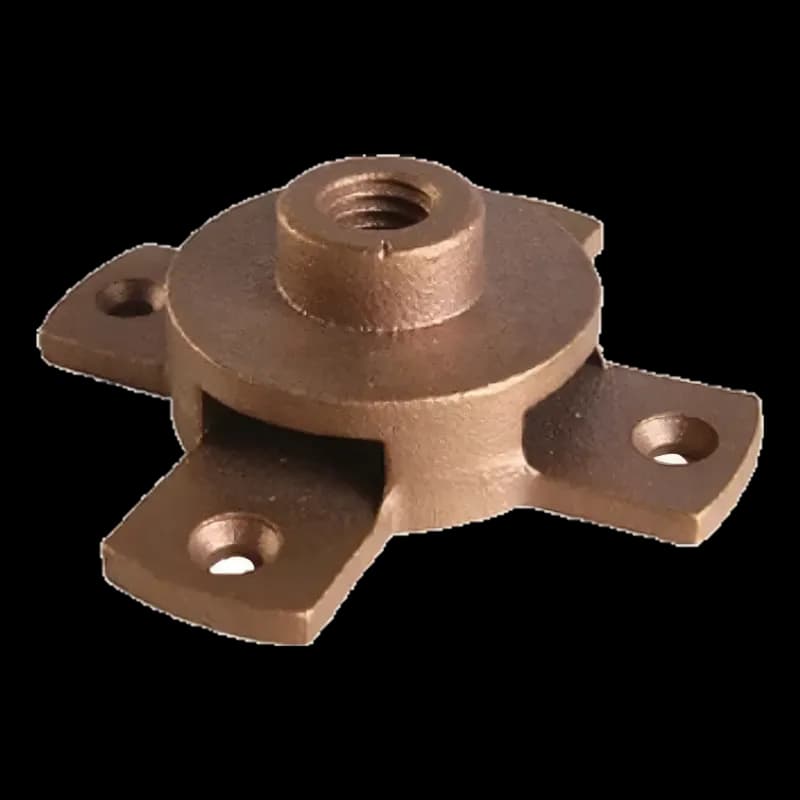
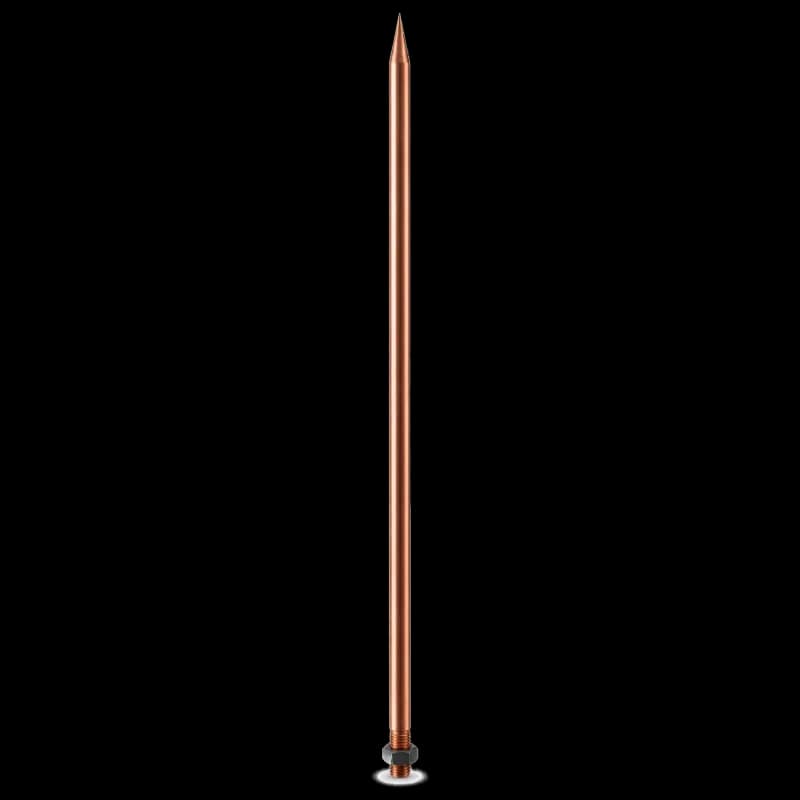
A conventional air rod whose threaded end matches the base code. See our conventional air rods under Conventional air rod in solid copper and Conventional air rod in stainless steel.
How does this base differ from the one-piece brass base?
The brass base for flat surfaces holds the air rod. The two-piece base also clamps the roof conductor between its two parts, which allows a straight, three-way or four-way conductor connection on the same base. To connect a conductor to an air rod without a base, see the coupling for connecting conductor to air rod and the coupling for connecting tape to air rod.
Can it also be installed on a pitched roof?
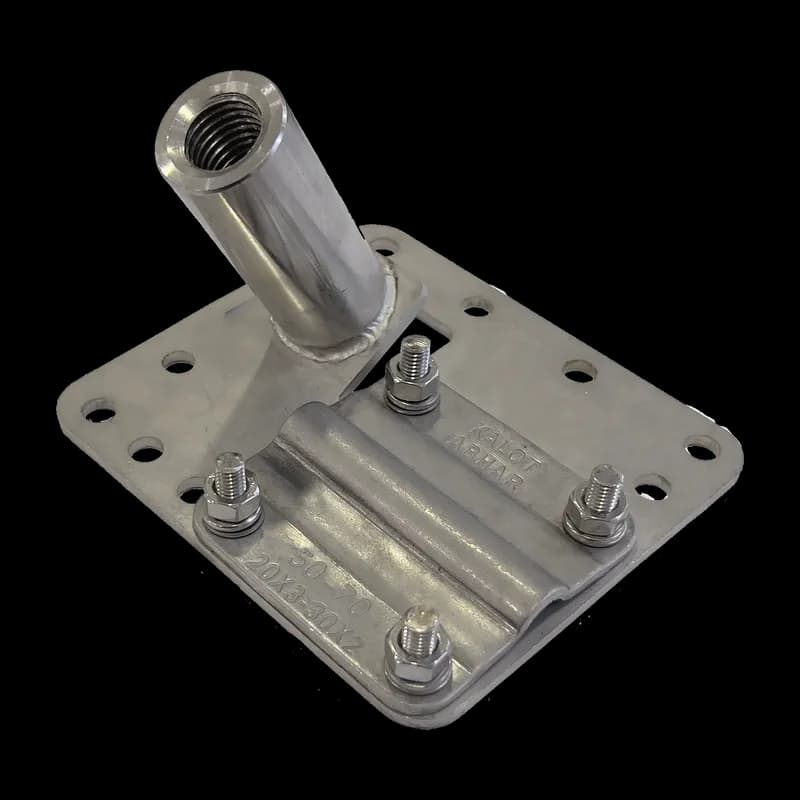
This base is made for flat surfaces. For a pitched roof, see the adjustable stainless steel air rod base, and for a roof ridge, see the brass base for roof ridges.
How do we fix the base to the roof?
The lower plate has four countersunk holes. Fix it with countersunk screws and wall plugs, or with screws that suit the roof material. On waterproof coverings, fit sealing washers under the screws to keep water out.
Have a Technical Question?
KALOT Group's technical experts are ready to answer your questions about lightning rods and earthing systems.