
Move your pointer over the image to zoom in
Complete Product Overview
Adjustable stainless steel air rod base for flat and pitched roofs
Last updated:
We designed the KALOT stainless steel air rod base for projects where the air rod has to stand on a flat or pitched roof. The tab of the base, with the threaded bush for the conventional air rod welded onto it, is bent on site to match the roof slope so the air rod always stands vertical. With its KALOT ABHAR clamp jaw, the same base also secures a 50 and 70 mm² round conductor or 20×3 and 30×2 tape, so holding the air rod and connecting it to the roof conductor both happen on one part.
One base for flat and pitched roofs
On a pitched roof, an air rod that tilts with the slope loses effective height and protection zone. In the KALOT stainless steel base, the tab carrying the bush bends to match the roof slope and keeps the conventional air rod vertical; on a flat roof it installs with no bending at all.
- Suits flat and pitched roofs
- Bendable tab, so the air rod is always vertical
- Clamp jaw for 50 and 70 conductors or tape
- Made entirely of stainless steel
Angle adjusted on site
The tab carrying the bush bends to match the roof slope, so one base model covers different slopes and a conventional air rod stands vertical on all of them.
Air rod and conductor on one part
The KALOT ABHAR clamp jaw secures the roof conductor on the same plate that holds the air rod, for simpler installation and a shorter connection.
Conductor or tape, it takes both
The central groove of the jaw takes 50 and 70 mm² round conductors, and the flat surfaces either side take 20×3 and 30×2 tape.
All stainless steel
The plate, tab, bush and jaw are all stainless steel, durable against rain, sun and pollution on the roof.
Secure fixing with 12 holes
The holes around the plate let you position the screws to suit the structure and covering of the roof.
Technical Product Information
Click to view enlarged
Feature | Value |
|---|---|
Product type | Conventional air rod base with adjustable angle and conductor clamp jaw |
Installation location | Flat and pitched roofs (concrete, tiled, metal sheet and similar) |
Angle adjustment | Tab bent on site to match the roof slope; the air rod stays vertical |
Material | Stainless steel: plate, tab, bush and clamp jaw |
Air rod connection | Threaded bush welded onto the tab |
Connectable conductor | Round conductor of 50 and 70 mm² or 20×3 and 30×2 mm tape (marked "50-70" and "20X3-30X2" on the jaw) |
Clamp jaw | 64 × 64 mm KALOT ABHAR jaw with four stud bolts, washers and nuts |
Plate dimensions | 140 × 140 mm, with 12 fixing holes |
Bush | Diameter 26 mm, height 70 mm |
Matching air rod | Conventional air rod with a threaded end matching the bush thread |
Reference standards | IEC 62305-3 (system design), IEC 62561-1 (connection components) and IEC 62561-2 (air rods and conductors) |
Our products are continually improved and some dimensions may be updated; please confirm the final dimensions with our specialists before you buy.
Click to view enlarged
The drawing shows the top and side views of the base: the 140 × 140 mm plate with 12 fixing holes, the tab bend line, the bush of 26 mm diameter and 70 mm height, and the 64 × 64 mm clamp jaw. The tab bend angle (β) equals the roof slope.
Download the drawing: PDF · SVG (vector)
Click to view enlarged
Why must the air rod be vertical?
When a lightning protection system is designed to IEC 62305-3, the protection zone of each passive air rod is calculated by the protection angle or rolling sphere method, from the vertical height of its tip above the surface being protected. A conventional air rod that tilts with the roof slope has a lower effective height and its protection zone shifts to one side. The result is less coverage than the designer allowed for on the drawing.
We built this base to bring the air rod back to vertical on any slope: the tab bends to match the roof slope, and the bush welded onto it holds the air rod plumb. On a flat roof, the tab stays unbent.
Installation notes
- Bend the tab once only and only as far as needed; repeated bending and straightening weakens the sheet.
- Longer air rods, especially those above about 60 cm, put more wind force on the base, so allow for extra bracing in the design.
- The spacing of the bases and the routes of the roof conductors are set by the system designer, according to the protection method and the roof dimensions.
Click to view enlarged
Installation steps
- Mark the position of the base on the roof according to the lightning protection system drawing, and set it on a firm surface where the screws will bite into the roof structure or its substructure.
- Fix the plate through the mounting holes with screws and wall plugs, or screws suited to the roof material. On roofs with a waterproof covering, fit sealing washers under the screws.
- On a pitched roof, bend the tab once, with a suitable tool, to match the roof slope so that the bush is fully vertical, and check this with a level. On a flat roof the tab stays unbent.
- Place the roof conductor under the clamp jaw: round conductor in the central groove, or tape on the flat surface.
- Fit the jaw over the stud bolts and tighten the four nuts gradually in a crosswise pattern until the conductor is held firmly between jaw and plate.
- Screw the air rod into the threaded socket and tighten it.
Base components
- Base plate: a square stainless steel plate with 12 fixing holes around it, screwed to the surface with screws suited to the roof material.
- Bendable tab and threaded bush: the tab is cut from the plate itself and bent on site; the threaded air rod bush is welded onto it.
- KALOT ABHAR clamp jaw: our same multi-purpose clamp jaw, marked "50-70" and "20X3-30X2". Its central groove takes round conductors and the flat surfaces either side take tape.
- Four stud bolts with washers and nuts: they press the jaw onto the plate and secure the conductor between jaw and plate.
The jaw on this base is the same half we use in the multi-purpose stainless steel four-way clamp, so both common roof conductor types, round conductor and tape, connect to the base with no extra parts.
Why all stainless steel?
An air rod base spends years on the roof, exposed to rain, sun, snow and pollution. The plate, tab, bush and clamp jaw of this base are stainless steel, so its resistance does not rely on a coating that scratches or fades with time. For highly corrosive environments, or for use with aluminium conductors, please talk to our specialists before ordering.
Inspection and maintenance
During periodic inspections of the lightning protection system, check that the air rod is vertical, that the plate screws and jaw nuts are tight, and the condition of the conductor under the jaw. Retighten the nuts evenly if needed.
The standards below are the reference for designing and selecting lightning protection system components, and they show where this base sits in the system.
System design: IEC 62305-3
Design, installation and inspection of a structure's lightning protection system, including choosing the position and height of air rods by the protection angle, rolling sphere or mesh method, and installing roof conductors and down conductors.
Connection components: IEC 62561-1
Requirements and tests for the metal connection components of lightning protection systems, such as the clamps and connectors that join conductors and air rods. The clamp jaw of this base belongs to this group of components.
Air rods and conductors: IEC 62561-2
Material, dimension and test requirements for air rods, conductors and earth electrodes.
Adjustable stainless steel base for flat and pitched roofs
Documents & Downloads
Drawings & schematics
- Dimensional drawing of the adjustable stainless steel air rod base (PDF)Language: Persian (opens in a new tab)
- Exploded view of the adjustable stainless steel air rod base (PDF)Language: Persian (opens in a new tab)
- Installation on flat and pitched roofs (PDF)Language: Persian (opens in a new tab)
- Steps for installing the base on a pitched roof (PDF)Language: Persian (opens in a new tab)
- Installation schematic on a pitched roof (PDF)Language: Persian (opens in a new tab)
- Installation schematic on a flat roof (PDF)Language: Persian (opens in a new tab)
Similar & Complementary Products
Frequently Asked Questions
Which roofs can this base be installed on?
On flat and pitched roofs, including concrete, tiled and metal sheet roofs. On a flat roof the tab stays unbent; on a pitched roof it is bent to match the slope.
How is the angle of the base adjusted?
The tab that carries the welded air rod bush is bent on site, with a suitable tool, to match the roof slope so that the bush stands vertical. Bend the tab once only, and only as far as needed.
Why does it matter that the air rod is vertical?
The protection zone of an air rod is calculated from the vertical height of its tip. A tilted air rod has a lower effective height and its protection zone shifts, so the real coverage ends up smaller than designed.
Which conductors connect to this base?
Round conductors of 50 and 70 mm² in the central groove of the jaw, or 20×3 and 30×2 mm tape on the flat surfaces either side of it. These sizes are marked on the jaw itself.
Which air rod fits this base?
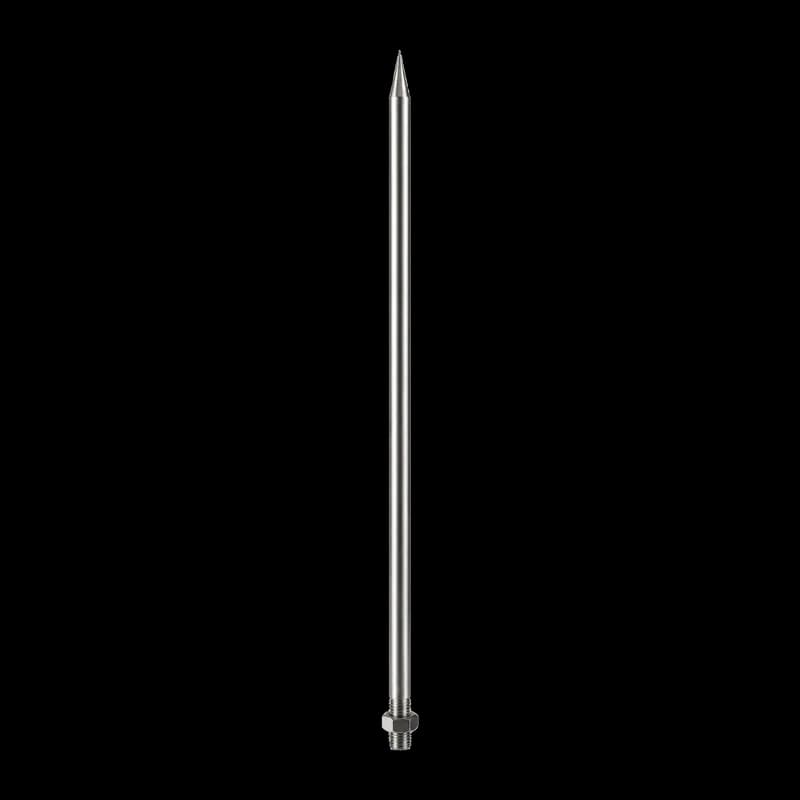
A conventional air rod with a threaded end that matches the thread of the base bush. You will find our conventional air rods under stainless steel air rod and copper air rod. Our specialists are here to help you choose the length, diameter and thread that suit this base.
How does this base differ from the base for flat surfaces?
The air rod base for flat surfaces is made for flat roofs. This base goes on pitched roofs as well as flat ones, and it carries its own conductor clamp jaw. For installation on a roof ridge, see the roof ridge base.
How do we fix the base to the roof?
Through the holes around the plate, using screws and wall plugs or screws suited to the roof material. On waterproof coverings, fit sealing washers under the screws to keep water out.
Can long air rods also be installed on this base?
Longer air rods, especially those above about 60 cm, put more wind force on the base, so allow for extra bracing in the design. Our specialists are here to help you choose the air rod length and type of bracing.
Have a Technical Question?
KALOT Group's technical experts are ready to answer your questions about lightning rods and earthing systems.