Short answer: ground improvement materials are conductive materials placed around an earth electrode to increase its contact with the soil and lower the resistance of the earthing system. Their three main generations are salt and charcoal, clay and bentonite, and carbon-based materials. Today the choice does not rest on a material's name or composition: a standard material is one that has passed the IEC 62561-7 tests.
How have ground improvement materials changed?
In the past, only lowering the resistance mattered. That is why salt and charcoal were used so widely and even found their way into the instructions and technical specifications of some organisations. Salts such as table salt, magnesium sulphate, copper sulphate and calcium chloride lower soil resistance sharply at first, but according to IEEE Std 142 the effect does not last, they need periodic renewal and they harm the electrode's protection against corrosion (Are salt and charcoal a standard material?).
Over time, corrosion, unstable resistance with its seasonal swings and environmental pollution became apparent. Designers turned to moisture-absorbing materials based on mineral soils (clay-based), the simplest being clay and sodium bentonite. Bentonite holds moisture well, and BS 7430:2026 considers it suitable for soils whose moisture changes with the seasons, provided it is well watered during installation. But when the soil dries out, it shrinks and pulls away from the electrode (Is bentonite a standard material?).
As the real needs became clear, the required properties were written into a standard: first EN 50164-7 in 2008, then the international standard IEC 62561-7 in 2011 with its 2018 and 2024 editions. This standard gives no recipe: it judges the material by testing. Salt and charcoal do not come through these tests because of leaching and corrosion, and bentonite fell out of favour in dry soils because of its dependence on moisture. A new generation of ground improvement materials reached the market, the most common being carbon-based materials.
What are carbon-based ground improvement materials made of?
These materials are made of conductive carbon or graphite particles, usually mixed with a mineral binder such as cement and with water, then poured around the electrode. Once set, they form a solid, conductive column around it. BS 7430:2026 considers conductive grouts with graphite or carbon powder suitable for backfilling around horizontal and vertical electrodes, because they have good physical stability and make uniform contact with the soil. The conductivity of these materials does not depend on moisture, so they also work in dry soils. The exact composition of each product is set by its maker (What are carbon-based ground improvement materials?).
What qualities does a standard ground improvement material have?
- low resistivity and little variation in resistance across the seasons;
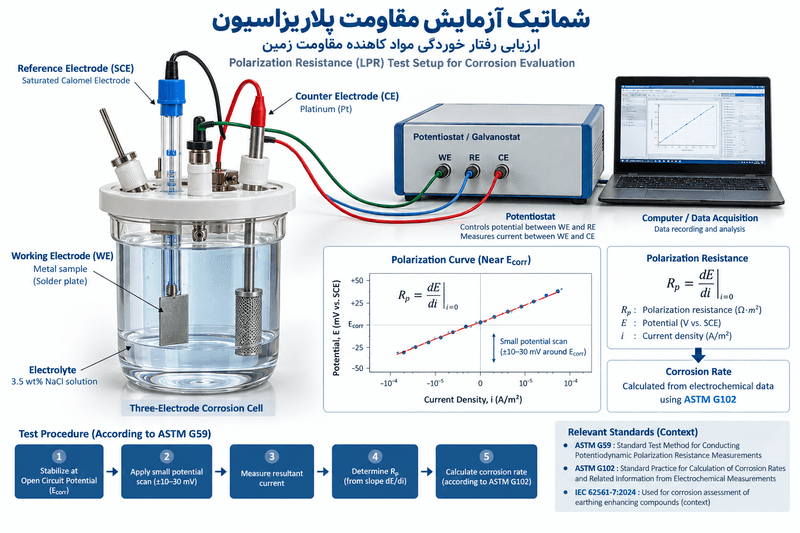
- non-corrosive to the electrode (Ground improvement materials and earthing system corrosion);
- chemically stable and not leached by surface water or groundwater;
- non-polluting to soil and groundwater.
These qualities are measured by the IEC 62561-7 tests. You will find the details in Specifications of standard ground improvement materials and The standard for ground improvement materials, and a comparison of material types in the ground improvement material comparison table.
We manufacture the GIM family of ground improvement materials to IEC 62561-7: GIM for highly corrosive soils and environments, GIM LIGHT for normal conditions and ECO GIM. The test reports for each product are on that product's page.