
Move your pointer over the image to zoom in
Complete Product Overview
Conventional air rod in nickel-chrome plated copper
Order Code: ATN 0516 … ATN 2020
Last updated:
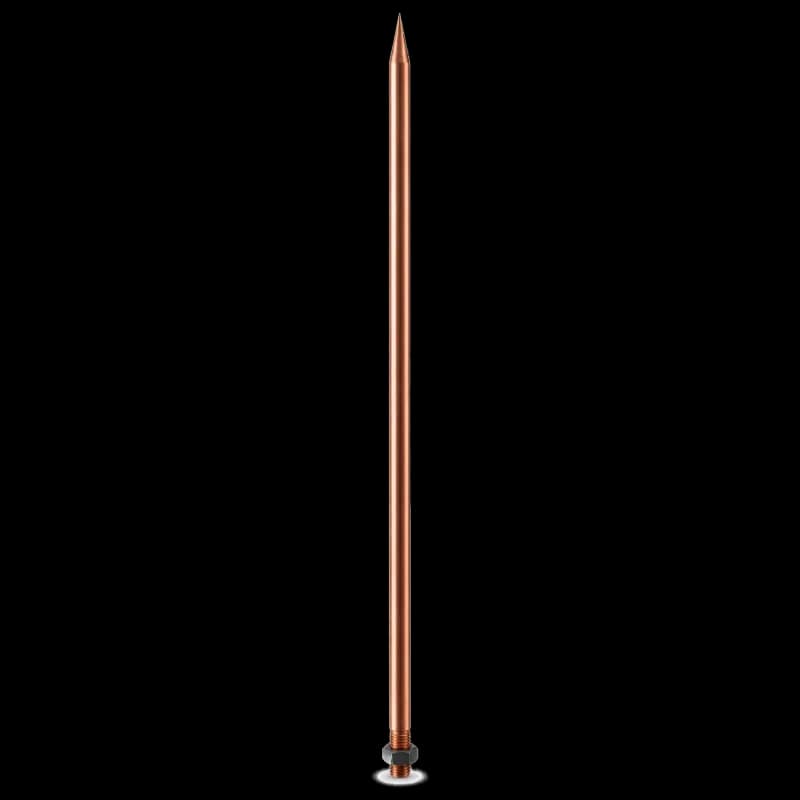
The KALOT conventional air rod in nickel-chrome plated copper, part of the Franklin (passive) rod-type family, is a copper air rod with a tapered tip and a nickel-chrome plated surface. Working as the air terminal of a lightning protection system, it covers the highest points of the structure and carries the lightning current to the down conductors and the earthing system.
The air rod fixes onto a base or connector by its threaded end, and each conventional air rod comes with a lock nut. Standard models are made in 16 mm and 20 mm diameters and in lengths from 500 to 2000 mm, and we make other diameters and lengths to your order.
We produce these air rods in line with the requirements of IEC 62561-2, giving your project a simple, long-lasting air terminal.
An air terminal for the protection angle, rolling sphere and mesh methods
Conventional air rods go at the points the lightning protection system designer sets using the protection angle, rolling sphere or mesh method. The nickel-chrome plated copper air rod suits places where you want the benefits of copper together with a bright metallic look and no darkening of the surface, such as architectural facades and visible roofs.
Copper core with nickel-chrome plating
The air rod body is copper with a nickel-chrome plating over its surface. The plating protects the copper from darkening outdoors and keeps the air rod's bright metallic look.
Tapered tip and threaded end
The air rod has a tapered tip, and the other end carries an M16 or M20 thread so it fixes directly onto a base or coupling.
Supplied with a lock nut
Each air rod comes with one lock nut, which holds it firmly on the base or connector and stops it working loose.
Eight standard models, made to order
Diameters of 16 and 20 mm in four lengths: 500, 1000, 1500 and 2000 mm. We make other diameters and lengths to order.
Produced in line with IEC 62561-2
We produce these conventional air rods in line with the requirements of IEC 62561-2, the standard for conductor and electrode components of lightning protection systems.
Technical Product Information
Feature | Value |
|---|---|
Product type | Conventional air rod with tapered tip (Taper Point Air Rod) |
Air rod material | Nickel-chrome plated copper |
Air rod diameter | 16 mm or 20 mm |
Threaded end | M16 for 16 diameter, M20 for 20 diameter |
Standard length | 500, 1000, 1500 and 2000 mm |
Nut | One lock nut with each air rod; nut material: stainless steel |
Made to order | Other diameters and lengths |
Production standard | IEC 62561-2 |
Order code | ATN 0516 to ATN 2020 |
Order code | Length L (mm) | Air rod diameter (mm) | Thread | Material |
|---|---|---|---|---|
ATN 0516 | 500 | 16 | M16 | Nickel-chrome plated copper |
ATN 1016 | 1000 | 16 | M16 | Nickel-chrome plated copper |
ATN 1516 | 1500 | 16 | M16 | Nickel-chrome plated copper |
ATN 2016 | 2000 | 16 | M16 | Nickel-chrome plated copper |
ATN 0520 | 500 | 20 | M20 | Nickel-chrome plated copper |
ATN 1020 | 1000 | 20 | M20 | Nickel-chrome plated copper |
ATN 1520 | 1500 | 20 | M20 | Nickel-chrome plated copper |
ATN 2020 | 2000 | 20 | M20 | Nickel-chrome plated copper |
In the order code, the first two digits give the air rod length in decimetres (05 to 20) and the last two give its diameter in millimetres. Each conventional air rod comes with one lock nut. For other diameters and lengths, tell us the size you need when you order.
Click to view enlarged
The KALOT drawing shows the air rod with its tapered tip, length L and threaded end, and the same sheet carries a table of the eight standard ATN models with the diameter, thread and length of each. This is not a manufacturing drawing. Its PDF and SVG files are in the "Documents and downloads" section of this page.
Click to view enlarged
Application
The conventional air rod is the simplest type of air terminal and is used in standard lightning protection systems:
- on flat roofs, parapets and roof edges, at the points set by the system design;
- on roof ridges, chimneys, towers and tall structures;
- together with a roof conductor network (mesh) to cover projecting points.
The nickel-chrome plated copper air rod suits places where you want the benefits of copper together with a bright metallic look and no darkening of the surface, such as architectural facades and visible roofs. The system designer sets the number, height and position of the air rods using the protection angle, rolling sphere or mesh method.
Related components
- Air rod base for mounting on a flat surface: air rod base for flat surfaces.
- Connecting a conductor to a conventional air rod: coupling for connecting conductor to air rod and coupling for connecting tape to air rod.
- Related copper air rod: conventional air rod in solid copper. The three-pronged tip for conventional air rods is made for use with pointed copper air rods.
- All KALOT conventional (Franklin) air rod models: conventional air rods.
Installation sequence
- Mark the position and height of the air rod according to the lightning protection system design.
- Install and secure the base that suits the surface (flat roof, roof ridge or wall).
- Run the lock nut onto the threaded end of the air rod, screw the air rod into the thread of the base or coupling, and tighten the nut against the base so it stays firm.
- Connect the system conductors to the base or coupling with a suitable connector.
- After installation, check that the connections are tight and that the path to the earthing system has electrical continuity.
Technical notes
- The nickel-chrome plating covers the copper surface, so avoid scratching it with tools during handling and installation.
- The core of the air rod is copper. Use it with copper or brass connectors, and avoid direct contact with aluminium or galvanised steel, especially where there is moisture.
- Longer air rods bear greater wind loads, so choose the base and bracing method to suit the air rod's length and the site conditions.
- In the lightning protection industry, nickel plating on copper air terminals adds a protective layer over the copper surface and keeps its bright metallic look, which is why this air rod is chosen for architectural facades and visible roofs. See the material comparison guide on the conventional air rods page.
Inspection and maintenance
During periodic inspections of the lightning protection system, check the air rod, lock nut and conductor connections for loosening, bending, corrosion and mechanical damage, and measure the electrical continuity of the path if needed. Inspect also after every known lightning event.
The standards below are listed to help you understand the requirements for air rods and their place in a lightning protection system.
Component standard: IEC 62561-2
This standard sets the requirements for conductors and earth electrodes of lightning protection systems, including air rods (air terminals): material, dimensions, and mechanical and electrical tests. We produce our conventional air rods in line with its requirements.
System design standard: IEC 62305-3
This standard covers the design, installation, inspection and maintenance of a structure's lightning protection system. Air terminals are positioned by the protection angle, rolling sphere or mesh method, and the height and number of air rods are the outcome of this design.
Installing a nickel-chrome plated copper conventional air rod on a building
Similar & Complementary Products
Frequently Asked Questions
What is a conventional nickel-chrome plated copper air rod used for?
A conventional air rod is the air terminal of a lightning protection system: installed on the highest points of the structure, it receives the lightning strike and carries its current through the down conductors to the earthing system.
What does the nickel-chrome plating do?
The nickel-chrome plating covers the surface of the copper air rod. It stops the copper surface darkening outdoors and keeps its bright metallic look. The core of the air rod is still copper.
Which diameters and lengths are available?
Standard models are made in 16 mm (M16 thread) and 20 mm (M20 thread) diameters, in lengths of 500, 1000, 1500 and 2000 mm. We make other diameters and lengths to order.
How are the height and number of air rods determined?
The lightning protection system designer sets the position, height and number of conventional air rods according to the required protection level, using the protection angle, rolling sphere or mesh method.
How is a conventional air rod installed?
The air rod fixes onto a base or coupling by its threaded end, and the lock nut supplied with it holds it firmly on the base. The system conductors connect to the base or coupling.
How does this air rod differ from the solid copper type?
A solid copper air rod has high conductivity, and its surface darkens over time. The conventional air rod in nickel-chrome plated copper suits places where you want the benefits of copper together with a bright metallic look and no darkening of the surface, such as architectural facades and visible roofs.
Which standard are these air rods produced to?
We produce our conventional air rods in line with the requirements of IEC 62561-2, and the protection system itself is designed to IEC 62305-3.
Have a Technical Question?
KALOT Group's technical experts are ready to answer your questions about lightning rods and earthing systems.