Introduction
Short answer: lightning occurrence is measured by "the number of thunderstorm days per year" or, more precisely, by "ground flash density", the number of flashes per square kilometre per year. In Iran, according to data from 50 synoptic stations over 35 years, average thunderstorm days range from about 2 days in Jask to about 31 days in Maku per year. Occurrence is highest in the northwest, west and southwest of the country. Worldwide, the most lightning-prone place is Lake Maracaibo in Venezuela, with about 233 flashes per square kilometre per year.
Lightning is one of the most dangerous atmospheric phenomena. Knowing how often it occurs in each region is essential for designing a lightning protection system to IEC 62305 and for building the earthing system.
Lightning occurrence worldwide
- Across the whole Earth, about 44 lightning flashes occur every second on average. Most of them happen over land and near the equator, and the oceans see far less lightning.
- According to 16 years of TRMM-LIS satellite data (Albrecht et al., 2016), the most lightning-prone spot on Earth is Lake Maracaibo in Venezuela, with about 233 flashes per square kilometre per year. Next come Kabare (about 205) and Kampene (about 177) in Congo, and Cáceres in Colombia (about 172).
- Central Africa has the largest number of lightning hot spots. Moving away from the equator and into dry regions, lightning falls off sharply.
Lightning statistics in Iran
A study of thunderstorm data from 50 synoptic stations across Iran for the Iranian calendar years 1358 to 1392 (Trends in thunderstorm frequency in Iran) paints this picture:
- Range: the annual average of thunderstorm days runs from 2.2 days in Jask to 31.5 days in Maku. The highest count in a single year, 67 days, was recorded in Urmia.
- Distribution: thunderstorms are more frequent in the northwest, west and southwest of the country, along the Zagros mountains, and become less frequent towards the east. Stations such as Tabriz, Khoy, Urmia and Khorramabad belong to the high-occurrence group.
- Season and time of day: spring has the highest occurrence. During the day, most thunderstorms come in the afternoon and evening. At the start of autumn, the Caspian Sea coast is also an important hot spot.
- Trend: at most stations in the country, the number of thunderstorm days has risen in recent decades.
The exact figure for each city should come from a lightning risk assessment, using data from the station or lightning detection network closest to that site.
From thunderstorm days to strikes on a building
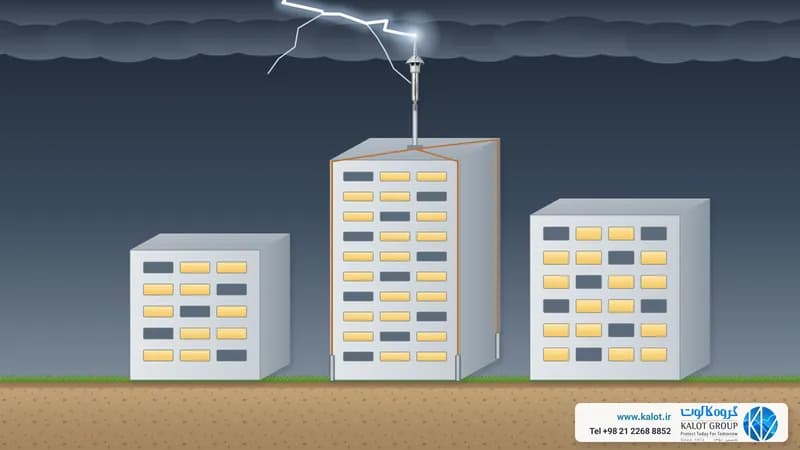
To assess lightning risk, IEC 62305-2 calls for the ground flash density NG. Where no detection network data exists, in temperate regions it takes approximately NG ≈ 0.1 · TD, where TD is the number of thunderstorm days per year. The number of direct strikes to a building per year then comes from ND = NG · AD · CD · 10⁻⁶. AD is the building's collection area: the building itself plus a strip around it as wide as three times its height. CD is the location factor, which is 1 for an isolated building.
An example: an isolated building measuring 20 by 20 metres and 10 metres high has a collection area of about 5627 square metres. In Maku this building takes one direct strike about every 56 years on average, and in Jask about every 808 years. A taller building, or one on a hill, has a larger collection area and location factor, and takes more strikes.
Why lightning occurrence matters
- Risk assessment: flash density is the basis of the IEC 62305-2 risk calculation, which determines whether an air terminal is needed and at what protection level.
- Low lightning does not mean no danger: even in a low-lightning area, a single strike on a hospital, fuel depot or data centre has severe consequences. Strikes near a building and its incoming lines also burn out equipment without any direct hit (types of lightning effects and secondary protection and SPDs).
- Safety of life and fire: in lightning-prone and mountainous areas, tall structures and open spaces are at greater risk.
- Maintenance planning: in lightning-prone areas, inspecting the earthing system and air terminal after the storm season matters more. A lightning strike counter records the number of strikes to the air terminal.
Conclusion
Lightning occurrence in Iran varies more than tenfold from one place to another, and is highest in the northwest, west and southwest. But the decision on protection rests on the building's full risk, and the number of strikes is only one factor in it. We carry out lightning risk assessment and lightning protection system design, and we offer ESE air terminals, conventional air rods and lightning protection equipment. For advice, send our specialists the site address and the building's dimensions, or reach us through our contact page.