
Move your pointer over the image to zoom in
Complete Product Overview
Threaded driving head for copper-bonded earth rods
Order Code: ETDH 58 · 34 / ITDH 58 · 34
Last updated:
The KALOT steel driving head transfers the blows of a hand or power hammer to the copper-bonded earth rod and keeps its top and threads from being crushed. It is removed after driving and used again for the next earth rod.
We manufacture this part in two types: externally threaded (ETDH), which fits inside the brass coupling, and internally threaded (ITDH), which fits directly on the thread at the top of the copper-bonded earth rod. Both are for 5/8" and 3/4" diameters.
Deep driving with no damage to the thread
A sound thread means a firm, conductive joint between earth rods. The driving head takes the hammer blows so that the top and thread of the earth rod stay intact.
Impact-resistant steel
Withstands repeated power hammer blows without deforming.
Two types for two methods
External thread in the coupling; internal thread directly on the earth rod.
Reusable
Removed after each earth rod is driven and used again for the rest.
For both diameters
5/8" and 3/4", matching the ERCB copper-bonded earth rod.
Technical Product Information
Feature | Value |
|---|---|
Product type | Threaded driving head (driving stud) for copper-bonded earth rods |
Material | Steel |
Type | External thread ETDH (in the coupling) / internal thread ITDH (directly on the earth rod) |
Size | 5/8" and 3/4" |
Driving method | Hand hammer or power hammer |
Our products are continually improved and some specifications may be updated, so please confirm the final specifications with our specialists before buying.
Order code | Size | Type | How it is fitted |
|---|---|---|---|
ETDH 58 | 5/8" | External thread | Inside a TCR/TCH coupling |
ITDH 58 | 5/8" | Internal thread | Directly on the earth rod thread |
ETDH 34 | 3/4" | External thread | Inside a TCR/TCH coupling |
ITDH 34 | 3/4" | Internal thread | Directly on the earth rod thread |
One or two driving heads per earth rod diameter are enough for each project, as the part is reused after each driving.
Click to view enlarged
The KALOT drawing shows the externally threaded ETDH driving head (a bolt with a knurled head) and the internally threaded ITDH (a steel cylinder with an internal thread). The table gives the codes for each size.
Click to view enlarged
Application
- Driving threaded copper-bonded earth rods with a hand or power hammer;
- Protecting the thread and top of the earth rod from impact.
How to drive an earth rod
- Mark the earth rod location according to the earthing drawing and a safe distance from foundations and underground services.
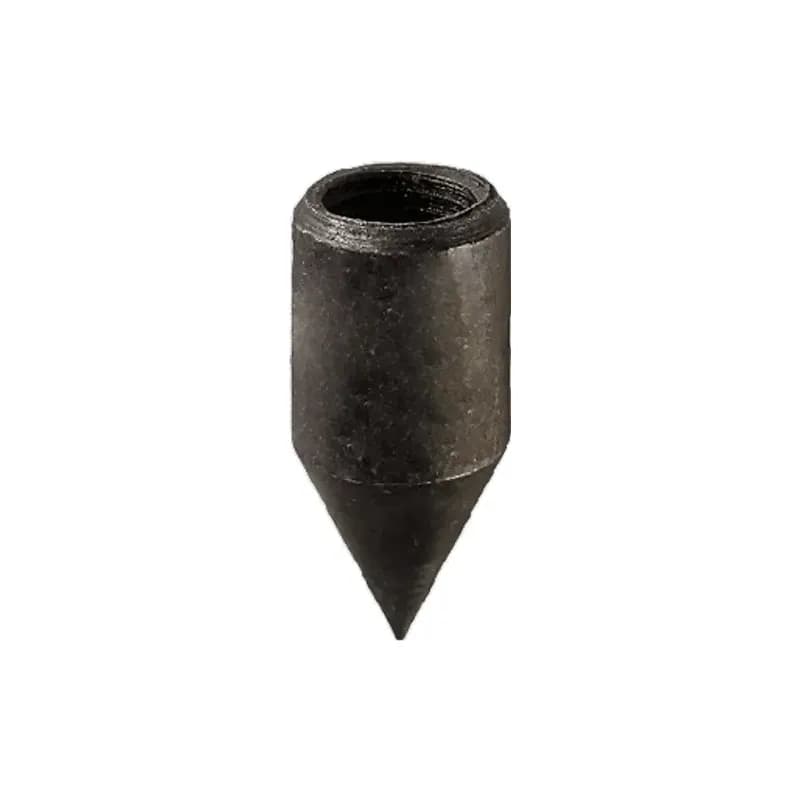
- In hard or rocky soil, fit the steel tip on the thread at the lower end of the earth rod.
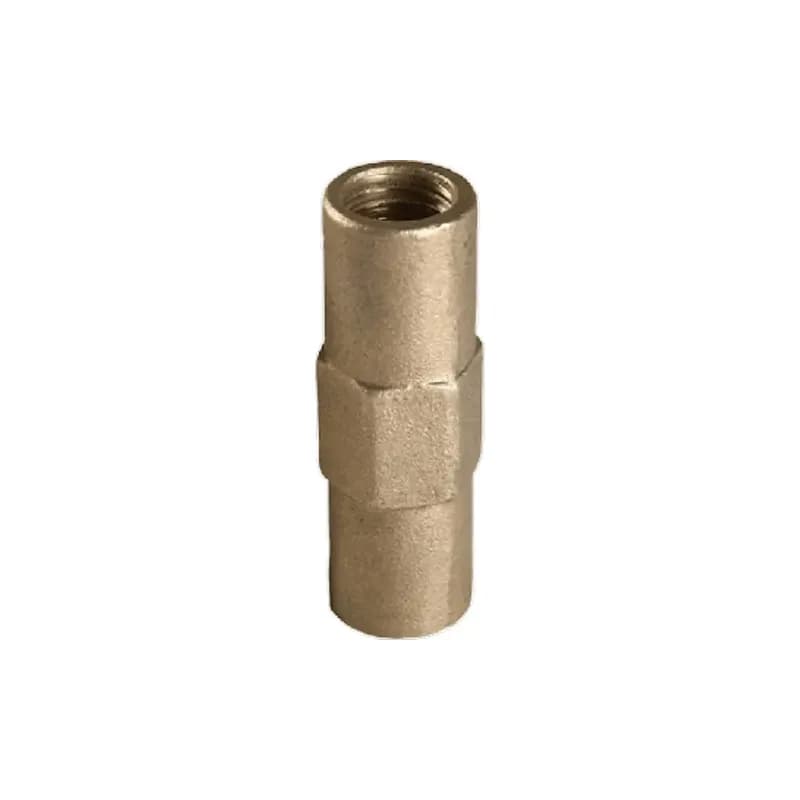
- Fit the brass coupling on the top end of the earth rod and screw the driving head into it so that the threads are not damaged by the blows.
- Hold the copper-bonded earth rod vertical and drive it with even blows from a hand or power hammer.
- For greater depth, remove the driving head, fit the next earth rod into the coupling and drive again. The ends of the earth rods meet inside the coupling.
- Once at design depth, remove the driving head, connect the earth conductor to the top of the electrode with an earth rod clamp or exothermic welding, and measure the earth resistance.
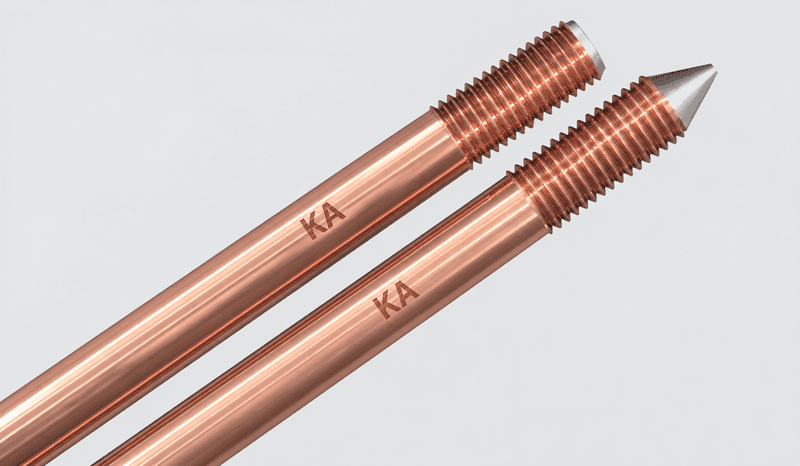
Other components: threaded copper-bonded earth rod, brass earth rod coupling and threaded steel tip.
A driving head is needed in every copper-bonded earth rod installation, even when no steel tip is used. Hammering directly on the top of a copper-bonded earth rod causes three kinds of damage: the top flares and mushrooms, the thread is crushed so the coupling no longer fits, and the copper coating at the top cracks. The steel driving head takes these blows instead.
Type | Where it fits | When it is used |
|---|---|---|
External thread ETDH | Inside the brass coupling on top of the earth rod | The common method: the coupling sits between the driving head and the earth rod, and the earth rod thread is fully protected |
Internal thread ITDH | Directly on the thread at the top of the earth rod | When the earth rod is driven as a single piece or no coupling is fitted on it |
- Tighten the driving head fully so that the blow lands on the full surface.
- With a power hammer, use a chisel or driving adapter sized to the driving head.
- If the striking face or thread of the driving head deforms, replace it so that the damage does not pass to the earth rod.
The standards below set out the requirements for driving tools and earth electrodes:
IEC 62561-2 (components for earthing and lightning protection systems)
This standard sets separate requirements for earth rod joints (couplings) and driving tools: the joint must be compatible with the earth rod and strong enough to withstand the driving force; in a threaded joint no earth rod thread remains exposed after installation; and driving heads and driving tools are used according to the maker's instructions.
IEC 60364-5-54 and IEC 62305-3
They set the material and minimum dimensions of earth electrodes: for a vertical copper-bonded earth rod, a minimum diameter of 14 mm and a minimum copper coating of 250 microns. For a full comparison of standard and non-standard earth rods, see the copper-bonded earth rods page.
Installing a copper-bonded earth rod in soil
Frequently Asked Questions
What does an earth rod driving head do?
It transfers the hammer blows to the steel-core, copper-coated earth rod and prevents its top and thread from being crushed during driving.
What is the difference between ETDH and ITDH?
ETDH is externally threaded and fits inside the brass coupling. ITDH is internally threaded and fits directly on the thread at the top of the copper-bonded earth rod.
Does the driving head stay in the soil?
No. It is removed after driving and used again for the next earth rod.
Can it be used with a power hammer?
Yes. This part is made for driving with both hand and power hammers.
What happens if I drive an earth rod without a driving head?
The top of the earth rod flares, the thread is crushed and the copper coating at the top cracks. After that, the coupling will not fit on the earth rod and the joint is weakened.
Which type should I buy, ETDH or ITDH?
If you are joining earth rods with couplings, choose ETDH. If the earth rod is a single piece or driven without a coupling, choose ITDH.
Have a Technical Question?
KALOT Group's technical experts are ready to answer your questions about lightning rods and earthing systems.