
Move your pointer over the image to zoom in
Complete Product Overview
Multi-purpose stainless steel four-way clamp for connecting conductor and tape
Last updated:
The KALOT multi-purpose four-way clamp is a bolted stainless steel clamp that makes three types of connection with a single part in the conductor network of lightning protection, earthing and bonding systems: conductor to conductor, tape to tape and conductor to tape. It is made of two identical formed halves that sit on each other, turned 90 degrees. Each conductor seats in one of the halves, and four stainless steel bolts and nuts press the two conductors together where they cross. The range of use is stamped on the body: conductor 50 and 70 mm² and tape 20×3 and 30×2 mm.
We manufacture this clamp for projects that want to make all their conductor and tape connections uniform and long-lasting with a single stainless steel part.
One clamp for three types of conductor and tape connection
In lightning protection, earthing and bonding networks that use both round conductors and flat tape, each conductor combination usually calls for its own clamp. The KALOT multi-purpose four-way clamp handles conductor-to-conductor, tape-to-tape and conductor-to-tape connections at 90 degrees with a single part.
Each half of the clamp has a semicircular channel for the conductor and two flat surfaces for the tape. The halves sit on each other, turned 90 degrees, and four stainless steel bolts press the two conductors together where they cross.
- Conductor to conductor, tape to tape and conductor to tape
- Body and bolts in stainless steel
- Conductor 50 and 70 mm², tape 20×3 and 30×2
- Bolted connection, easy to inspect
Three connection types with one clamp
The central channel of each half takes the round conductor and the flat surfaces either side take the tape, so the same clamp makes conductor-to-conductor, tape-to-tape and conductor-to-tape connections.
All-stainless steel construction
The two body halves, four bolts and four nuts are all stainless steel, suited to damp and outdoor conditions and giving the joint a longer life.
Bolted connection, easy to inspect
The connection needs no welding, only four bolts. At periodic inspections it can be seen, opened and retightened.
For mixed conductor and tape networks
Where round conductors and flat tapes meet or cross, one type of clamp is enough, which makes material selection and sourcing simpler.
Four fixing points for even pressure
The four bolts sit at the four corners of the clamp, with the conductor crossing at the centre between them. Tightening them crosswise spreads the clamping force symmetrically over the conductors.
Technical Product Information
Click to view enlarged
Feature | Value |
|---|---|
Product type | Multi-purpose four-way clamp for conductor and tape connections (Multi-Purpose Cross Clamp) |
Connection types | Conductor to conductor, tape to tape, conductor to tape: two conductors at 90 degrees |
Conductor range (round conductor) | 50 and 70 mm² (marked "50-70" on the clamp) |
Tape range (flat conductor) | 20×3 and 30×2 mm (marked "20X3-30X2" on the clamp) |
Body material | Stainless steel, formed sheet 1.5 mm thick |
Components | Two identical formed halves + 4 M6 hex bolts + 4 M6 hex nuts |
Bolt and nut material | Stainless steel; bolt heads marked A2-70 |
Dimensions of each half | 64 × 64 mm, R8 corners, 8 mm high |
Bolt holes | 4 Ø7 holes at 48 mm centres |
Conductor seating | R5.5 central channel for the conductor; 21 mm flat surface for the tape |
Marking | KALOT ABHAR and 50-70 / 20X3-30X2 on the body |
Application | Conductor network of lightning protection, earthing and bonding systems, especially mixed conductor and tape networks |
Related standards | IEC 62305-3 (design and installation of lightning protection systems) |
The conductor range is stamped on the clamp itself: "50-70" for round conductors with a cross-section of 50 and 70 mm², and "20X3-30X2" for tape of 20×3 and 30×2 mm. The KALOT ABHAR manufacturing drawing gives the same range for this clamp, and the R5.5 channel and 21 mm flat surface match these sizes. For a conductor outside this range, please check with KALOT Group before ordering.
Click to view enlarged
The drawing shows the front view and cross-section of one half of the clamp with the dimensions of version R1: 64×64 mm plate, four Ø7 holes at 48 mm centres, 1.5 mm sheet, each half 8 mm high, a 21 mm flat surface for the tape and an R5.5 channel for the conductor.
Download the drawing: PDF · SVG (vector)
Three connection types with one clamp
- Conductor to conductor: each conductor sits in the semicircular channel of one half, and the two conductors pass through the clamp at 90 degrees.
- Tape to tape: each tape rests on the flat strips of one half, and the two tapes pass through the clamp at right angles to each other.
- Conductor to tape: the conductor sits in the channel of one half and the tape on the flat surface of the other, which suits a point where the conductor type changes along the route.
In all three cases the main connection is a cross joint, with both conductors passing through the clamp. For a T branch (where one conductor ends at the clamp), the end of that conductor must carry on to the opposite edge of the clamp so that it is held along the full length of the channel or flat surface. Because the channels of the two halves are perpendicular, this clamp is not designed for parallel or end-to-end connection of two conductors in one line.
How does the clamp's geometry work?
Each half of the clamp is formed from 1.5 mm stainless steel sheet. At the centre of each half, a semicircular channel runs the full length of the part, where the round conductor sits and is guided along its path. On either side of the channel are two formed flat strips on which the flat tape rests, and along the two outer edges are flat flanges with the bolt holes.
The two halves face each other, turned 90 degrees, so the channels of the top and bottom halves are perpendicular. The first conductor sits in the top half and the second in the bottom half, and they lie on each other where they cross. As the four corner bolts are tightened, the halves draw together and press the two conductors against each other. The gap between the halves after installation depends on the type and size of the conductors, which is why the bolts pass through the flanges and not through the conductor area.
Why a multi-purpose clamp?
In many projects, the conductor network of a lightning protection and earthing system is not built from one conductor type alone. Part of the route runs in flat tape and part in round stranded conductor: a round conductor on the roof may reach a down conductor tape, for example, or a horizontal round conductor may cross over tapes. At these points, a separate clamp is usually chosen for each combination.
The multi-purpose four-way clamp covers these same combinations with one part. The result is simpler material selection at the design stage, fewer part types in the store and on site, and a bolted connection that can be seen, opened and retightened at later inspections.
Click to view enlarged
Where it is used
This clamp is used in the conductor network of a lightning protection system (roof conductors and down conductors), the earthing network and bonding conductors, especially wherever round conductors and flat tape are used together in one network: where a round roof conductor reaches a down conductor tape, where a horizontal round conductor crosses a tape, or where bonding branches from metal structures connect to the network. The system designer sets the location and number of clamps according to the conductor route in each project.
Installation sequence
- Before installation, compare the conductor sizes with the marking on the clamp: conductor 50 or 70 mm² and tape 20×3 or 30×2 mm.
- Clean the contact surfaces of the conductors and clamp of paint, grease, dust and heavy oxide.
- Place the first conductor in the bottom half, with a round conductor in the central channel or a tape on the flat surfaces either side of it, so that it sits at the centre of the clamp.
- Place the second conductor at right angles to the first and lay the top half over it, turned 90 degrees, so that the second conductor sits in the channel or on the flat surface of this half.
- Pass all four bolts through the corner holes and first fit the nuts by hand.
- Tighten the bolts gradually in a crosswise pattern so the two halves seat evenly on the conductors.
- After
- tightening, check that the conductors are not loose and have not moved off their path, and that the gap between the two halves is roughly equal at all four corners.
Material and corrosion considerations
The clamp body and its four bolts and nuts are stainless steel, and the bolt heads carry the marking A2-70. An all-stainless build stands up well to atmospheric corrosion and damp environments, and over time it keeps the bolted joint easy to open and retighten. Even so, no metal is immune to corrosion in every environment.
When a copper conductor touches a stainless steel clamp, two different metals sit side by side. This pairing is common in normal atmospheric conditions, but in highly corrosive environments (industrial, coastal, chemical), for installation underground or in concrete, or with aluminium or galvanised steel conductors, check material compatibility before work begins with the system designer and the KALOT Group technical team.
Inspection and maintenance
During periodic inspections of the lightning protection and earthing system, check this connection for loose bolts, conductor movement, mechanical damage, corrosion or unusual discolouration, and if needed measure the electrical continuity of the route. After every opening and closing, retighten the bolts gradually in a crosswise pattern.
When to choose a multi-purpose clamp, and when a dedicated one?
Choose the multi-purpose stainless steel clamp when: the project uses both conductors and tape; you want one clamp type to cover several connection combinations; an all-stainless build is preferred for the project environment; or fewer part types in purchasing and storage matter to you.
Choose a dedicated clamp when: the project has only one fixed conductor combination; a smaller clamp or one made for that combination is a better fit; or the project specification requires a tested clamp with a specific report. Other KALOT options are the four-way conductor-to-tape clamp and two-way conductor-to-tape clamp for conductor-to-tape connections with a brass body, and the square four-way tape-to-tape clamp for all-tape networks.
The following standards are the reference for the design, installation and selection of connection components in lightning protection systems.
System design standard: IEC 62305-3
This standard covers the design, installation, inspection and maintenance of a structure's lightning protection system. Air-termination conductors, down conductors, the earthing system and bonding are among the parts whose requirements it sets. The choice of conductor type, connection points and number of clamps rests with the system designer.
Cross clamps for wire and tape
Documents & Downloads
Catalogues & datasheets
Drawings & schematics
- Dimensional drawing of the multi-purpose four-way clamp (PDF)Language: Persian (opens in a new tab)
- Three connection types: conductor to conductor, tape to tape, conductor to tape (PDF)Language: Persian (opens in a new tab)
- How the conductor and tape seat in the clamp (semi-transparent and sectional view) (PDF)Language: Persian (opens in a new tab)
- Exploded view of the multi-purpose four-way clamp (PDF)Language: Persian (opens in a new tab)
- Application schematic in a combined conductor and tape network (PDF)Language: Persian (opens in a new tab)
Similar & Complementary Products
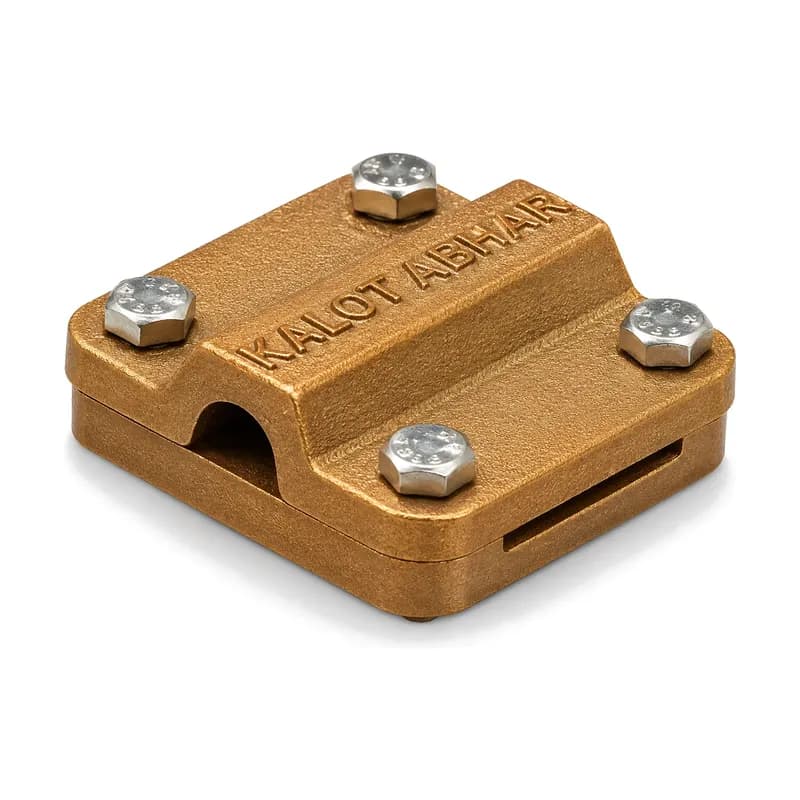
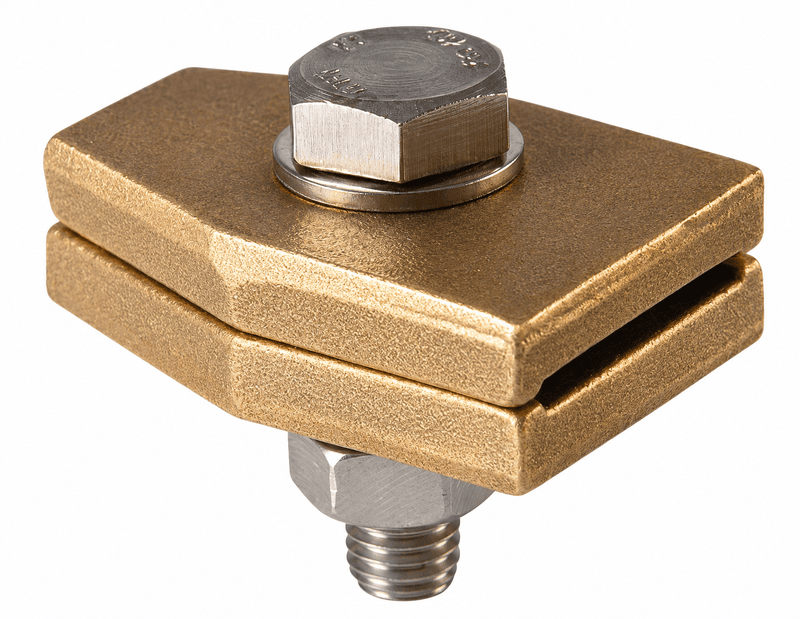
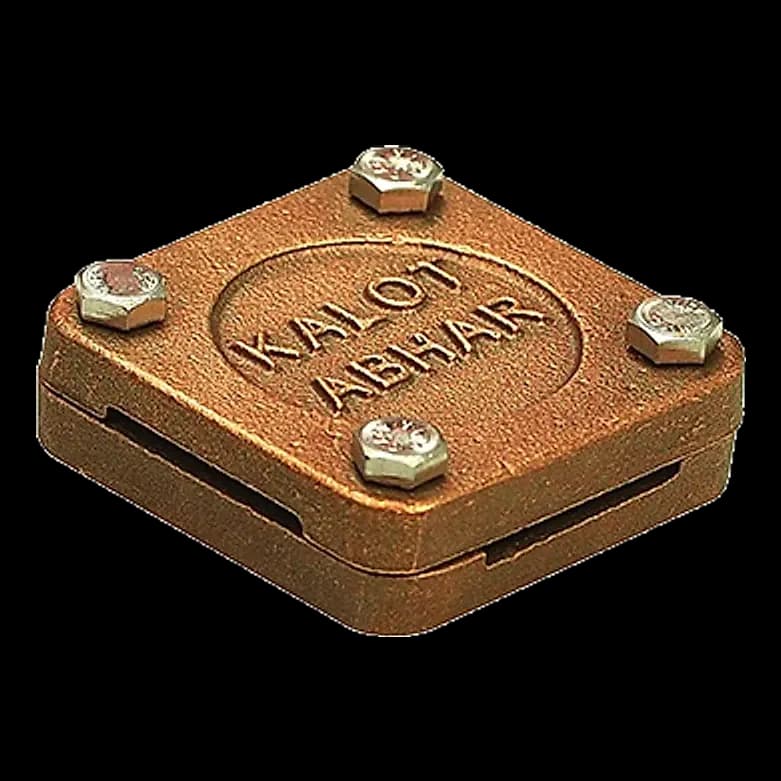
Frequently Asked Questions
What types of conductor does the multi-purpose four-way clamp connect?
Round conductor and flat tape in three combinations: conductor to conductor, tape to tape and conductor to tape. In all three, the two conductors pass between the clamp's two halves at 90 degrees.
Is this clamp suitable for conductor-to-conductor connections?
Yes. Each conductor sits in the semicircular channel of one half, and the two conductors, at right angles to each other, are pressed together where they cross.
Can it also be used for tape-to-tape connections?
Yes. Each tape rests on the flat surfaces either side of the channel in one half, and the two tapes are joined at right angles to each other.
Is it suitable for connecting conductor to tape?
Yes, this is one of its main uses. The conductor sits in the channel of one half and the tape on the flat surface of the other, which suits any point where a round conductor reaches a tape or crosses over it.
What conductor range can it take?
According to the marking on the clamp and the KALOT ABHAR manufacturing drawing: conductors with a cross-section of 50 and 70 mm², and tape of 20×3 and 30×2 mm. For any other conductor, please check with KALOT Group before ordering.
Why are the body and bolts stainless steel?
Stainless steel resists atmospheric corrosion and moisture, and over time it keeps the bolted joint easy to open and retighten. An all-stainless build also avoids having ordinary steel or galvanised bolts next to the body. In highly corrosive environments or for underground installation, check material compatibility before work begins.
Can it be used in lightning protection and earthing systems?
This clamp is designed for the conductor network of lightning protection, earthing and bonding systems. The system designer decides where and how many clamps to use, and whether the clamp suits each point of the network, based on the project and the reference standard.
How should the four bolts be tightened? Is there a specific torque?
Once both conductors are in place, first fit the nuts by hand, then tighten the bolts gradually in a crosswise pattern so the two halves seat evenly on the conductors.
Is this clamp suitable for parallel or end-to-end connection of two conductors?
No. The channels of the two halves are perpendicular, and the clamp is designed to join two conductors at 90 degrees. For an in-line connection, use KALOT two-way clamps.
When is a dedicated clamp better than a multi-purpose one?
When a project has only one fixed conductor combination, a smaller clamp or one made for that combination is the better fit, as it is when the project specification requires a tested clamp with a specific report. In mixed conductor and tape networks, the multi-purpose clamp makes selection and sourcing simpler.
Have a Technical Question?
KALOT Group's technical experts are ready to answer your questions about lightning rods and earthing systems.