
KALOT Group
This translation is an AI-assisted draft pending human review. It is not indexed for search yet.Read the reviewed Persian original

Earthing and lightning protection for airports, radar and navigation equipment

Air navigation equipment is usually installed where conditions are worst for an earthing system: on hilltops, on rock, far from everything, with antennas that are the highest point in the area. A study that compared lightning data with one country's navigation equipment outage records over twelve years found that, despite protection guidelines, lightning-related outages are still common, and some are even logged under a different cause. We have installed the earthing and protection systems of 37 navigation and radar units at 12 airports across Iran and at the Tehran control centre.

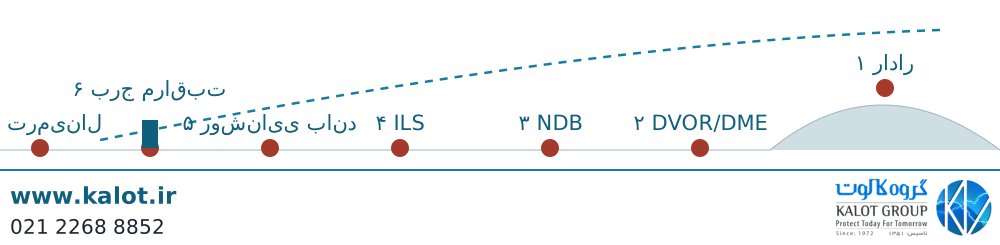
Diagram of an aircraft approaching an airport with seven stations: mountain radar, DVOR/DME, NDB, ILS, runway lighting, control tower and terminal

Site by site, along the aircraft's approach path

RADAR1. Radar on a mountain

The problem

Radar sites are built on rock or shallow soil, where low earth resistance is hard to reach. Salts poured into the soil to cut resistance wash away and must be topped up every year. Concrete poured around the electrode also cracks in shifting soil and breaks the conductor. An old report on two airport radars that were knocked out by lightning 25 times in six weeks traced the cause to poor earthing and wiring.

Our answer:
Soil resistivity measurement in several directions, a ring electrode and earth rods with GIM ground improvement material, and a down conductor for every leg of the radar tower.

DVOR / DME2. DVOR and DME station

The problem

If the equipment shelter, antenna mast and fence each have a separate earth, a voltage difference builds up between them during a lightning strike and the equipment inside the shelter is damaged.

Our answer:
One earthing system for the whole site, buried joints made with KALweld® exothermic welding, and bonding of the tower, shelter and fence.

NDB3. NDB transmitter

The problem

A study of a major airport reported that lightning struck the NDB on the runway extension and knocked out the transmitter. The same study found a link between the number of lightning strikes and NDB disturbances.

Our answer:
Earthing of the antenna and shelter, surge protective devices on the power supply and RF line, and periodic inspection.

ILS · LOC · GP4. Localiser and glide path

The problem

Long buried cables between the antenna array, monitor and shelter pick up lightning surges from far away.

Our answer:
A buried shield wire laid above the cables and connected to earth rods at intervals, plus surge protective devices at both ends of every cable.

AGL5. Runway and approach lighting

The problem

In one airport's report, lightning knocked out both navigation equipment and runway lighting, and the airport could only operate in daylight until repairs were made.

Our answer:
A bonding conductor (counterpoise) along the lighting cable routes, and earthing system testing.

TOWER6. Control tower

The problem

In a well-known incident, lightning struck the control tower of a major airport, a controller was injured and flights were halted for more than two hours. The likely cause was a lightning protection cable cut during earlier building work that nobody had noticed. Afterwards, that country's aviation authority scheduled inspections of all its towers.

Our answer:
Bonding of the tower's structural reinforcing bars, surge protective devices on the vertical cables between the cab and the tower base, and periodic inspection with a continuity test after every repair.

APRON7. Terminal and refuelling apron

The problem

During aircraft refuelling, static electricity must be discharged through bonding, and bonding reels lose their effectiveness as they corrode. Like any large public building, the terminal also houses many sensitive systems.

Our answer:
Apron earthing points, continuity testing, and lightning and surge protection design for the terminal.

Reference: FAA-STD-019, IEC 62305, IEC 61643

Units we have completed

AirportUnits
YazdILS, GP, LLZ, RCAG, TX, DVOR/DME, technical block
Imam KhomeiniRadar, Approach, UPS
ShirazRadar, DVOR, localiser
BushehrTransmitter, GP, LOC
TabrizTransmitter, RCAG, NDB
Khorramabad and KermanshahNDB, ILS, DVOR/DME
Sabzevar and LarestanNDB, DVOR/DME, technical block
Bojnurd and ArdabilILS, LOC, GP
ShahroudDVOR/DME
Tehran control centreRCAG site

What to send for design and a quotation

Type of facility (radar, DVOR, ILS, NDB, RCAG), a site plan showing the mast, shelter and fence, ground type (soil or rock), buried cable routes, and the equipment manufacturer's installation guide.

Frequently Asked Questions

How do we achieve low earth resistance on a rocky mountaintop site?

With a ring electrode and horizontal electrodes in trenches, a stable ground improvement material instead of salt, and every part of the site connected into one system. The goal is an equipotential site, not just a number.

Why shouldn't the shelter and antenna mast have separate earths?

Because at the moment of a lightning strike a voltage difference appears between two separate earths, and the cables linking them become the path for damage.

How often should the control tower's lightning protection be tested?

Regularly, and always after any construction or repair work, because a cut cable cannot be seen from outside.

Have a Technical Question?

KALOT Group's technical experts are ready to answer your questions about lightning rods and earthing systems.