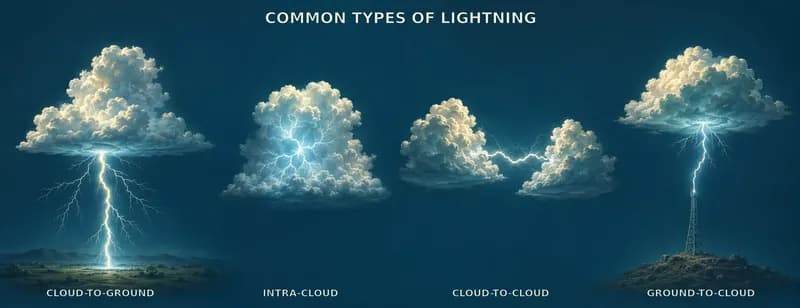
Lightning, often spoken of in everyday language as thunder and lightning, is a very large electrical discharge between cloud and earth. (Strictly speaking, thunder is the sound it makes and lightning is the light we see.) This discharge releases enormous energy within a few milliseconds and can lead to fires, explosions and damage to electrical and electronic equipment.
In this article we look at how lightning forms: in simple language, in six stages, and with the exact name of each phenomenon. The model we discuss is downward negative cloud-to-ground lightning, the most common type of lightning to strike buildings and structures.
Short glossary: key lightning terms
Before we begin, here are five terms that come up in all technical writing on lightning:
- Downward stepped leader: a faint channel that comes down from the cloud towards the earth step by step. It is also called the “downward leader”.
- Upward streamer (upward pre-discharge): a short discharge that leaps upwards from high points on the earth. Most streamers die out.
- Upward leader: a streamer that grows and turns into a complete channel. Only this reaches the lightning, not a simple streamer.
- Attachment: the moment when the upward leader and the downward leader meet and the strike point is decided.
- Return stroke: the intense, bright current that travels from the earth up towards the cloud after attachment. This is the flash our eyes see.
The six stages of cloud-to-ground lightning formation
Stage 1: Cloud growth and particle collisions
Under certain weather conditions, very tall clouds called cumulonimbus form, and their height can be between 2 and 16 kilometres. These clouds are the main setting in which lightning forms. Inside the cloud, rising and falling air currents move water and ice particles around at speed, and the constant collisions between these particles start the transfer of electrical charge among them.
Stage 2: Charge separation
Lighter particles are carried upwards by the rising current, while heavier particles stay lower down. The result is a separation of charge at different heights in the cloud: in the simple model of negative lightning, positive charge gathers mainly at the top of the cloud and negative charge in its lower part. This separation creates the electric field needed for a discharge.
Stage 3: Charge induction at the earth’s surface
The negative charge built up at the bottom of the cloud rearranges the charges on the earth’s surface: positive charge is drawn to the surface and concentrates on the highest and most prominent points (buildings, masts, chimneys, trees). The potential difference between cloud and earth can reach about 100 million volts.
This stage reveals the first engineering lesson: lightning does not strike at random. The higher and more prominent a point is, the more charge gathers on it and the more likely it is to become the strike point.
Stage 4: Downward stepped leader
When the electric field exceeds what the air can withstand, the air becomes ionised and a faint, branching channel moves from the negative region of the cloud towards the earth. This channel, the downward stepped leader, does not advance all at once but in short, successive steps, and it may form new branches at each step.
Up to this point, there is still no lightning that we can see. The downward leader is almost invisible to the naked eye.
Stage 5: Upward streamers and attachment
This is the most important stage, and in practice the entire job of an air terminal is done right here.
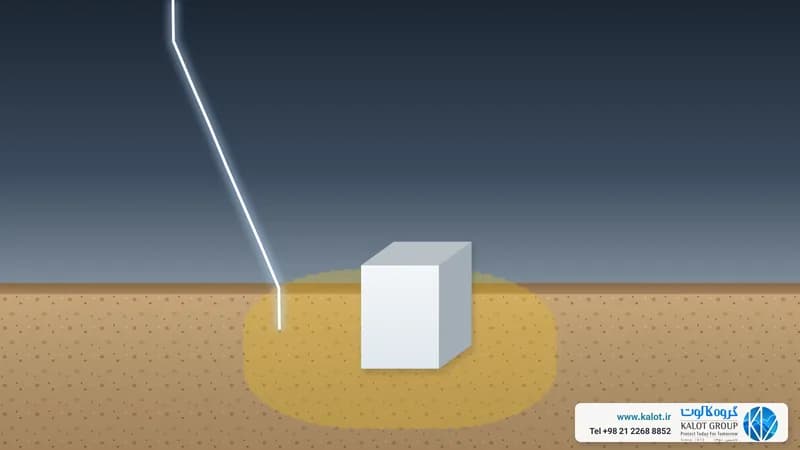
As the downward leader approaches the earth, the electric field on high points becomes so intense that discharges leap upwards from several different points at the same time: from the edge of a building’s roof, from the tip of a mast, from a tree, from an air rod. These first discharges are called upward pre-discharges or upward streamers.
Most of these streamers die out. Some of them, however, grow and turn into a complete channel: the upward leader.
And this is where a real race begins. Several upward leaders rise from different points on the building and the surrounding site, all closing in on the downward leader. The one that starts first and climbs fastest and highest reaches the downward leader first, and at that moment the path of the lightning is locked in. This moment is called attachment.
The winner of this race becomes the lightning strike point. The other upward leaders die out and those points stay unharmed.
This is the whole logic of an air terminal: it is installed in a position and in a way that lets its upward leader win this race, rather than the edge of the roof, the antenna mast or the rooftop cooling unit. The lightning current then passes along the path we have built for it, not through the heart of the building. ESE air terminals work on exactly this point: they aim to start the upward leader earlier than a plain air rod, to improve their chance of winning.
Stage 6: Upward return stroke
As soon as attachment is complete, an intense current is established in the ionised channel and a bright front rises from the strike point towards the cloud. This return stroke is the brightest and most energetic part of lightning. It is the flash we see, and the sound of thunder is the pressure wave of this hot channel.
The current of this discharge can reach about 200 kA, and all of it is transferred in a very short time.
Why does a lightning flash often repeat several times?
Most lightning does not occur just once. After the return stroke, the ionised channel is still conductive, and several successive discharges may pass along the same path at very short intervals. The flicker sometimes seen in a lightning flash comes from these repeated strokes. In engineering terms, it means the protection system must be designed for several discharges in a row, not a single stroke.
How does this knowledge help?
Each stage has a practical consequence:
- Stage 3 explains why the air terminal must be the highest point of the building.
- Stage 5 (the race between upward leaders) explains why the position and height of the air terminal are decisive, and why it must take effect before attachment, not after it.
- Stage 6 explains why the earthing system must be able to discharge a current of this magnitude without a dangerous rise in potential.
To read further, see the different ways lightning has an effect and the damage caused by lightning. The design and installation of protection systems continue in our lightning protection section.