
Move your pointer over the image to zoom in
Complete Product Overview
Stainless steel and plastic cable ties (Tie Wrap)
Order Code: TWS 15–30 · TWP 15–30
Last updated:
The KALOT cable tie (Tie Wrap) holds the down conductor of a lightning protection system (round conductor or tape) on a mast, tower or pipe. The strap is wrapped around the mast and conductor and pulled tight, with no holes in either.
It comes in two materials: stainless steel (TWS series) and plastic (TWP series), each in four lengths of 150, 200, 250 and 300 mm.
A cable tie is a mechanical holder and does not create an electrical connection or bonding.
We supply both the steel and plastic types, so you have the right tie for every mast and every environment.
Simple down conductor fixing on masts and pipes, with no drilling
In a lightning protection system, the down conductor must be held at regular intervals along its route so that it does not shift or get damaged. On masts, towers and round pipes, a cable tie does this without drilling the mast or the conductor. The system designer decides the type and spacing of the holders.
Two materials for two working conditions
The TWS stainless steel series is for outdoor areas, roofs and air terminal masts. The TWP plastic series is for protected routes and light-duty applications.
For wire and tape conductors
The strap goes around the mast and conductor together, for round wire and tape on circular objects such as masts, towers and pipes.
No drilling
Neither the mast nor the conductor is drilled. NF C 17‑102 does not permit drilling a down conductor to fasten it to its support.
Four lengths in each material
Lengths of 150, 200, 250 and 300 mm for bundles with a maximum diameter of about 35 to 82 mm. Choose the model according to the diameter of the mast and conductor bundle.
Technical Product Information
Feature | Value |
|---|---|
Product type | Cable tie or cable strap (Tie Wrap) |
TWS series material | AISI 316 stainless steel |
TWP series material | Black polyamide 66 (nylon), UV resistant |
Length | 150, 200, 250 and 300 mm in each material |
Strap width × thickness | TWS: 4.6 × 0.25 mm; TWP 15: 3.6 × 1.1 mm; TWP 20 to TWP 30: 4.8 × 1.3 mm |
Lock type | TWS: self-locking ball lock; TWP: internal locking tongue |
Loop tensile strength | TWS: about 80 kg; TWP 15: 18 kg; TWP 20 to TWP 30: 22 kg |
Working temperature | TWS: −80 … +300 °C (TWP): −40 … +85 °C |
Application | Mechanical fixing of the down conductor (wire or tape) on a mast, tower or pipe |
Electrical function | Mechanical holding only: it creates no electrical connection or bonding |
Installation method | Wrapped around the mast and conductor and pulled tight, with no drilling of the mast or conductor |
Width, thickness, maximum bundle diameter, tensile strength and temperature range are nominal values and may vary slightly between production runs.
Order code | Length (mm) | Width (mm) | Max. bundle diameter (mm) | Tensile strength (kg) | Material |
|---|---|---|---|---|---|
TWS 15 | 150 | 4.6 | 38 | 80 | Stainless steel |
TWS 20 | 200 | 4.6 | 50 | 80 | Stainless steel |
TWS 25 | 250 | 4.6 | 63 | 80 | Stainless steel |
TWS 30 | 300 | 4.6 | 76 | 80 | Stainless steel |
TWP 15 | 150 | 3.6 | 35 | 18 | Plastic |
TWP 20 | 200 | 4.8 | 50 | 22 | Plastic |
TWP 25 | 250 | 4.8 | 65 | 22 | Plastic |
TWP 30 | 300 | 4.8 | 82 | 22 | Plastic |
Width, thickness, maximum bundle diameter, tensile strength and temperature range are nominal values and may vary slightly between production runs.
Click to view enlarged
The models drawing shows the eight KALOT cable tie models to scale, with their length and width: four stainless steel (TWS) and four plastic (TWP), along with each model's maximum bundle diameter and nominal tensile strength. The lock shape in the drawing is illustrative.
Choosing the length
- On site, measure the circumference or diameter of the "mast or pipe + conductor" bundle and choose a model whose maximum bundle diameter (see the "Models and order codes" table) is larger than the bundle's diameter.
- After going around the bundle, the end of the tie must pass through the lock and leave enough tail to pull and tighten.
- For example, the circumference of the KALOT telescopic mast, 38.25 mm in diameter, together with a round conductor of about 9 mm or a 25 × 3 mm tape, is about 131 mm (equal to a diameter of about 42 mm). The 150 mm models are therefore too short, and the 200 mm models (TWS 20 or TWP 20) are the shortest that fit.
The PDF and SVG files of this drawing are in the "Catalogues and documents" section of this page.
Click to view enlarged
Application
Cable ties hold the down conductor (round copper conductor or tape) on air terminal masts, towers and round pipes, including the KALOT telescopic mast for ESE air terminals. The conductor runs along the mast and is secured at several points with cable ties. The system designer decides the location, number and spacing of the fixing points.
Choosing the material and choosing between holders
- Stainless steel (TWS): AISI 316 strap with a ball lock, tensile strength of about 80 kg and a working temperature up to +300 °C. Sunlight does not degrade it, so it is the first choice for outdoor areas, roofs and air terminal masts with a long service life.
- Plastic (TWP): UV-resistant black polyamide 66, with a strength of 18 to 22 kg and a working temperature of −40 to +85 °C. For protected routes, light-duty applications and places where periodic replacement is possible. Even the UV-resistant type wears gradually in direct sunlight.
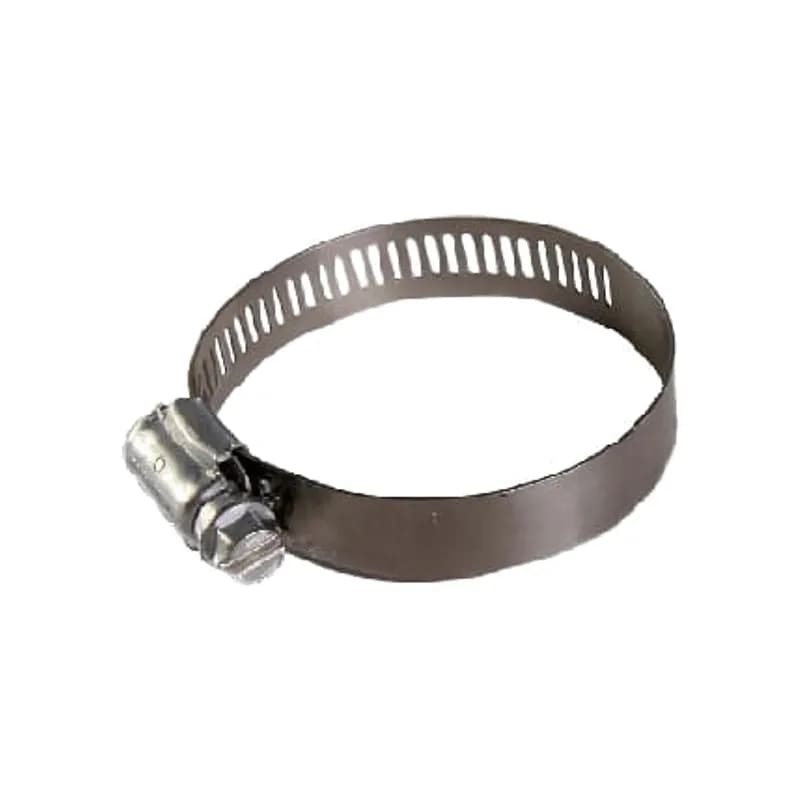
- Adjustable bolted metal clamp for masts from 33 to 127 mm: stainless steel hose clamp (CCS35, CCS68, CCS11).
- Electrical connection and bonding of tape to a metal pipe: two-piece tape-to-pipe bonding clamp (RWPB 026). A cable tie does not do this job.
Installation sequence
- Measure the diameter of the mast and conductor bundle, then choose the right length and material.
- Lay the conductor along the mast in its final position. Do not drill the mast or the conductor.
- Take the strap around the mast and conductor and pass its end through the lock.
- Pull the tie until the conductor sits on the mast with no play. For steel ties, use a dedicated tensioning and cutting tool. The conductor must stay fixed but must not be crushed or deformed.
- Cut the excess tail flush with the lock. The cut edge of a steel tie is sharp and must not stick out.
- Repeat the fixing points at regular intervals according to the design. NF C 17‑102 recommends three fixing points per metre for a down conductor (about every 33 cm).
Technical notes and limitations
- A cable tie is a mechanical holder, not a connector. The electrical continuity of the conductor route must come from suitable connectors and bonding clamps.
- Direct contact between a copper conductor and a galvanised steel or aluminium mast, especially in the presence of moisture, can cause galvanic corrosion. A cable tie does not remove this contact, and the system designer decides on material compatibility.
- On insulated conductors or cables, do not overtighten the tie, so the insulation is not damaged.
- A cable tie usually does not open once locked. To move the conductor, cut the tie and fit a new one.
Inspection and maintenance
During periodic inspections of the lightning protection system, check the ties for breaks, loosening, conductor slippage and corrosion. Also check plastic ties for cracks, discolouration and brittleness. Replace a damaged tie with a new one of the same material or a more resistant one.
The following standards are the reference for the design, installation and fixing of conductors in a lightning protection system.
ESE lightning protection systems: NF C 17‑102
For fixing the down conductor, this standard recommends three fixing points per metre (about every 33 cm). The holders must be compatible with the support, and drilling the conductor to fasten it is not permitted.
System design: IEC 62305‑3
This standard covers the design, installation, inspection and maintenance of a structure's lightning protection system. Conductors must be held so that mechanical and electrodynamic forces do not shift or detach them. The system designer decides the type and spacing of the holders.
Hose clamp and cable tie on a tubular pole
Documents & Downloads
Frequently Asked Questions
What are cable ties used for in a lightning protection system?
They hold the down conductor (wire or tape) mechanically in place on air terminal masts, towers and round pipes. The strap goes around the mast and the conductor and keeps the conductor where it belongs, with no holes drilled in either.
What is the difference between the stainless steel (TWS) and plastic (TWP) models?
Both series come in lengths of 150, 200, 250 and 300 mm. The stainless steel model suits outdoor areas, roofs and air terminal masts better because sunlight does not degrade it. The plastic model is used on protected routes and for light-duty applications.
How do I choose the right cable tie length?
Measure the diameter of the mast and conductor bundle, then choose a model whose maximum bundle diameter is larger: about 35 to 38 mm for the 150 length, 50 for 200, 63 to 65 for 250 and 76 to 82 mm for 300. For the KALOT telescopic mast (38.25 mm diameter) with its conductor, the 200 mm models are the shortest that fit.
What are the strength and working temperature of KALOT cable ties?
Nominal values: the TWS stainless steel series (AISI 316 steel, 4.6 mm wide) has a loop tensile strength of about 80 kg and a working temperature from minus 80 to 300 °C. The TWP plastic series has a strength of 18 kg (150 length) and 22 kg (200 to 300 lengths) and a working temperature from minus 40 to 85 °C.
Are plastic cable ties suitable for roof installation?
KALOT plastic models are made of UV-resistant black polyamide 66 and can be used outdoors, but they wear gradually in direct sunlight, so check them at inspections and replace them when needed. For roofs and air terminal masts with a long service life, the stainless steel model (TWS) is the better choice.
Does a cable tie create an electrical connection or bonding?
No. A cable tie only holds the conductor. For an electrical connection or for bonding a tape to a metal pipe, use a tape-to-pipe bonding clamp (one-piece or two-piece).
How far apart should the ties be on a mast?
NF C 17‑102 recommends three fixing points per metre for a down conductor (about every 33 cm). The system designer sets the final spacing according to the project's reference standard.
What is the difference between a cable tie and a hose clamp?
The KALOT stainless steel hose clamp has a slotted band and an adjusting screw, is made for diameters of 33 to 127 mm and can be opened and closed. A cable tie is simpler, comes in fixed lengths and usually does not open once fastened. Both are mechanical holders.
Have a Technical Question?
KALOT Group's technical experts are ready to answer your questions about lightning rods and earthing systems.