
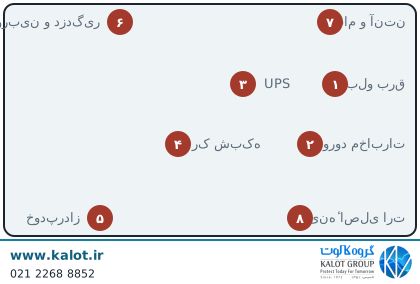
1Incoming power switchboard
Without surge protective devices, every surge from the utility grid or a nearby lightning strike goes straight to the equipment. In older buildings, the neutral and earth conductors are sometimes one and the same.
One standard for every branch. A bank is a network, and its weakest branch is the weakest link in that network.
Bank branches are usually on the ground floor of rented buildings. Power, telephone, network and antenna each come in at a different point and are connected to a separate earth. As a result, one nearby lightning strike can knock out the branch's computers, ATM and cameras all at once. We have worked alongside banks in more than 60 bank buildings, from branches to head offices and data centres.
Without surge protective devices, every surge from the utility grid or a nearby lightning strike goes straight to the equipment. In older buildings, the neutral and earth conductors are sometimes one and the same.
Surges also come in through telephone and data lines, not just power. Protecting power alone is only half the job.
A UPS is built for power cuts, not impulse surges. Its bypass path carries the surge straight to the computers.
Painted, bolted racks do not make a reliable electrical contact. Daisy-chaining racks together also turns them into a path for surge current.
An ATM is connected to both power and a data line, and is often mounted on an outside wall. Repairing it can halt branch service for hours.
The long cables of these systems pick up surges. A branch with a failed intruder alarm cannot be left unguarded overnight.
An antenna added to the roof later is usually left unbonded, and its cable enters the building wherever it can.
When power, telecom and antenna each have a separate earth, a voltage difference builds up between them during a lightning strike and burns out the equipment at both ends.
Reference: IEC 62305-4, IEC 61643-11 and 21, IEC 60364-5-54, EN 50310, ANSI/TIA-607 and 942, IEEE 1100
Instead of a separate design for each branch, we build one template and repeat it across every branch.
A few branches that are representative in building and equipment
One drawing and one standard equipment list
Installation nationwide by our own teams
Earth resistance and continuity measurements at every branch
Repeated in the dry season, using the same form
What we record and keep for each branch:
If the data centre or head office goes down, every branch goes down with it. For these buildings we carry out a lightning risk assessment that gives heavy weight to economic loss and continuity of service, then design the air terminals, the division of the building into lightning protection zones, the signal reference grid beneath the raised floor and coordinated surge protective devices.
Head offices: Central Bank of Iran (IT centre and the banknote printing building), Bank Mellat, Tejarat Bank, Karafarin Bank, Export Development Bank, Gardeshgari Bank; a bank data centre building
Branch network: 22 Karafarin Bank branches in Tehran and other cities, and Bank of Industry and Mine branches in more than 10 cities
Provincial offices: Bank Mellat and Bank Melli regional head offices in Bandar Abbas, Yazd, Karaj, Rasht, Zahedan, Qom, Ahvaz and Gorgan
Yes. Most surges that damage branch equipment come in through power and telecom lines, not from a direct lightning strike on the building.
When power, telephone and antenna have separate earths, a voltage difference appears between them during a surge. Connecting them all to one bar removes it.
In the driest season of the year, because earth resistance is higher in dry soil and a winter reading does not give a true picture.
KALOT Group's technical experts are ready to answer your questions about lightning rods and earthing systems.